
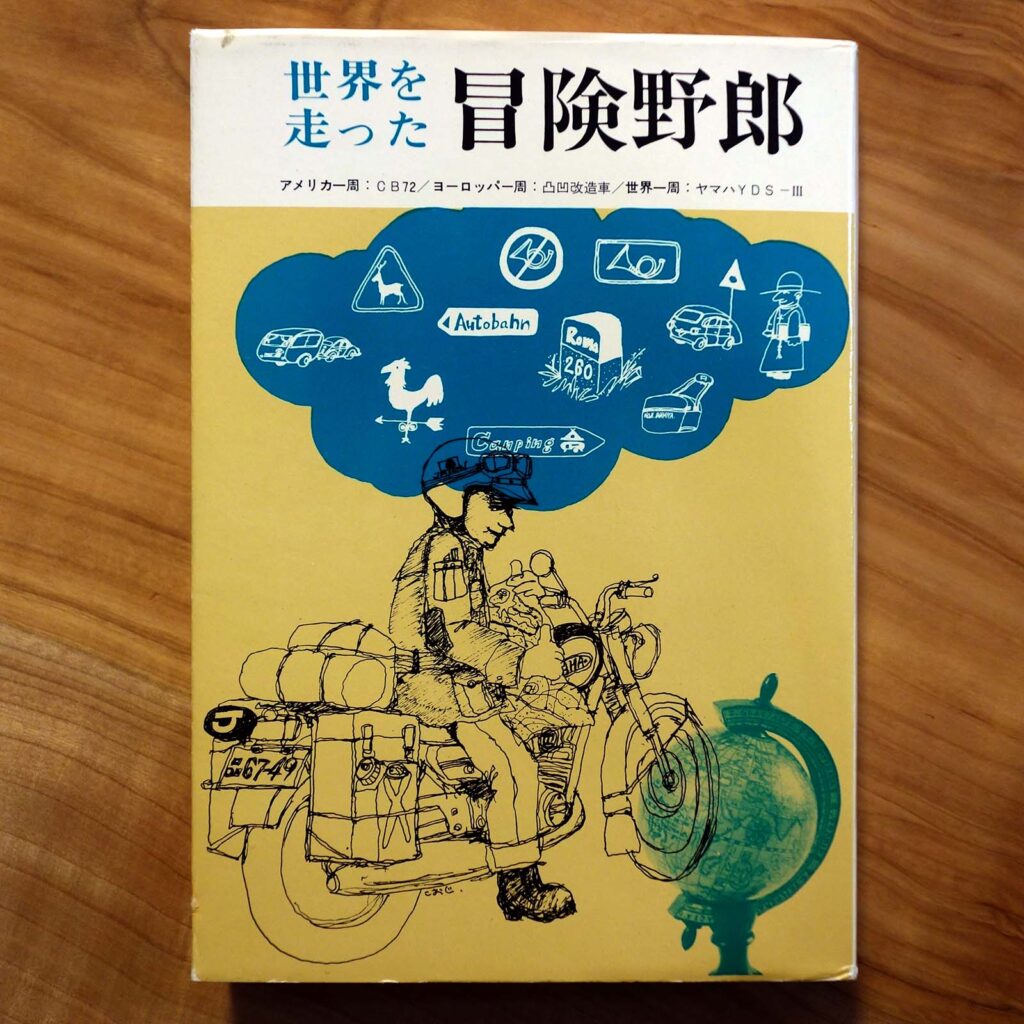
Around the World (Yamaha YDS-III): 136,000 Kilometers
Setting the World Record for the Longest Motorcycle Adventure Journey
Shigeru Yoshida
Published in 1969 (Showa 44)
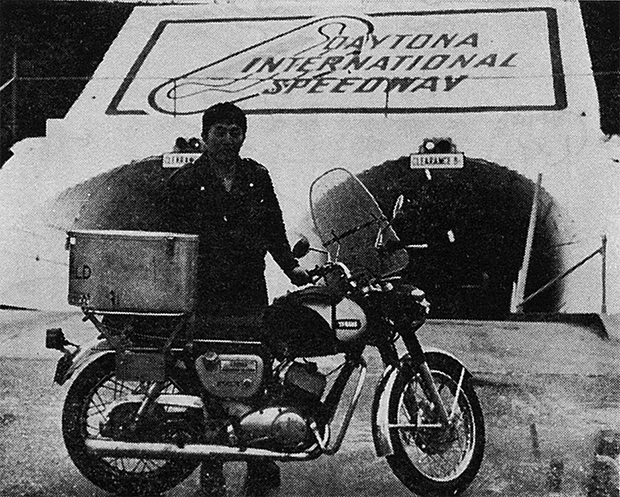
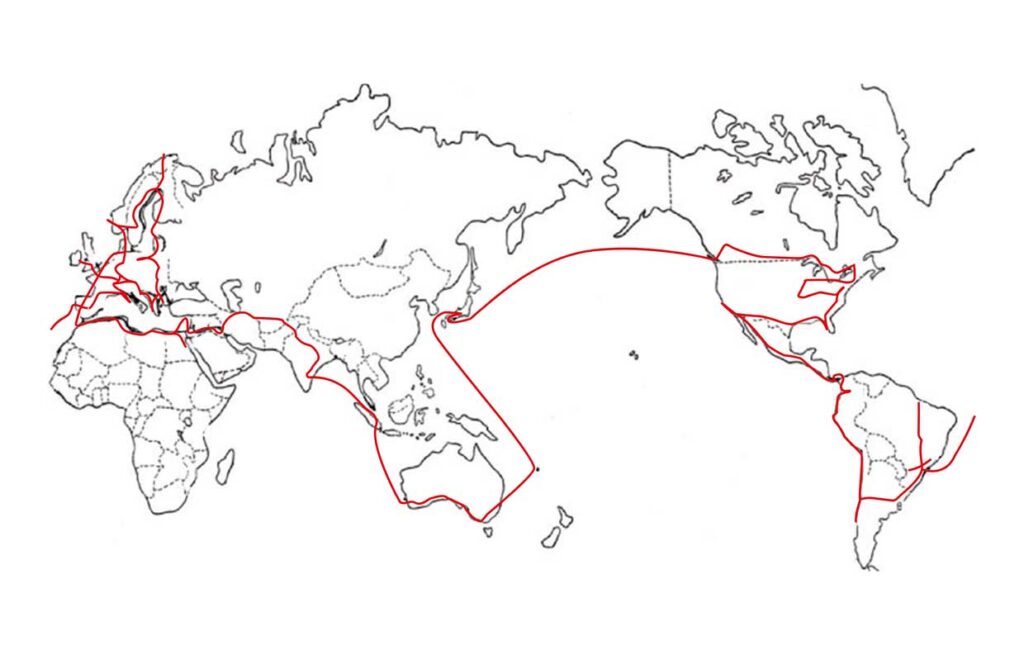
(Reprinted from Yamaha Motor Technical Review No. 42, “Two Round-the-World Challenges by Motorcycle”)
Contents
- Chapter 1: Preparing for Departure
- Chapter 2: North America
- Chapter 3: Central America
- Chapter 4: South America
- Chapter 5: Europe
- Chapter 6: Eastern Europe
- Chapter 7: Africa
- Chapter 8: The Middle East and Asia
- Chapter 9: Australia
- Epilogue
Chapter 1: Preparing for Departure
Meticulous Preparation That Took Three Years
It wasn’t until my third year of high school that I had a dream of going to a foreign country and seeing it. Without even preparing for university entrance exams, he often visited the South American Immigration Agency with the intention of moving overseas.
However, the procedure is complicated. The cost was too much for an 18-year-old like me, so I had no choice but to give up.
As soon as I entered university, I started making long-term plans. I want to see as many countries as possible while working. Seeing the world is worth it. That’s what I thought. The reason why I drove around on a motorcycle for 1,000 days is due to the following three factors.
First, since you were born into this world, it would be a loss if you did not see the tremendous nature that is the world.
2. There are still only a limited number of people who know about Japan today, so I would like to visit the countryside of each country and meet as many young people as possible so that as many people as possible can get to know the Japanese people.
3. We will test whether Japanese motorcycles, the world’s largest motorcycle producing country, can withstand any adverse conditions in the world.
Building Physical Strength and the Resolve to See It Through
I started steadily preparing for it while I was still in school. I spent three years preparing for only two things. This is a big deciding factor in whether or not to go on a trip, so it was well worth spending three years on it.
One was to develop my physical strength, and the other was to instill in myself the mindset of just doing it.
To develop his physical strength, he first put aside his studies and devoted himself to rugby for four years. If you were to get sick in the Amazon or the Sahara Desert, there would be nothing you could do while traveling alone.
I wrote that you should instill in yourself the mindset of just doing it, but this is extremely difficult. In my case, it would be better to say that it came out naturally and burned into my heart.
As long as you have the mindset that you don’t need anything else, you can jump out of anything.
A Trial Run Around Japan on the Yamaha YD-II
During the two-month summer vacation of his second year at university, he conducted a 16,622-kilometer dry run around Japan on his Yamaha YDII.
He bought a rickety YDI II and drove around every corner of Japan, including Hokkaido, Honshu, Kyushu, and Shikoku, staying in youth hostels.
At that time, I realized that there is nothing more maneuverable than a motorcycle. After getting a permit to ride a motorcycle at the minimum age, I started riding and tinkering with it, and eventually fell in love with motorcycles.
He was so enthusiastic that he didn’t care about anything else as long as he was with the motorcycle.
A Concrete Plan
I Tried Every Possible Measure
When I entered my fourth year of university, I took time out of my graduation thesis to carefully prepare the things I would need to prepare for my trip around the world. In order to research the climate, road conditions, and procedures in countries around the world, I read travelogues, bought science dictionaries, met people who wrote travelogues, and even met people from NHK’s special information team. I walked around each country’s embassies and gathered detailed information on maps and procedures.
We re-twisted the course several times, trying to minimize the number of ocean crossings and shorten the distance as much as possible, but we were most concerned about the oceans, which are larger than the land, such as the Pacific and Atlantic oceans.
Regarding land, we also avoided the rainy season. There are many roads in Central and South America and Africa that become impassable during the rainy season.
Even with a motorcycle, it’s not like you can run it all the way through, but you have to carefully select consumables and transport them, and if the crankshaft breaks, leave it to heaven, but you have no choice but to carry parts that you know will become unusable after tens of thousands of miles.
Taking Action
With Persistence and Passion, I Succeeded in Borrowing a Yamaha
At the end of his fourth year, just as the graduation ceremony was approaching, he actually started taking action. For about five months until my departure, I spent the rest of my life alone. It was a difficult period.
As for the boat, I had told my teachers about my plans since I was still in school, and I had asked them about the boat as well.It was early March when Professor Okamoto, the head professor in my department, found me a boat to Canada.Next is the most important motorcycle for my journey.By the 1960s, it was no longer uncommon for people to travel overseas by car or motorcycle, and car and motorcycle manufacturers were already refusing to cooperate with people like me.
I enclosed a detailed plan and submitted it to Yamaha Motor’s president, Genichi Kawakami. The content is not an attempt to advertise the company or promote the excellence of Yamaha motorcycles. However, I earnestly insisted that a motorcycle was essential to my plan.
A week later I received a reply.My feelings were understood.When I got the answer, I immediately flew to Hamamatsu’s president, Kawakami, and after discussing the plan in more detail, he promised to lend me a motorcycle and take care of the parts.Since then, I have been under the care of Yamaha Motor Company in many ways during my departure and travels, and I am deeply grateful to President Kawakami for opening the door for us to cooperate, even though I had no understanding of things from the sea or the mountains.
Raising Funds by Walking My Legs Off
Once I had decided on a boat and a motorcycle, I sent plans to the presidents of about 70 well-known companies in order to raise more funds.Target amount: $10,000 (3.6 million yen).After sending in the plan, I would walk around five companies on the fewest days and ten on the most days and meet with the presidents.Most of the time, I was chased away by the secretarial department, but I was asked to meet with the president as many times as I wanted.Even though I sometimes ended up being turned away after going ten times, I persevered.
Although the money raised was about 1,000 dollars, or one-tenth of the goal, they were not discouraged. I’d love to go to Japan even if I’m broke, so as long as I have a motorcycle, a thousand dollars, a passport, and an entry visa, I’m willing to go.
Essentials for a Round-the-World Journey
The motorcycle was kept as standard for durability testing. If you drive around the world, you will inevitably run in all kinds of climates and road conditions. This was the most suitable condition for testing, so we purposely chose a standard motorcycle.
Now, regarding my belongings, the amount has become enormous. He had a lot of things that could be called a complete set of household goods. It is difficult to buy even slightly necessary items once you are on a trip. I took as much as I could to fit into the motorcycle.
① Documents
- (a) Passport
- (b) Carnet de Passage
- (c) International Driving Permit
- (d) Registration Certificate
- (e) Yellow Card (International Certificate of Vaccination)
- (f) JAF Membership Card
- (g) Youth Hostel Membership Card
- (h) YMCA Membership Card
- (i) Cash (Gold)
- (j) Traveler’s Checks
② Motorcycle Gear
- (a) Helmet
- (b) Ankle Boots
- (c) Leather Jacket
- (d) Leather Trousers
- (e) Rain Gear (top & bottom)
- (f) Gloves
- (g) Goggles
- (h) Face Mask
- (i) Spare Parts (see separate list)
③ Tent & Camping
- (a) Tent and accessories (complete set)
- (b) Ground Sheet
- (c) Sleeping Bag
④ Cooking Equipment
- (a) Gasoline Stove
- (b) Frying Pan
- (c) Mess Tin (Army-style cookpot)
- (d) Deep Plate/Bowl
- (e) Knife, Spoon, Fork
⑤ Writing Supplies
- (a) Writing Paper
- (b) Envelopes
- (c) Fountain Pen
- (d) Pencil
- (e) Eraser
- (f) Penknife
- (g) Ruler
- (h) Ink
⑥ Medicines
- (a) Aspirin
- (b) Malaria Medication
- (c) Snake Antiserum
- (d) Water Purification Tablets
- (e) Bandages
- (f) Adhesive Bandages (Band-Aids)
- (g) Vitamins
- (h) Anti-diarrheal Medicine
- (i) Digestive Aid
- (j) Antibiotics
- (k) Mentholatum
- (l) Kinkаn
- (m) Seirogan
- (n) Mercurochrome
- (o) Manganese Dioxide
⑦ Clothing
- (a) Underwear
- (b) Shirts (summer & winter)
- (c) Socks
- (d) Jeans
- (e) Trousers
- (f) Black Suit (jacket & trousers)
- (g) Necktie
- (h) Dress Shirt
- (i) Cufflinks
- (j) Towels
- (k) Sweater
- (l) Scarf
- (m) Swimming Trunks
- (n) Bed Sheet
- (o) Sewing Kit
⑧ Books
- (a) Dictionaries (Japanese–English, English–Japanese, English–Spanish, English–Portuguese, English–French, Japanese–German)
- (b) Phrasebooks (Japanese–Spanish, Japanese–Portuguese, Japanese–German)
- (c) Favorite Reading Book
- (d) Motorcycle Manual
- (e) Motorcycle Parts List
- (f) Reference Data / Documents
- (g) Diary / Journal
- (h) Motorcycle Magazine
- (i) Address Book
- (j) Autograph Book
- (k) Letter of Introduction
- (l) Origami Instruction Book
- (m) Origami Paper
⑨ Miscellaneous Equipment
- (a) Camera
- (b) Watch
- (c) Film
- (d) Lighter
- (e) Mirror
- (f) Comb
- (g) Razor
- (h) Toothbrush
- (i) Fishing Gear
- (j) Color Slides (400 sheets, Japanese-made)
- (k) Coins
- (l) Adhesive / Glue
In addition, I stored the listed parts and tools in a special stainless steel box, two side bags, two backpacks, and a touring bag. The total load was 70 kg.
Spare Parts Carried
| Part name | quantity |
|---|---|
| piston | 2 |
| Piston ring (Top, 2nd) | 2 each |
| piston pin | 2 |
| small end bearing | 2 |
| Plug (6H, 7H, 7HZ, 8HC) | 4 each |
| Drive sprocket (15, 16, 17T) | 1 each |
| change petal | 1 |
| air cleaner element | 1 |
| exhaust pipe gasket | 2 |
| joint gasket | 2 |
| Pump Assy | 1 |
| Footrest arm (L/R) | 1 each |
| footrest bolt | 2 |
| footrest rubber | 2 |
| Rear arm bush A | 2 |
| Rear arm bush B | 2 |
| brake shoe | For 2 cars |
| brake spring | 8 |
| Brake wire (rear) | 1 |
| brake pedal | 1 |
| Brake wire (front) | 1 |
| tube | 2 |
| Chain (525) | 1 |
| Handle lever Assy (L/R) | 1 each |
| Handle lever (L/R) | 1 each |
| Headlight (ball) sealed beam | 2 |
| tail light bulb | 2 |
| tail light lens | 2 |
| flasher valve | 2 |
| flasher lens | 4 |
| tachometer cable | 1 |
| speedometer cable | 1 |
| ignition coil | 1 |
| regulator | 1 |
| brush | 4 |
| contact breaker | 2 |
| stop switch | 1 |
| clutch wire | 1 |
| Accelerator wire A | 1 |
| Accelerator wire B | 2 |
| pump wire | 1 |
| cylinder packing | 10 |
| case cover packing | 4 |
| head gasket | 6 |
| pin | 30 |
| main jet | |
| S.T.D # 120 | 2 |
| #110 | 2 |
| #100 | 2 |
Tools Carried
| Tool name | quantity |
|---|---|
| Spurner 9×10 | 1 |
| Spurner (monkey) large | 1 |
| Spurner (monkey) small | 1 |
| nose pliers | 1 |
| Driver + large | 1 |
| steel hammer | 1 |
| soft hammer | 1 |
| Amateur removal bolt (made by Mitsubishi) | 2 |
| Crankcase disassembly tool body | 1 |
| Crankcase disassembly tool bolt (long) | 2 |
| Crankcase disassembly tool bolt | 2 |
| Crank insertion tool body | 1 |
| Crank insertion tool bolt | 1 |
| Ring nut attachment/detachment tool | 1 |
| dial gauge | 1 |
| gauge stand | 1 |
| oil jug | 1 |
| sandpaper | 1 |
| Yamaha Bond (Small) | 1 |
| Fork attachment/detachment | 1 |
| tire lever | 2 |
| tire gauge | 1 |
| puncture repair set | 1 |
Chapter 2: North America
Travel period = July 29, 1965 to March 23, 1966
Total mileage = 32,445 km (including 3,000 km of break-in)
Wakayama to North America for 15,000 Yen
Worked as a Crewman to Save the Fare
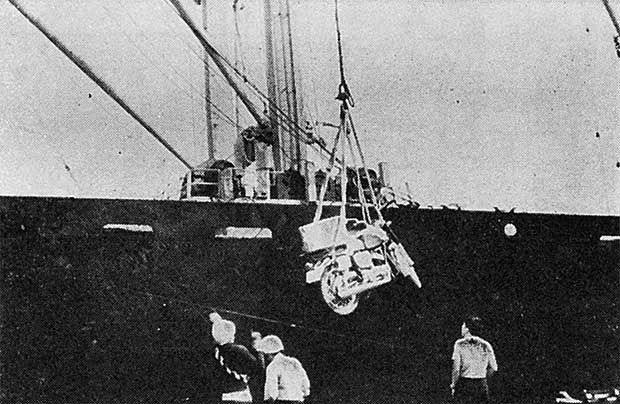
On July 12, 1965, I finally boarded the Eastern Sakura from Wakayama Port with my Yamaha YDS-III.I spent three months wandering around the company, and I had a lot of trouble going through the formalities.However, I was finally able to come this far.Over the next two years and eight months, I will embark on a solo motorcycle trip around the world.I wasn’t particularly nervous, but I felt a quiet fighting spirit, like a sense of responsibility towards the people who had expectations of me and who had helped me.
This ship was a 15,000-ton cargo ship owned by Hong Kong, and had a crew of about 50 people, including the captain and four British, the second officer and about 40 Chinese, an Indian radio operator, and one new-faced Japanese.In order to reduce the fare, I was allowed to board the ship as a sailor.In the end, I don’t work as a sailor.However, since I only had to pay for food, the boat fare from Japan to Canada, including the motorcycle, was only 15,000 yen.Moreover, the cabin was on the same deck as the captain’s, and was a small, well-equipped room about 6 tatami mats in size for a Japanese cabin.In hindsight, this was the most luxurious cruise I’ve taken in nearly three years.But a big pitfall awaited him.There was no way for me to know since I wasn’t a god, but…
Sailor qualifications! Refused entry in Canada
After a two-week voyage, the ship arrived in Vancouver, Canada, on July 24th.Private motorboats were running around the port, and five seaplanes were flying around.A large cabin-shaped boat, which is rarely seen in Japan, was running happily, blowing through the wind and throwing up white spray.There were several floating gas stations in the harbor.This is said to be a stand for motorboats and seaplanes.I was impressed that it was a country that could have it.
Although I thought I had taken all the necessary steps to complete the immigration procedures, I was immediately fooled by a Canadian immigration officer.The problem was that I was nominally on the ship as a crew member in order to get cheaper fares.Canada does not allow seafarers to enter the country.Even if you have a passport, you will not be able to land there.I am the only Japanese person on this ship, a young man planning to travel around the world on a motorcycle, and I am very aware that I am not a sailor.But they say it can’t be helped because it’s a rule.It would be more than disappointing to come this far and not be able to land.I sent a telegram to the ship’s owner, the T-Shipping Company, in an attempt to allow him to enter Canada, but they were unable to revoke his status as a “sailor.”
But I was very lucky.If the Eastern Sakura had been a ship that sailed directly to Japan, I would have been returned to Japan and returned to the beginning of my journey.Fortunately, the Eastern Sakura unloaded the iron material in Vancouver, then loaded up on lumber at the port of Port Angeles in the United States before heading to Japan.There was still an opportunity to land at Port Angeles.He said he has a visa for the United States and should be able to enter the country without any problems.The immigration officer added:“If you want to enter Canada, you can land at Port Angeles in the United States and then enter Canada by land.”I wish they could let me land now if I could eventually get into Canada, but apparently the regulations won’t allow that.
The first landing incident made me painfully aware that I would be troubled many times on future trips by procedural issues that I would not understand until I encountered them on the spot.
The Start of the World Adventure
You can easily enter the United States
On July 29th, I arrived at the port of Port Angeles in the United States. First, an immigration officer checked my passport and vaccination status, and immediately granted me permission to stay for six months.I have never complained about the qualifications of sailors here.Customs only took a quick look at the luggage, but didn’t look at the motorcycle, tools, or parts, and everything was fine.However, we carefully examined the drugs, but there were no drugs in his possession, so there were no problems.To the customs authorities, the 70 kilograms of luggage I was carrying probably looked like it was nothing of value, just boring luggage.However, these 70 kilograms of luggage are the very important items I will need to carry with me as I travel to 60 countries around the world for the next three years, cooking my own meals and sometimes camping out in the wild.
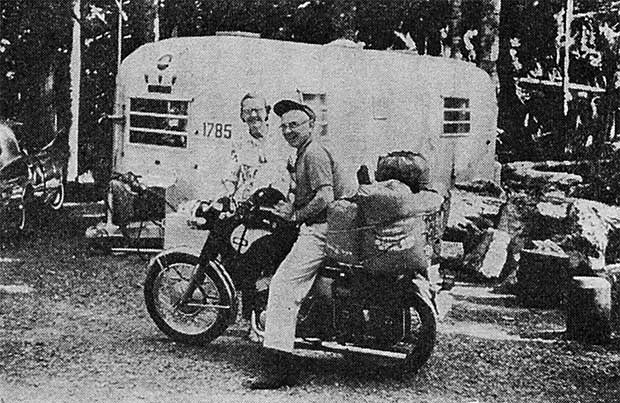
The journey to North America began the moment Chinese sailors unloaded the motorcycle into Port Angeles port.My journey does not begin when I land alone.The journey begins only after the motorcycle, which is my companion and right-hand man, has landed safely.This buddy’s motorcycle took more effort to land than I did as a human.It was 4:30 when we left the ship, and although the road is opposite to Japan where you drive on the right, it was easier to get used to it since I hadn’t ridden a motorcycle in over two weeks.There are foreign cars everywhere you look.It’s normal to see foreign cars when you come to a foreign country, but even that is unusual in the beginning.There is a steep, narrow climb to Olympic National Park.It’s not a good road.I headed towards the camping village, keeping an eye on the horizontal road sign.In the United States and Canada, there are camping villages for motorists set up all over the country, from public camping villages in national parks to private camping villages.
Generally, public schools have better facilities and are cheaper. This camping village cost 50 cents, but in some places they don’t take money, and in the more expensive places it was only $1.50. This large camping village was packed with people of all kinds, from families in trailers to blue-sky groups with only sleeping bags.
A Fracture Accident
A motorcycle that can confidently run in the middle of the road
The mountains behind Vancouver were rocky and there was still snow on the top even though it was summer. The coastline is also full of steep rocks. The blue sea and sky, white snow, and coniferous trees all harmonize beautifully. When I saw it from a distance, it reminded me of Yakushima in early spring in Japan.
Vancouver is the largest city in Western Canada and a major export port for primary resources such as timber. There were about ten cargo ships anchored in the port at any given time.
The roads in the town are four lanes, but during rush hours, they were quite congested.Apparently only in Canada is it possible to go straight on the left when turning right.Pedestrian traffic lights are separate from cars and turn red much earlier than car traffic lights.At one intersection, all four vehicle traffic lights turned red, while all pedestrian traffic lights turned green, allowing pedestrians to cross the road diagonally.The driver was a gentleman, and was often seen yielding the right of way to pedestrians.
No matter where you go, the overwhelming majority of motorcycles are Japanese-made, with European-made ones outnumbering them. Since it’s a motorcycle, there’s no law that says you can’t pass on the edge, so you ride it proudly in the middle of the road.
Departing from Vancouver
On August 4th, we left Vancouver and headed to Kamloops in the cold rain.It is a four-lane highway with a green belt in the middle that is about the same width as the road, and a similar amount of road width on both sides.The speed limit is 70 mph (110 km/h), but since it was raining and visibility was poor, I was moving at 60 mph (96 km/h).It was about 120 kilometers to Rosedale, and from there it became a single lane and headed into the mountains.The Trans-Canada road had two lanes on the uphill side only at steep climbs.Vehicles that slow down when climbing, such as large trucks, drive on the right side of the road, so there is no congestion on the road.I thought it was wonderful in a way that you can’t see in Japan.
There was a path that continued up and down, up and down.The rain continued to fall.But the meter still read 60 miles.This is because the road is one lane, so it can be dangerous to drive slower than other cars.Past the town of Hope, the road ran along the Fraser River.The mountains covered in coniferous trees are obscured by the rain.A trailer was driving in front of me.I was following that car for 100 km.While I didn’t think the car in front of me would brake suddenly on such a straight road, I was aware of the danger of doing so as I drove along.
The trailer in front brakes suddenly! Right ankle fracture and disarticulation
However, in a place with poor visibility, the trailer in front of me suddenly braked suddenly.I applied the brakes right away, but it didn’t work at all.It slips and there is no friction.With nearly 70 kg of luggage on board, speed of 100 km/h, and poor road conditions, the 20 meter following distance was of no use at all.A trailer quickly approached in front of me.At this rate, you’ll run into a lot of things!
With a split-second decision, I lightly released the brake, approached the center line, and tried to exit.But no, there’s an oncoming car coming from in front.There was nothing I could do.I had no choice but to put the steering wheel back and apply the brakes.As soon as I applied the brakes, I was slammed onto the road along with the motorcycle.I probably slid 20 to 30 meters along the right side of the center line.I felt intense pain in my right leg, but I couldn’t stop riding the motorcycle.My motorcycle and body spun around as I slipped.I could feel the surrounding landscape slowly rotating.
The motorcycle finally stopped.Luckily, a police car was parked right in front of me.I tried to get up by myself, but the weight of the motorcycle prevented me from moving.A large police officer came straight out of his patrol car.I hold back the pain and wait for him to lift me up, but I can’t do it alone.Another person came running from the police car, and it took two people to finally pull me out.It probably only took a second or two for the second person to arrive, but it was a long time.
When I looked at my ankle, it was pointing 90 degrees outward from the normal direction.
“This guy has a bad attitude even though it’s my leg!” I yelled in my head, and with a considerable amount of force applied to my hands, I forced them back in the normal direction. I played rugby in college, so I was used to getting injured, which seemed to calm me down quite a bit.
He was taken to the hospital by ambulance, and X-rays revealed that his right leg was fractured and his right ankle joint had separated. Hospital admission fees were extremely high at 19 dollars and 75 cents (approximately 4,800 yen) per day, and it was not a place I could stay in for long.
Mr. Asano’s unforgettable kindness
However, very fortunately for me, a Japanese doctor named Asano-san was working at the hospital I was taken to.Mr. Asano could not bear to see me as I was preparing for a long journey, so he took me home after eight days in the hospital.He and his Canadian wife and two children warmly welcomed me as part of their family for 40 days until the cast was removed.What’s more, Mr. Asano talked the Canadian doctor into paying the $230 surgery fee to $150.Because of my carelessness, I ended up incurring a huge expense of 308 dollars (approximately 110,000 yen), including 158 dollars for hospitalization and 150 dollars for surgery.Moreover, if Mr. Asano hadn’t been there, this would not have been possible.Although it cost 308 dollars and required 53 days of treatment, this injury served as valuable advice for the long journey that would follow.
Hoping to wait for the snow to arrive, we left the town of Hope on September 26th, dragging Bikko’s feet, and set out across the continent, crossing the Rockies. Despite the cold October snow, we passed through Winnipeg and Montreal before arriving in Quebec on October 21st. From there it went to the United States.
A Tent Miserable with Rain
Even my sleeping bag was soaked
At the end of October, all the camping villages go into hibernation, and it is no longer possible to stay overnight at any of them. However, there are picnic areas along the roads where people traveling by car can have lunch or take a break, and as long as there are no signs that say “No tents allowed,” you can camp there.
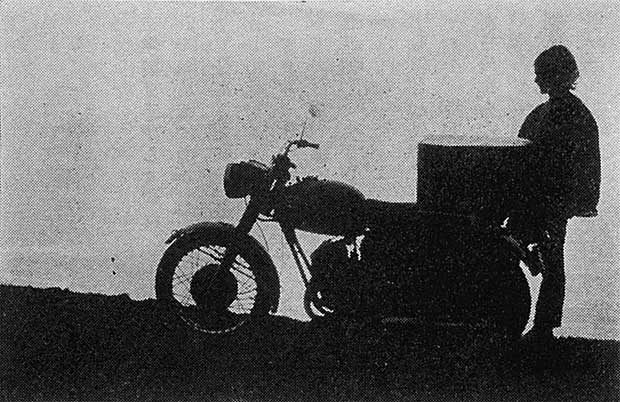
Near The Forks, we found a picnic area next to a large lake.I immediately set up my tent and went to sleep, but it started raining heavily in the middle of the night.I pitched my tent in a place where there were no trees, so the rain was blowing all over me.The area below is on the side of a lake, so drainage is poor.Water was slowly coming in from below.Even though it was no longer there from the top, it was seeping into the seat from below and gradually making its way into my sleeping bag.There’s nothing I can do about it now.Stop wasting energy.
Hey, go to sleep!I said that to myself and slept until morning.I woke up because it was bright outside, but the rain still hadn’t stopped.When I’m riding a motorcycle, it doesn’t really matter if it snows or rains, but what bothers me the most is when I set up a tent and it starts raining in the middle of the night and doesn’t stop in the morning.At this time, I wore leather pants and a leather jacket over my body, still soaking wet.This is a lot of work in a small tent.My head touches the tent when I’m sitting, so when I put on my pants, I support my weight with one hand and put one leg in.Repeat that twice.After putting on a leather jacket and leather pants, I trudged through the rain to fold up my tent and fold up my sleeping bag.By the time I finished folding it, my leather jacket and pants were already soaked.It’s heavier than usual because it’s soaked with water.Dragging my heavy legs, I loaded my belongings onto my motorcycle and set out in the rain.
Detroit, the Motor City
Motorcycle club visit
I arrived in Detroit on October 28th, and there were a lot of cars.The Mustang is the one that stands out the most.Although they are rare among imported foreign cars in Japan, they are extremely common in Japan.It has recently surpassed Pontiac in annual sales of over 400,000 units.There are so many cars in town that, as someone from Japan, I think all the cars manufactured in Detroit are running in this town.The roads had the best grade-separated intersections of any town I’ve ever visited, and the pavement was clean.
At the automobile factory, I toured Ford’s engine assembly line, Mustang assembly line, General Motors’ Corvair assembly line, Chrysler’s Imperial Chrysler Plymouth, and Dodge assembly line, but they never showed me anything good.It’s mostly a routine assembly line, with Ford showing us a little bit of engine assembly.First of all, they did not show me the part processing site.When I toured an automobile company, I noticed that there were many female and black workers.
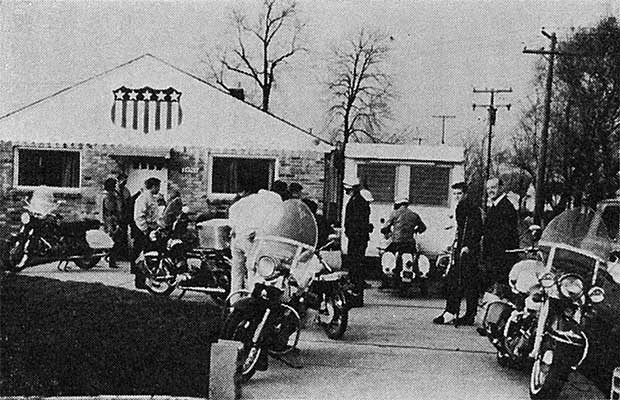
There are twenty-three motorcycle clubs in Detroit.I was invited to join the Liberty Motorcycle Club, the largest of them.I visited a club in Calgary, Canada, and they had a beautiful clubhouse just like there.On the day I visited, there were about 50 people, not only members of this club but also people from other clubs.There were six women, and they are also fine motorcycle riders.Since it was a rich club, there were many people riding Harleys.They didn’t seem to know much about Japanese-made motorcycles, and when we rode together for a while, they were amazed at how well my Yamaha started.
After I talked about the progress of my trip and my future plans at the meeting, club members asked me a variety of questions about motorcycles and the general living conditions in Japan. After the meeting was over, two women approached me and said, “We each have a 2,500 yen BMW, so would you mind taking them with us?”
I was a little confused by this unexpected request, but I explained clearly that it was unbearable for a woman to ride a motorcycle every day, sometimes riding in the snow, sometimes sleeping in a sleeping bag on a rocky field, sometimes drenched in cold rain.Furthermore, I tried very hard to get him to give up, thinking that things would be even more difficult after Central America.Deep down, I couldn’t help but feel that there was no need to make him give up.Traveling isn’t always hard, it’s also often fun, but in this case I had to say that.
Midnight Touring
From Key West, Florida to Tampa
By January 1966, they were already approaching Florida. On January 21st, I ran 650 km from Key West, Florida to Tampa in the middle of the night. Speaking of Florida, it’s not cold even in the winter, so this was the perfect opportunity for me, who had always wanted to try touring in the middle of the night.
We left Key West at midnight and crossed several bridges connecting the islands to reach the southern tip of the Florida peninsula.During this time, the longest bridge spans 11 kilometers, with the Gulf of Mexico on the left and the Atlantic Ocean on the right.We drove north on No. 1 to Miami, traveling along the flat road of the Everglades.For about 100 miles (about the distance between Tokyo and Numazu/Shizuoka), there was no town-like town, just a few Indian villages and a few motel gas stations that seemed to be used by tourists.There were only four cars on the way.It was a world of just the asphalt illuminated by the motorcycle’s headlights and the black rearview mirrors on each side between my eyes and the white asphalt.
Since it was midnight, I was worried about getting gas, but just before I ran out of steam, I came across a 24-hour gas station. I was planning to pitch my tent as soon as it ran out.
At eight o’clock the next morning, after driving 645 km, we arrived in Tampa. Partly because it was foggy that day, touring in the middle of the night had poor visibility, and my nerves were much more strained than during the day. I felt sleepy in the early morning hours, and would often doze off. I now have a general understanding of night touring, and I felt it was dangerous, so I didn’t do anything I liked to do after that.
Traffic Conditions in America
Parking violation is a $15 fine.
As we all know, the United States has an absolutely excellent road network throughout the country. When you’re in Japan, you know about it from movies and books, but when you actually ride it, your surprise becomes even greater than before.
New York is centered around Manhattan, which is home to many skyscrapers, including the Empire State Building. There are nearly two dozen bridges and tunnels connecting Manhattan with Long Island, Richmond, and the mainland, and highways also span Manhattan.
Once inside Manhattan, there are almost no intersections without traffic lights.Traffic is also prone to congestion, just like in Tokyo.On the other hand, the subway and buses are very well equipped.Judging from the amount of commotion that occurred during the subway and bus strike in January 1966, when I went there, it is clear that there are many users.However, I was annoyed by how dirty the subway was.Parking will be prohibited in town from 8 a.m. to 6 p.m.I drove around town several times and parked on Broadway, the busiest street, Fifth Avenue, in the middle of the day, but since it was a motorcycle and had an unrecognizable international license plate, I didn’t get a green parking ticket.However, I parked it once on the west side, far from the center of town, and received a piece of green paper.The fine is fifteen dollars.
False pedestrian traffic ethics
A police officer specializing in parking violation enforcement rides a small Vespa, circling around his area like a mouse.There are plenty of parking lots, but motorcycles are often turned away, and even if you are allowed to park there, you will be charged the same fee as a car.Also, pedestrians in New York City have no proper traffic ethics.I cross traffic lights even when the lights are red, I cross roads where there are no crosswalks, and I throw my spit everywhere.Even police officers who were supposed to be directing traffic were seen crossing the street even though the light was red.
Traffic Conditions in American Cities
There is a small town in Texas called Orange.On the 30th of January, I was heading west on the No. 10 Highway from New Orleans to refuel, and it was so cold that I was drinking coffee in the stand’s office to warm myself up when a newspaper reporter, who must have seen me along the way, came in.After taking a run-of-the-mill article, he showed me around his town of Orange.He says today is the coldest day in 15 years, and tomorrow will be even colder.Orange was the first town to be established in Texas, and they used to grow oranges, but now their shares have been taken over by Florida and California, and their main industry is refining the oil produced in Texas.Old European-style small towns in America are far from the main roads and are probably rarely visited by tourists.When I was actually shown around the town, it was quiet, there was little traffic, the refinery was located far from town, and the town gave me the impression of a quiet residential area.
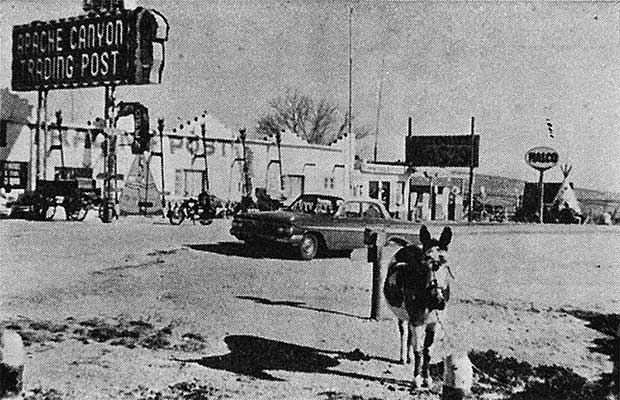
There is a small town in New Mexico called Carlsbad. It’s a new town built as a result of potash mining, but it’s nestled in the middle of a semi-desert that stretches across New Mexico and Texas. Five major companies operate the mine, and I visited one of them, IMCC.
Four roads pass through the town, including the road to Santa Fe and the road to El Paso, and motels are lined up along the roads. This town was very active, with residential areas for people involved in mining and motels catering to tourists. The town has no bus, subway, or train service, except for long-distance buses that come from other towns. Therefore, the townspeople have no choice but to use cars.
What about Los Angeles?It has the best roads in America.Seven freeways radiate out from the downtown area, including roads leading to Hollywood, San Francisco, and San Diego.People use this freeway to go anywhere, from residential areas to work or from residential areas to the suburbs for fun.It is no exaggeration to say that in this town, where there is no subway and few bus services, it is impossible to live without a car.
Even with such well-developed roads, during the 8:00 to 9:00 a.m. and 5:00 to 6:00 p.m. commutes, the freeways that would normally be able to travel at 65 mph (104 km/h) become clogged, forcing drivers to stop or drive slowly.Even if you build an expressway, if you don’t create entrances and exits that are the right size for the road, you won’t be able to make full use of it.But in the case of Los Angeles, it is no longer a question of that, but a much deeper question of the absolute number of cars.
I have written about the traffic conditions in the four cities above, but after traveling around the United States, I believe that the traffic conditions in cities can be roughly divided into four categories.
One is an old metropolis like New York.
One is an old small city like Orange.
One is a new metropolis like Los Angeles.
The last one is a new small city like Carlsbad.
In old metropolises, it is possible to live without a car, and it is even more convenient to use buses, trains, and subways. On the other hand, in new towns and small towns, cars have become a necessity and an indispensable item. Furthermore, despite having such good roads, the number of automobiles in large cities is astounding.
Roads between cities can be broadly divided into two: eastern and western. The road winds gently up and down, surrounded by the greenery of the eastern part of the country, and is dotted with houses. In the arid regions of the west, there are no trees at all, just grass that is drought tolerant and looks fluffy and soft, but in reality it is just a thin, hard grass growing here and there. There is only one road that I know of.
There were no houses between the towns, and while I thought I was running along rocky mountains, I found myself running across a vast desert. Both roads are unfamiliar scenery to us Japanese people, so we never get tired of seeing them. Even in desert areas with similar scenery, the scenery changed subtly.
The Reputation of Japanese Vehicles in America
Motorcycles are for leisure and sports
I arrived in the northern part of the United States in late October, and it was almost the off-season for riding motorcycles, so I hardly saw any motorcycles riding on the highways. But the further south they go, the more they increase, reaching their highest numbers in Los Angeles.
In Japan, the proportion of people who use motorcycles for leisure has increased recently, and most of them use them for leisure and sports.
In the 50cc to 125cc class, even younger teenagers ride, and those with bikes over 250cc include high-teens and even elderly men over 50, taking short long rides with their girlfriends or wives in the back.
Overwhelmingly popular Japanese-made motorcycles
There are also many races, with drag races and speed races held every Sunday. Everyone who is a motorcycle fan seemed to be having fun participating in the races.
I went to see a speed race held at Willow Springs, about 100 miles from Los Angeles in the mountains. It is an interesting course of 2.5 miles, making good use of the slopes of the mountain. There are very few spectators, just race participants, their friends and family. First, before the race, there was a race (qualifying) to determine the starting lift, which took about as long as the actual race.
The classes are divided into 50cc, 100cc, 125cc, 175cc, 250cc, and 500cc, and of the 77 cars that participated, 56 were made in Japan. These include Yamaha, Honda, Suzuki, Bridgestone, and Tohatsu, and 56 of the 68 cars under 3,500 yen were made in Japan. In breakdown, there were 25 Yamahas, 17 Hondas, 6 Suzukis, 4 Tohatsus, and 1 Bridgestone.
Products other than those made in Japan were made by Spain’s Brutago and Ducati for 125cc, Ducati and Harley-Davidson for 250cc, Ducati for 350cc, and Norton, B.S.A., Triumph, and Harley-Davidson for 500cc.
Japanese-made motorcycles are often used in races like this, and their results are excellent.In this race too, the winning cars under 3,500cc were completely Japanese-made.There was no one who didn’t know the names of Yamaha and Honda.Once again, I went to see a race that was a cross between a speed race and a motocross held in Downingtown near New York, and as expected, it was dominated by Japanese cars, just like the previous race.
huge american market
What about the case of automobiles?Even though exports increased, it was rare to see Japanese cars outside of Los Angeles.Still, I occasionally saw a Bluebird, Fairlady, or Datsun truck in Canada or the eastern United States.Many bluebirds and fairlady were seen around Los Angeles.They called Datsun the Datsun Sport.When I look at the Bluebird and Fairlady mixed in with American cars, they seem to be about the same size as light cars like Subaru and Carol.I felt happy when I saw them running undefeated among the big American cars.
When I was stopped at a red light in a town called Savannah in Georgia, a Fairlady stopped next to me.
So a few words…
”How’s it going? How’s your running?”
”That’s a really nice car! Are you traveling around the world? It’s a Yamaha. Mine is a Datsun. You know that, right?”
As a Japanese person, I thought it was only natural that the light turned green and he waved and walked away. We also saw coronavirus in Los Angeles. Isuzu had a truck in.
America is a country where both motorcycles and cars can still be sold, and the bottom line is immeasurable. If it has the best performance in the world, then depending on the advertising, wouldn’t it be able to sell at a similar price? There are still many factors that make it difficult.
Chapter 3: Central America
Travel period = March 23rd to May 28th, 1966
Total mileage = 9294 km
The Giant Cacti of Mexico
After taking his first step into Central America on March 23, 1966 in Tijuana, the western tip of Mexico, he traveled 9,294 km in Central America, traveling to Guatemala on April 11, Salvador on April 15, Honduras on April 20, Nicaragua on April 29, Costa Rica on May 3, and Panama on May 7.
Central America is a land rich in travel, with Mayan and Aztec ruins dotted throughout the region, and old colonial-era towns. Away from the city, there are shabby farmhouses with straw roofs made of tied wood and mud. Horses, cows, and donkeys are their feet and play an important role in transportation. Many farmers lack running water or electricity, and women and children can be seen walking around barefoot with water turtles on their heads. Mexican farmers in particular seem to be poor.
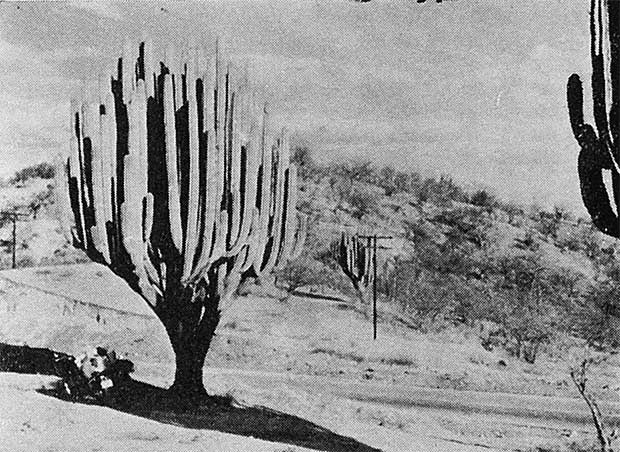
Mexico is also the land of cacti.Cacti can be found all over the country.The cacti in the northern desert region are so large that they are not even as thick as telephone poles, and they extend as far as the eye can see in the vast desert.The most enjoyable part of my trip to Central America was watching the cactus stand out in the crimson sunset as the sun set over the mountains in the distance.Even when I wanted to go to the next town before it got dark, this sunset was something I couldn’t wait to see.After watching the sunset, I didn’t feel tired whether I arrived at the next town at ten o’clock or eleven o’clock at night.
South of Guatemala is a country with many volcanoes and a lot of greenery.With the exception of Costa Rica and Panama, all countries are small enough that you can drive from capital to capital in one day.Although the coastline was humid and humid, the temperatures in Guatemala’s capital Guatemala, Honduras’ capital Tegucicalpa, and Costa Rica’s capital San José were located at altitudes of more than 900 meters, so the temperatures were somewhat cooler, making it easier to beat the weather.The main products are agricultural products such as bananas, sugar, coffee, and cotton, and in terms of industry, sugar refining and cotton textiles have just begun.
Entering a Race and Proudly Taking Second Place
Skill is not praised, Yamaha is praised.
When I met the president of a motorcycle club in Honduras, he strongly encouraged me to come and watch the race that will be held on Sunday. There was information about the race in the newspaper, so I decided to delay my departure for three days and go see it, hoping for a great race.
However, in reality, the way the race was run and the people running the race were completely sloppy, the number of participating cars was not properly gathered, and it was just a way for the club to make money. Still, about 600 spectators gathered, and the race was broadcast on the radio.
There is no Yamaha agency in this town, and there were 15 Honda and Suzuki cars in attendance, divided into three classes: 50cc, 125cc, and 250cc.During the 2,500cc class race, there weren’t many cars participating, and I ended up being passed out.Since there was only one Yamaha competing, and I was the only Japanese rider across the ocean, the eyes of the 600 spectators were forced to focus on me.Although I agreed, I was not in a calm state of mind as I had no racing experience at all, hoping that I wouldn’t get upset.
There were five cars participating in the race, including mine, making 12 laps around a 400 meter long track.
start! On the straight course, my Yamaha had good horsepower and high rpm, so it ran well, but it gave out right after the first curve, and you won’t be able to take the curves on the mud course properly until you actually race. In the first half, I was repeatedly flying in a straight line and flopping around curves, but from about the 6th lap onwards, I started to understand how to make the tires slide around curves. I gradually caught up, and by the ninth lap I was in third place.
On the 10th lap, the second rider fell, so he took second place, and on the 11th lap he finally took the lead. It’s closed! It was only for a moment that I thought this, but at the important last corner, I increased my speed too much and veered far to the outside. Unfortunately, it was removed from the inside and I fell into second place.
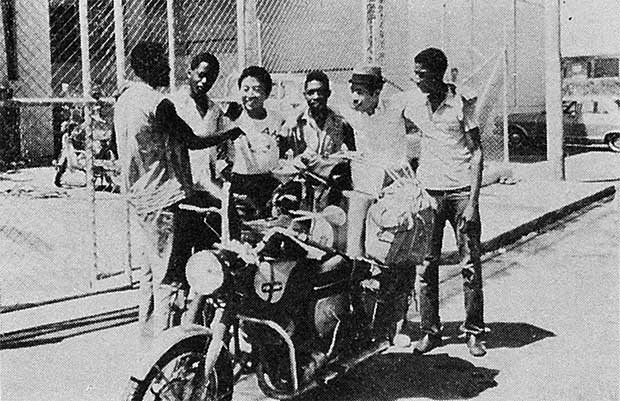
Still, everyone at the club, including the president, was overjoyed and shook hands with me as I crossed the finish line. There were also interviews from broadcast stations. The onlookers who surrounded me kept praising me and saying, “That’s wonderful, that’s wonderful.” However, this was my compliment to Yamaha, and it didn’t seem to be a compliment saying, “You’re a good rider.”
Road Conditions in Central America
Most of the main roads are paved. Among them, the roads in Mexico are outstanding.
In Japan, even though I couldn’t research the roads clearly, when I actually visited them, I found that the main roads were generally good roads. Mexico in particular has excellent roads. There are three roads from the United States to the capital, Mexico City, one on the Pacific side, one on the central side, and one on the Atlantic side, all of which are completely paved.
The longest road is the one I took along the Pacific coast starting from Tijuana on the west coast, reaching 2,930 kilometers to the capital.
If you use the Pan American Highway south of Guatemala, there are only 80 kilometers of gravel roads in Nicaragua, 350 kilometers in Costa Rica, and 80 kilometers in Panama.
Of course, I came to Central America from the United States, which had perfect roads, so even riding on paved roads felt terrible, but when I remembered the roads in southern Kyushu and southern Shikoku when I toured Japan on a motorcycle in 1962, I reconsidered that they were better than those. Bad road conditions are clearly visible in worn tires. However, even if the road surface is bad, visibility is good and you can cover 80km.
The tires I replaced in Los Angeles had traveled over 10,000 km, but in Guatemala there was already only about two minutes left on the rear tires. In America, even after 20,000 km of use, the rear wheels still had about a quarter left.
The Worst Road in San Jose—Mountainous Region on the Panama Border
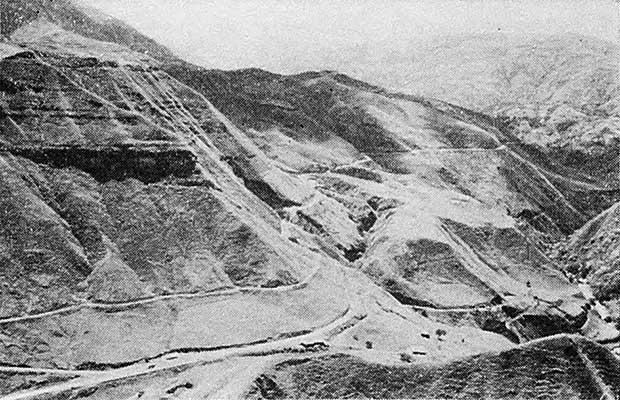
Tires wear out quickly on gravel roads. There is a steep 3,335 meter mountain pass between San Jose in Costa Rica and the Panamanian border, making it a difficult part of the journey across Central America. When I passed by, it was the rainy season and there was heavy rain, so the road looked like a river with flowing mud. I had to be very careful when driving because there were stones suddenly sticking out of the road, and there were also falling rocks.
Just when I was about to reach the border, I ran into a hole that I couldn’t see due to the muddy water, punctured my front tire, and fell down. At that time, I noticed that there were two cuts on the front wheel and two cuts on the rear wheel, each about 1 or 2 centimeters long. Fixing a puncture in the rain is unpleasant, but it’s even worse when you can’t drive anymore.
Honduras has bad roads but beautiful scenery
Honduras is the least modernized country in Central America.The capital, Tegucigalpa, is located at an altitude of 970 meters, and the entire town is surrounded by mountains, perhaps in a Spanish style, with reddish-brown brick roofs and white-walled houses stretching halfway up the mountain.I was drawn to such a place, and even though I knew it was bad for the tires, I decided to make the 300km round trip from the capital Tegucigalpa to San Pedro Sula on the Atlantic coast.
This road is one of the main roads in Honduras, but it was in extremely bad condition.Because it was the end of the dry season, the road surface had lost moisture and was covered in bumpy mud.We had to cross three mountain passes with such bad roads.What cures this is the wonderful scenery.Once you reach the top of the mountain pass, you will see a small stone farming village and distant green mountains that blend in with the tropical banana and palm trees, creating a stunning landscape.Honduras is the most beautiful country in Central America.
Be careful! Cows and horses and road signs
When driving on the roads in Central America, you have to be careful about cows and horses.They are free-ranging everywhere and appear on the roads no matter where you are.There was a cow that wouldn’t budge no matter how big the truck honked its horn.Sometimes I encountered cows or horses instead of cars when I couldn’t see curves.Cows and horses, which had probably been hit by cars, were lying pitifully on the side of the road, and on top of them were about ten bald ducks ruthlessly pecking at their flesh.
For gasoline, I never had to use the 8-liter spare tank I had prepared in Los Angeles. With the exception of Mexico, American gasoline companies are everywhere. Outboard oil for two-cycles is also available at stands in every country except Mexico.
Road signs become increasingly inadequate the farther you get from the capital. Once inside a town in the northern part of Mexico, which is a large country, it was difficult to find the exit, and I had to ask someone several times. It was a good opportunity for me to learn Spanish, as I am the only person riding a motorcycle.
Mosquitoes, ticks, cockroaches, and rats
There was always at least one hotel in every small town, and the cost was around two dollars, but I was disgusted by how filthy it was. There are cockroaches, mosquitoes and ticks, and I once had my precious food stolen by rats. The worst part was that there was a hotel where bats flew in during the night. As a precaution, I avoided pitching a tent alone in Central America.
We took a Volkswagen minibus from Alaska to Costa Rica and Panama for 10 days. When I traveled with two Germans and an Australian, we pitched tents in the mountains and on the coast, which were much more comfortable than in a hotel. This may be an advantage of traveling in a group.
How Japanese Vehicles Performed in Central America
Motorcycles Win Popular Support
Japanese motorcycles are running everywhere.However, Mexico has a domestically produced motorcycle, Motoislo, and one other company, so imports are almost prohibited, and only a small number of Yamahas, which were sold before then, are still running.For young people, motorcycles, which are more affordable than cars, seem to be more appealing.As soon as I parked my motorcycle in the middle of town, five or six young men approached me.There aren’t many motorcycles over 2,500cc in Central America, so my Yamaha felt extremely large here.I guess it’s because everyone said it was so big.
Cars are also doing great.Japanese cars are perfect for these people, who live in mountains and only have narrow gravel roads once they leave the main roads.There are so many car models that it seems like all Japanese car companies are involved.However, compared to American and European cars, they were introduced later, so their sales power seems to be far inferior.The problem with these countries is that they have a small middle class.Rich people buy American cars, farmers use horses, and Japanese cars cater to the middle class, as well as cargo-carrying trucks, jeeps, and minibuses for communication, and their success is remarkable.However, if the town is small and there are only 100 to 200 cars, it will be noticeable, but the absolute number cannot be said to be large.
Given their lifestyle, it is currently difficult for them to even afford a motorcycle.In addition to low incomes, motorcycles retail for nearly twice as much as in Japan, except in Panama.Cars are also about 1.5 times more expensive.Generally speaking, their salaries are around $80 for a skilled car or motorcycle repairman, around $50 for a shop worker, and $20 to $30 for a housekeeper.Even the cost of food is not cheap in Central America, so imports such as motorcycles, cars, machinery, and electrical products are difficult to come by.
When the middle class increases and incomes rise a little more, I think the growth in Japanese cars will increase rapidly. However, that time seemed a long way off.
Chapter 4: South America
Travel period = May 30th to December 9th, 1966
Total mileage = 27947 km
Entering South America: A Tense Motorcycle Landing
How cheaply you can cross the sea is the key to determining the success or failure of your trip.
It was May 28, 1966, when I found a small cargo ship and boarded it from the port of Colon on the Atlantic coast of Panama.Due to some trouble with the ship on the way, we stopped at the isolated islands of San Andres and Presidisia in the Caribbean, and it took us 11 days to finally reach Cartagena, Colombia, which would normally take us a day and a half by regular boat.Using a liner, the day-and-a-half trip costs a hundred dollars, including the motorcycle.The cargo ship only had crew beds, and they slept on top of beer bottles in their luggage every night.At twenty-one dollars for transporting a motorcycle, I can’t complain.How cheaply you cross the ocean with your motorcycle is the key to the success or failure of your trip.
It was difficult to bring the motorcycle to shore.Unfortunately, the ship ended up anchored ten meters from the shore.It wouldn’t be a problem if there was a crane, but this cargo ship didn’t have anything fancy like that.I repeatedly urged the captain to put down his motorcycle, but he just put down beer bottles and coke bottles and didn’t pay any attention to my motorcycle.Not knowing when it would arrive, I became impatient and negotiated with a laborer’s boss who was waiting for work in front of the ship to let me drop off my motorcycle.He found a plank 10 centimeters thick, 30 centimeters wide, and just long enough to connect the boat to the shore, and decided that he would be able to ride his motorcycle on top of it, so he and four friends agreed to do it for 40 pesos (1,000 yen).
They passed the planks to the ship and to the shore.It was too narrow at 30cm, so I could barely fit one person in front of the motorcycle and one in the back, but not on the side.The motorcycle began to move slowly.Once the motorcycle tilts, the force to stop it on the side is close to zero, so it’s all over.”Bochan!” between the shore and the ship!”It would be.This rare motorcycle landing immediately drew a crowd of people to Kuroyama.I held my breath on the shore, watching their movements.They are also cautious.At that moment, I was so anxious and anxious that I didn’t feel like taking a photo.
The motorcycle gradually approached the shore, but when it got halfway, the board buckled and it became a climb.The motorcycle stopped for no reason.Two people and a motorcyclist were stuck on a board 30 centimeters wide.The faces of the two laborers supporting the motorcycle from the front and back turned bright red and their muscles bulged.I couldn’t bear it anymore and jumped into a nearby boat.He then yelled at the other laborers to get into the other small boat and support the motorcycle from the other side.When two people in a boat supported the motorcycle from both sides, the motorcycle began to move quietly again.The captain, who had been looking away, must have been unable to remain silent after seeing what was happening, and began calling out loudly to the workers from the upper deck.
Thanks to Tenyawanya’s Sueya, we were able to take the first step towards landing in South America. Even if I’m the only one who steps on the ground, it doesn’t mean I’ve landed. This was the first time he had landed on a motorcycle.
The Vastness of South America
South America has a variety of topography and customs that I have never seen in North or Central America, and my travels were incredibly impressive and memorable.
Every country is still unfinished, has resources endowed within it, and its future seems immeasurable. Each country has distinct characteristics on its vast land, and its sheer scale cannot be expressed in words.
The rugged mountains and deep valleys of Colombia and Ecuador, the coastline that stretches throughout Peru, the more than 4,000 kilometers of barren desert and rock in northern Chile, the well-shaped green mountains and beautiful lakes of southern Chile, the high, snow-covered Andes mountains that separate Chile from Argentina, the flat pampas that stretch from Mendossa to Buenos Aires in Argentina – all of them are unspoiled and majestic, beyond the reach of human power.Uruguay, the smallest country in South America, is a green pasture with hills all over it, and Brazil, the largest country in South America, is nearly 5,000 kilometers from its southern border to Belem in the north, and the 2,000 kilometers between Brasilia and Belem is a desolate land with only bad red dirt roads and no towns.
Road Conditions in South America
Colombia’s rugged mountain roads
The Pan American Highway, which was cut between Panama and Colombia, begins anew in Colombia and connects the countries of South America.
Colombia has three mountain ranges running north and south, so I had to cross three large mountain passes to get from Cartagena on the coastline, where I set foot in South America, to the capital Bogoda.
All of the mountain passes were around 3,000 meters high, and there was only a paved road between the capital Bogoda and the large cities of Medellin and Cali, and the rest were steep, uneven gravel roads.On the roads away from the city, there were almost no cars, only long-distance trucks and jeeps.There were very few motorcycles, and even in the capital city of Bogoda, there were only a handful of them.I think it’s because there aren’t many motorcycles in Colombia, but the big truck drivers ignore motorcyclists like me.Not only were there sharp curves, but even on straight roads, two cars often appeared in front of each other, side by side.
There are no guardrails on the road that runs through the deep valley, making it extremely dangerous. There are many crosses on the roadside. We’ve seen this in Central America, too, and the numbers are surprisingly high. There were as many as four on dangerous sharp curves. It is said that this was erected at the site of the disaster to pray for the repose of the souls of those who died after falling off a cliff and those who died in traffic accidents.
The most difficult stretch is the 500km road from Cali to Toulcan, on the Ecuadorian border.The steep climb continues forever, with a deep valley on the left and a vertical cliff on the right.I was often impressed by the fact that they had built roads in places like this, even though the roads were rough, that cars could pass through.However, there were so many mountains that I started to wonder if the road was purposely built to cross over high places to get to the top of the mountain.Why didn’t they build a road to avoid the mountains?No, you can’t move forward here unless you cross the mountain.This is a mountain country, after all, so I told myself that it was obvious and moved on.There wasn’t much traffic, and around the time I remembered, I’d almost run into a large truck.
Two groups of bandits still exist
I had heard that there were bandits in Colombia, but the more I saw the deep mountains, the more I was impressed.In fact, there were brutal murders in which all the people in one village were killed, and all 50 people on one bus were killed.In the past, there were ten groups of bandits, but now the number has been reduced to two due to government suppression.Although they were especially advised to avoid touring at night, they often had to touring late into the night as they could not make it through the mountains.It certainly wasn’t a pleasant experience when I suddenly saw shadows of people illuminated by the headlights.
Ecuador, located right on the equator, is not hot
Ecuador means “equator” in Spanish, and as the name suggests, it is a country located directly on the equator. But if you thought it would be hot, you were wrong; the mornings and evenings were freezing cold. This is because the capital, Quito, is located in the mountains at a height of 2,860 meters, and my trip to Ecuador took me through high mountains from Toulcan, the border with Colombia, to Peru.
The map is false, and the paving is a big lie.
Looking at the map, the Ecuadorian side of the border is paved.I was happy to finally be able to enter a paved road from the rough roads of Colombia, but when I actually entered the Ecuadorian side, I found that the road was simply a cobblestone road made of rectangularly cut stones with many gaps in between.I continued onward, hoping that the road would someday become paved, but it never appeared, and the cobblestone pavement continued for 260 kilometers until I finally reached the town of Kito.It was a steep road running at a high point of around 3,000 meters, but the scenery was spectacular.The Indians plowed the slopes of the mountains to high places, and the mountains looked like they were wearing checkered kimonos.Small towns were also gathering places for these Indians, who gathered there with their harvests on the backs of horses and donkeys.
The cobblestone pavement is only about 3 meters in the middle of the road, so when cars pass each other, the cars on the outside end up on the dirt outside, creating a tremendous amount of dust. Indians wearing black cloaks have to dodge cars and dodge dust every time they walk down the road.
The distance from Kito to Ambattoo was over 100 kilometers, well paved.Among the high mountains, I could see a snow-capped mountain that was even higher.It snows even right below the equator.From Ambatou, the pavement broke off again and I entered the gravel road again.Apparently, there were two places along the way where the cliff had collapsed, and we had to wait for about an hour due to construction.There was one bus and several trucks waiting, but Ecuadorian people are very tolerant of having to wait.It seemed like I was the only one who was impatient.
The journey from Cuenca to Agua Verde, near the border with Peru, is a thrilling ride. I ran after dark, so I could only see silhouettes of the high rocky mountains on my right and the deep valley on my left, illuminated by the moonlight. In front of me, the path I was about to pass could only be seen as a small depression in the middle of a cliff that had fallen vertically.
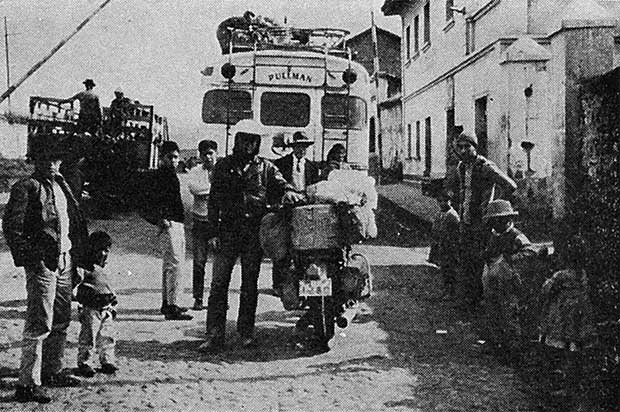
A desert of sand, rock, and sun, completely devoid of life – Peru
The Pan American Highway runs along the coast of Peru.If you go a little south of the border, you will soon find yourself in the desert.This desert is completely different from the semi-deserts found in Texas in the United States and northern Mexico, with no cacti or even drought-resistant grasses growing at all.It is a world made entirely of sand and rocks.After driving 100 or 200 kilometers, a small town appears like an oasis, with a sign saying “Water available.”It makes the feeling of a desert area even stronger.
This desert area is said to be extremely hot during the day, except during the winter when I went there. On windy days, we even encountered sandstorms. The sand is blown by the wind and spills onto the road. If you drive too fast in such a place, you will fall all at once. Even though it is located in the middle of a desert, Lima is a modern city with so much greenery that you will forget about the desert. However, once you leave the town of Lima, the desert continues.
Peru is all paved except for some parts.
Peru is approximately 2,500 kilometers from its northern tip to its southern tip, and except for a 100-kilometre stretch near Molendo in the south, it is completely paved.It’s a two-lane road with some waves, but visibility is good, so it’s easy to walk 100 km.The visibility is good and the traffic is light, so cars are moving at a fairly fast speed.However, in some places there are curves and slopes with poor visibility.Because the road is easy to overturn, accidents are common, and cars that are so damaged that you can’t even look at them are lying on the side of the road.
Amazing Chilean roads and Santiago
The desert area continued even further into Chile. The roads in Chilly are excellent and there is very little traffic. I was surprised that they were building such a tall road in an area with such little traffic. It is said that with the aim of developing the northern part, they first built a fine road. That’s a really smart thing to do.
There were very few gas stations, and from the border of Arica to a small village 230 kilometers away, there were none. The further south you go, the shorter the intervals, but you should be careful as there are many places that don’t have a gas station for more than 100 kilometers.
The desert began in Tounzus, just down the border between Peru and Ecuador, and continued 400 kilometers south to the Chilean caldera.More than monotony, I was impressed by the majesty of nature as I ran.From the caldera, the road went into the mountains, the greenery gradually increased, and eventually we reached the town of Santiago.Santiago is a quiet town lined with buildings of more than 10 stories, overlooking the snowy mountains of the Andes.There were many sooty buildings built during the heyday of Chilean saltpeter.
Taking on the Andes in Midwinter
Swallowing tears at Portillo
To enter Argentina from Chile, you must cross the Andes Mountains. The Andes mountains seen from the town of Santiago in the middle of winter were covered in deep snow, as if they were keeping us away. I first decided to try the route from Los Andes to Mendoza, Argentina. Although it is a road with a mountain pass of 3,832 meters, it is the main route.
Along the way, I met various people and asked for information. The long-distance truck driver’s story seemed to have the most truth. However, their prediction was that it would be impossible. Still, I couldn’t give up until I tried it myself and found out it didn’t work.
After passing Los Andes, the road suddenly narrowed, and I climbed up a steep sandy path along the river.On the way, he was arrested by a police officer and was told that he was going to reach Argentina, which was outrageous, and that he could barely get to Portillo.Well, I say that’s enough and move on.Before we knew it, we entered the high Andes and the road became snowy.There was more than two meters of snow, and the roads were covered in ice.With the World Ski Championships just a few days away, snow has been removed, but the slope is so steep that cars without chains had their rear wheels tangled.After climbing the zigzag road with the cold wind blowing down, we reached Portillo, 10 kilometers from the border.I was impressed that I didn’t slip as much as I expected when riding a motorcycle on snow.The 70 kilograms of luggage behind me must be listening.
Beyond Portillo, we were stuck in deep snow, and no further progress was possible. I returned to Santiago, looking at the steep mountains in front of me. Even though I knew it was impossible, I still felt sad about turning back.
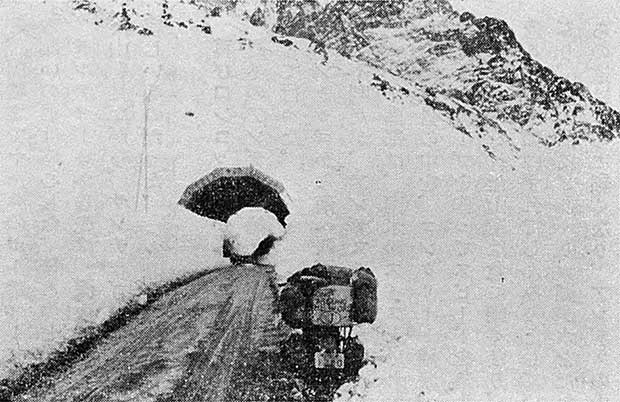
Trying the route from Roncoche again
Still wanting to cross the Andes in the middle of winter, I headed south toward the possible route from Roncoche.
There is a road that crosses the Andes 800 kilometers south of Santiago. Conditions are unfavorable in terms of latitude, but this is where the Andes mountains are lower.
The southern part of Chile is so beautiful that it has been called the Switzerland of South America. Easy-to-ride concrete roads lead through the peaceful countryside where farmers use horses to plow their fields. It’s flat and straight, but there are big curves at the entrances and exits of the town to slow down the road.
The mountain road that deviated from the main road suddenly became narrow and muddy.We passed through Pucon, a popular tourist destination in the summer, but it was out of season and it was somber.Mount Villarrica, a volcano that looks like a miniature version of Mt. Fuji, is capped with snow, and in front of it is Lake Villarrica, full of water.The scenery is reminiscent of Japan’s Fuji Five Lakes.The road from Pucon became narrower and deeper into the Andes.There are no cars passing by, and you only occasionally come across farmers wearing cloaks and riding horses.
Eventually, the road became so narrow that I wondered if a car could even pass through it.
Falling down in a freezing stream
Although it was a small river, there were two places where there were no bridges. The first one was shallow, so I was able to put my foot down and cross it successfully. The water from melting snow is cold. However, when crossing the second river, a large stone at the bottom of the river grabbed the steering wheel and caused him to fall.
The river was shallow, about 10 meters wide, but my motorcycle fell over and my lower body was drenched in cold water. I was drenched, water had entered my side bag, and my books, stationery, and other items were soaked with water. Regardless, I moved on.
The road is so rickety and narrow that I wonder if this is the road to cross the border.The roads were covered in snow, barely enough for a person to walk alone.As we went further, we saw footprints dotted in the snow.Before long, the footprints also disappeared into a farmhouse.Eventually, we arrived at a village called Puesco, 16 kilometers before the border.A cold sensation slowly creeps into my gloves, and my whole body starts to go limp.I can barely feel my fingers.
The snow is deep and I can’t move forward anymore.
We continued onward, but the fog was getting thicker.There was about 30 centimeters of snow, and we couldn’t go any further.cold.I fell down in the river and the wet area started to freeze and crunch.It was only two kilometers from Puesco.The steep rocky Andes can sometimes be seen through the mist.Was it impossible after all?On the way back, I was disappointed and headed down.This time, I felt so tired that I couldn’t do anything about it.From the time I started descending from Santiago, I was feeling weak due to the cold weather.
When I arrived at Pucon, which I had passed earlier, I went to the first hotel I saw. My body is cold and my head is dizzy. I gulped down some wine, carried my stuff into my room, collapsed onto the bed, and fell asleep.
It is impossible to cross the Andes in the middle of winter. I had no choice but to use an international train to cross the border from Los Andes in Chile.
The Road to Belem
Dangerous Amazon Estuary
On August 26, 1966, I entered Brazil from a coastal town called Chui. The road for 130 kilometers from the border was difficult to drive due to nearly 10 centimeters of sand, but after that the road became paved and we crossed several low mountains before arriving at São Paulo.
Starting from São Paulo, I traveled to Paraná, Belém, and Rio.When I was about to embark on a journey of 2,200 kilometers to the Amazon river Lobelen, many people opposed me and tried to stop me from going there.Of course, no one has ever traveled to Belém on a motorcycle alone, and it is said that the journey is so dangerous that even trucks and buses always run in groups of two or three vehicles in case of an accident or breakdown.Occasionally, when the weather is not favorable, a Caboclo (a mixed race of Indians and whites who live in remote areas, planting bananas and papayas and raising a few livestock) will send people for food.He was worried that if I were to go, I would ask Torak to join the squad and go with me.
In general, advice is often exaggerated.When I was heading from the United States to Mexico, Americans told me to be careful because Mexico was a dangerous country, and in Panama, there was a black man who gave me a bright jackknife when I went to South America, telling me that it would be dangerous to go into South America. However, as if to contradict that advice, the trip was a leisurely one, and the people were kind wherever I went.
I decided to ignore the advice.
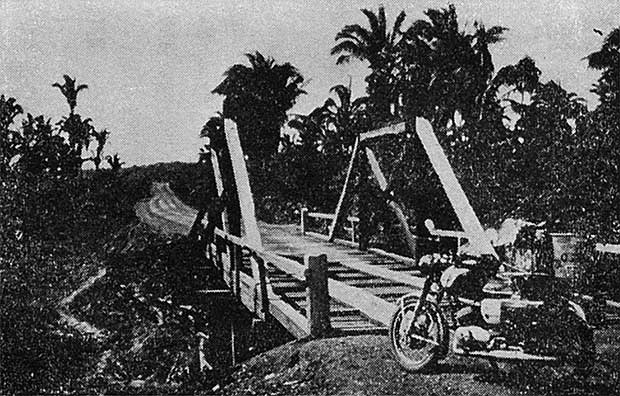
Despite the opposition, I headed straight to Belem.
I left Brasilia on September 28th. About 100 kilometers back on the road from Sao Paulo, there is a town called Annapolis. Go around the roundabout there and turn right in the direction of the Belen arrow. As soon as I turned right, the asphalt broke and turned into a red dirt road. This rough road runs 2,200 kilometers across the Brazilian plains to the Amazon river Robelén.
There is little traffic on the rough red dirt road, and from time to time we come across trucks and buses that drive by, raising a tremendous amount of dust.
Usually two or three come in a row. When we pass each other, the dust makes it impossible to see what’s in front of us.
The track is like a roller coaster. Because it carries a lot of luggage, it climbs slowly, and when it comes down, it goes down the hill with great force, without even applying the brakes.
Although the road is wide, regular waves like a washboard form on the road surface, making it difficult to drive on. It’s a straight road lined with low shrubs. Sometimes there are farmers. There are more people than I expected. The sun in the Brazilian highlands was hot and relentless, and by the second day, my hands and face, which were already black, had turned even darker.
Marvel at the strong vitality of cows!
On the evening of the second day, as the sun was about to set, I turned a curve onto a straight road and saw a large truck turned upside down.When I approached the car to see what had happened, I found that it had left its cargo platform on the road and had hit the front of the car in a ditch, leaving the driver’s seat flattened.Next to him, a woman holding a baby was bleeding from the nose.My feet are covered in mud.The baby is completely naked and crying.A man was trying to smash into the bed of a truck with a hammer.The man spoke quickly.When I looked under the loading platform, I saw about ten cows struggling under it.There was a cow standing nearby, which must have been thrown out when the truck fell over.
The woman was breastfeeding the crying child and rubbing the sore spot. I hurriedly unpacked my bag and handed the woman some water. The man seems to want to bring the cow back to life as quickly as possible, and doesn’t even pay attention to the woman.
The cow finally came out from the hollow gap. There were about five cows. I didn’t get any injuries.
Large cattle are difficult to remove due to the weight of the truck.Just then, a large truck passed by.I was finally able to raise the upside down truck using wire.Of the four animals that were trapped underneath, one had its neck broken and was completely dead.The rest of the cows can only move their heads but cannot stand up.One of them staggered to his feet, and the other two barely managed to get up as well.It’s strong!I was impressed.When the cow was dead, I used a short knife to cut the aorta, and used the slope to drain the blood.
I was impressed by how a passing truck driver helped out as if it were his own. “What I was told in São Paulo was a lie. Even if I had an accident like this, they would still help me, right?” Thinking this, I was relieved that the journey ahead would not be so difficult.
At night, when the weather was getting colder than during the day, a long-distance truck passed by, and the family in the fallen truck got on board.After seeing off the truck, I continued onward.Illuminated by the light, a snake jumped in.Before I could dodge it, I was hit.The moon is round.Will there be a full moon today?There are a lot of clouds, but you can see the stars clearly.A rabbit quickly crosses the road.The snake appeared again.This time I successfully dodged it.
That day, I started running early in the morning, but I only managed to cover 441 km before I reached the town of Gurupi.The next day, we set off again early in the morning.The rough road continues.Two trucks with broken rear axles were stuck helplessly in the middle of the road.My motorcycle holds up really well.Just driving along the heat and rough roads makes me angry.All you have to do is run wild and run wild.There were no human houses to be seen.
I saw a wolf-like animal cross the road. An ostrich, which I thought only existed in Africa, was startled by the sound of a motorcycle and jumped out of the forest. He then ran in front of the motorcycle at a tremendous speed and fled onto the opposite side of the road.
The Cabokuros I meet from time to time all have old guns. I carry it for hunting and for self-defense, but it’s not pleasant to see several people with guns at night, illuminated by motorcycle lights.
Twice I almost ran out of gas, but I was saved at a critical moment.
In some villages along the way, Dormitorio (mainly lodging for drivers) did not even use lamps, just putting oil in a dish and lighting a string for light.
On the fifth day after leaving Brasilia, the scenery finally changed from the previous one, changing from highland shrubs to tall jungle.The slope becomes steeper.It’s an extremely steep slope.Even after climbing the hill and starting to descend, I still can’t see the bottom of the hill.The road surface became even drier, and the tires were worn out.The surrounding tall primeval forest had leaves only at the top, and shrubs at the bottom.Large, deep blue butterflies with shiny metallic wings occasionally fly by.In addition to blue butterflies, there are yellow and red butterflies, but their numbers have declined dramatically due to unnecessary collection and export.
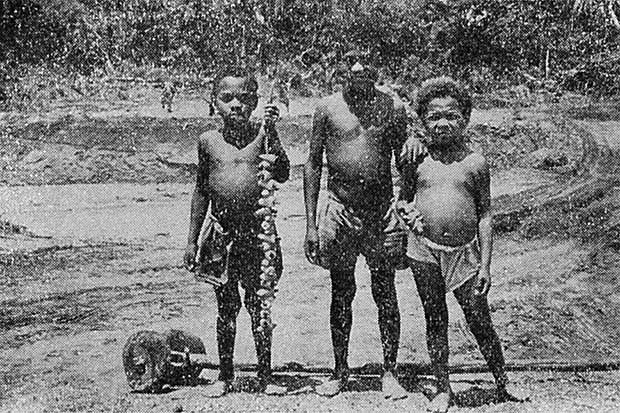
Arrived safely in Belem
After running 300km that day, I hit the asphalt for the first time in four days. I was able to run without any problem. After driving 100 kilometers through a rainy squall, we arrived at our destination, Belém.
It was around 6 o’clock when we arrived in the town of Belem. Perhaps because it’s so close to the equator, the people here are black, though not black. People’s clothing is often simple and barefoot. The mango tree is delicious and totally tropical. After the rain, the atmosphere in the town was cool and refreshing.
The motorcycle ran really well over the 2,200 kilometers from Annapolis on rough roads, from the beginning of Hokkaido to the end of Kyushu.
Biggest accident: front part of frame breaks
From Belém, after visiting the Japanese settlement in the Amazon, we headed back to São Paulo via those bad roads.
When I headed to Belém, no matter how bad the road was, I was interested because I was heading to an unknown world that I was going to for the first time. However, the thought of having to drive 2,200 kilometers on the same bad road I had traveled before on my way home made me nervous from the start. I just ran straight to Sao Paulo. The pace is 600 km a day.
On the third day after leaving Belem, with only 300 kilometers to go from Annapolis, I was flying along the corrugated road at nearly 70 kilometers per hour.Suddenly, I noticed that the rearview mirror reflected the lower part of my car than it should be.When I slowed down and tried to stop, the seat suddenly lowered and made a clatter.This is the first time such a failure has occurred.When I stopped and inspected it, I discovered that the front of the frame had broken off and the engine had landed on the ground.If he had continued at high speed, he would have been seriously injured.The totalizer showed 65,367 km.It was a journey of 4,000 kilometers on this rough road.It’s tough just going one way, so if you’re going round trip, any motorcycle would definitely want to go on strike.What’s more, this Yamaha has always been loaded with over 70 kilograms of luggage and has traveled 65,367 kilometers in harsh conditions.Even though I was stuck in a place like this, I couldn’t help but feel sorry for the motorcyclist.
On my way to Belém, I had two flat tires on the way.Even just standing there in the scorching sun made me feel tired, and I was able to recover by sweating profusely.But this time, no matter what tools or portable parts I had, I couldn’t fix it.All I had to do was wait for the truck.After waiting for about two hours in the scorching sun with no shade, a truck came from the direction of Belem.I stopped the truck in the road, and when I explained the situation, he graciously let me pick up his motorcycle.As I sat down in the front seat of the truck, I was so relieved and tired that I fell asleep before I knew it.
When I woke up, it was dark, but the truck was slow and hadn’t even reached Annapolis yet. I ended up staying at Dormitorio on the way. The driver and his assistant stayed at the Dormitorio, but I was curious about the motorcycle, so I spread a sleeping bag and crawled into it next to the motorcycle on the bed of the truck. It doesn’t cost much, and the outside air is pleasant.
The next day, I went to Annapolis in the morning. I found a repair shop and got out of the truck. The driver charged ten comte (1,500 yen). It’s a 300km journey, so I guess that’s unavoidable. It was October 14th when I took the motorcycle apart, welded the broken parts of the frame, and returned to Sao Paulo.
Motorcycles and Automobiles in South America
Brazilians who hate working
Several Japanese companies have expanded into Sao Paulo. Among them, I visited companies such as Toyota, Kubota, and NGK Ishikawajima Shipbuilding. All companies have refrained from making capital investments due to concerns about inflation, so they are not big at all.
Unlike large companies, there are many problems. Employee issues are a problem that every company faces. This is unthinkable based on the same standards as Japan, but the abilities of its employees are said to be less than half that of Japanese people. In short, I don’t like working.
“Brazilians think that making money means being lazy more than getting a lot of money,” said a Kubota factory manager.It seems that the Japanese employee has the key to the toilet and hands it over only when necessary.It is said that if you leave the toilet open, some people will go to the toilet for even 30 minutes or an hour and never come back.Also, some of the employees worked very hard, so I gave them a raise.As a result, the employee ended up taking more days off, and the pay increase ended up having no effect.
Large companies also have priority in terms of materials, and they bring them in as quickly as possible. Apparently, because of this, the supply of materials often stops and the factory shuts down.
For this reason, car prices are extremely high, with a Toyota Jeep costing as much as 11,880 comte (1.8 million yen).Even Volkswagen, Brazil’s largest manufacturer, has a price of about 1 million yen, which is comparable to Japanese luxury cars.Volkswagen accounts for more than half of Brazil’s cars.In addition to Toyota and Volkswagen, there are also Renault, Simca, DKW (two-stroke, three-cylinder), and Benz operating in Brazil.
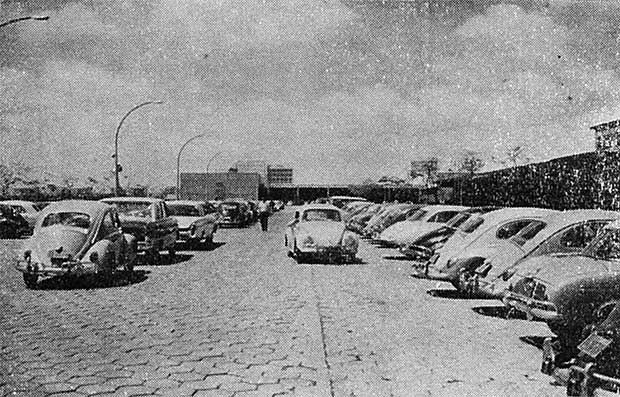
The continent with the least popular motorcycles in the world
Argentina is the second largest car producing country in South America after Brazil. Most cars in Argentina are domestically produced Fiat cars. Other countries do not yet have domestically produced capabilities and have just started knocking them down.
Now, what about motorcycles? Even in Brazil and Argentina, which have active automobile industries, there are no large manufacturers. The question remains as to why the motorcycle industry has not grown despite such a large population.
Exports of Japanese-made motorcycles are also subject to strict import restrictions, and the number of exports is miniscule. It was something a rich man’s son would use for fun, and it was rarely used for practical purposes. They don’t know how to use a motorcycle. No other continent has so few motorcycles.
It can be said that this is a continent that has great potential for explosive sales once affordable, high-performance Japanese cars enter the market and people learn how to use motorcycles.
Chapter 5: Europe
Travel period = December 23, 1966 to August 17, 1967
Total mileage = 34232 km
He had planned to cross from Brazil to the Union of South Africa, but was met with racial discrimination in the Union of South Africa, had to wait for 40 days, and was eventually refused entry. It is difficult to travel by boat from Brazil to other African countries. First, I went to Portugal to go to Europe.
From Portugal, we headed north through winter Europe, passing through Spain, France, Belgium, and the Netherlands. After that, he headed to West Germany and worked as a lumberjack for three months to earn enough money to travel, and had the chance to watch four major races: the West German Grand Prix, the Isle of Man TT, the Dutch Grand Prix, and the Finnish Grand Prix.
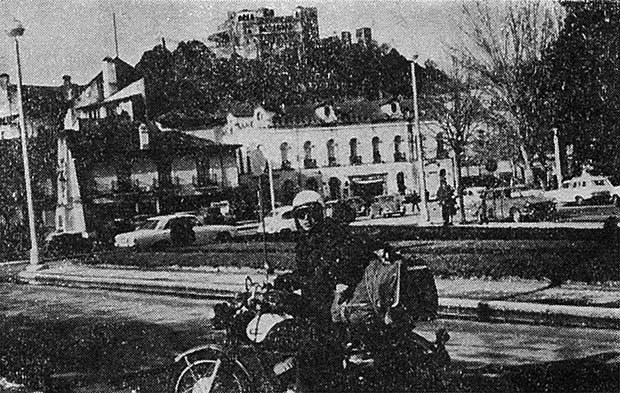
West Germany
Germans love camping
The day before the race on May 6th, I left the village early in the morning with two motorcycle fans I had met in the village where I worked. In southern West Germany, where it had snowed all of April, the warm spring sun was shining through the fields and forests in May.
The two friends who departed with me were friends who used their time off from work to enjoy long rides.They fly really well.The roads off the autobahn are by no means wide.Even on narrow, winding roads in the countryside, they can cover 100 or 110 kilometers without incident.I was able to clearly see the difference in speed.We run in a line under the bright morning sun.Hockenheim, from which the West German G.P. opens, is a small, nondescript German town located near the beautiful old town of Heidelberg.
When we arrived at Hockenheim, it was already filled with colorful tents. Among European people, Germans especially like tents, and you can often see them pitching tents and enjoying tent life.
There are tent villages in every big town, in the countryside, in the mountains, and by lakes, and even if you get lost, you can easily find the sign of the camp village.Speed fans with tents on their motorcycles and cars had been pitching tents around the course for several days, watching practice and waiting for the race day, even though the race was tomorrow.Take advantage of this race to your advantage and spend the first few days of spring relaxing.There were a variety of people, some sitting naked on their chaise lounges in front of the tent, listening to music while basking in the sun, others reading books, and others engrossed in stories about race.They brought folding tables and chairs from their own cooking utensils, and when it was time to eat, they sat around the desk and filled their bellies.Our group also found a spot and pitched our tents.
Meeting with Giacomo Agostini
The rain started in the afternoon and continued into the evening after practice. We wandered through the rain through a town full of motorcycle enthusiasts. Nothing out of the ordinary happened, and as I was walking towards the camping village to get back to my tent, I saw a team somewhere putting the finishing touches on something in the backyard of a certain hotel. Of course we approached.
One of the team members told me,
”Hello! You’re Japanese,” he said to me. I
”That’s right!where are you from?” I asked him again, but he didn’t answer, as if he didn’t know whether he understood or not.I later found out that he was Giacomo Agostini, the 500cc world champion.If you’re a motorcycle fan and come to watch GP races, you should have known his face.The reason he didn’t reply wasn’t because he didn’t understand, but because I was confused or ridiculed and asked him, “Where are you from?” I must have thought he was asking me back.But Agostini, a diminutive black-haired Italian boy, gave me a sense of familiarity with the big race I was seeing for the first time.
Afterwards, I met Agostini at the Isle of Man and the Finnish Grand Prix, but he seemed to have completely forgotten about Hockenheim.
They expressed their amazement at my travels by saying, “I’ve been riding a motorcycle for two years now!” They said, “Please come to Monza, Italy!” It seemed like they wanted to show as many people as possible about racing in their home country.
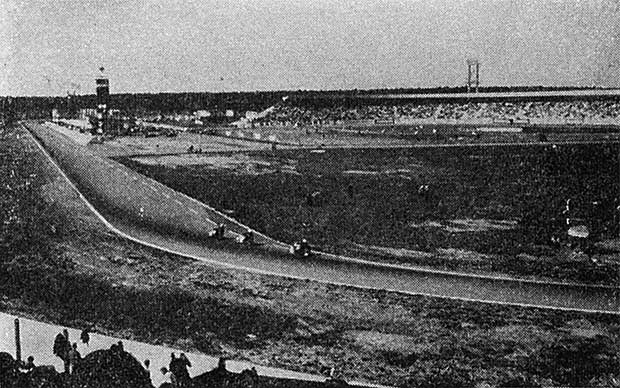
West Germany G/P race progress
The race attracted a crowd of 200,000 people and was a great success. The venue was also a magnificent stadium with large stands surrounding the start and hairpin curves.
People who had set up tents and waited began pouring in from early morning to get good seats in the stadium, and less than an hour before the start of the event, the front stands were so crowded that there wasn’t even a place to step. The rain that had been feared had subsided, and it was a sunny day for the race with no wind. However, the race was a little rough and the results were as follows.
▽50cc class: Anscheidt (Suzuki) won without a doubt, Graham (Suzuki) and Katayama (Suzuki) dropped out due to machine failure, and Kreidler came in second.
▽125cc class = Reed (Yamaha) and Ivy (Yamaha), who were riding far apart from the others, were caught up in a fall by a rider who was one lap behind them in the middle of the race, causing them both to fall.One lap later, the car that was running in front of the four cars crashed right in front of our seats, and Reed and Ivy, who were trying to pass, got caught up in them and crashed one after another, and Katayama (Suzuki), who was running in third place, snatched the win.
▽250cc class: Hailwood (Honda) and Ivy (Yamaha) disappeared shortly after the start, with Reed (Yamaha) in the lead and Brians (Honda) in second. However, midway through, Reed pitted and Brians took the lead.After that, the pursuit of the lead who jumped out of the pit was amazing.The audience watched intently as the lead narrowed the gap with each lap, but Bryans managed to escape by a small margin and win the race.
▽350cc class = Hailwood (Honda) won.
▽500cc class: Hailwood (Honda) jumped out from the start, opening up a large gap over Agostini (MV). In the second half of the race, Hailwood slipped into the pits and never came out, giving Agostini the victory.
The Road to the TT Race on the Isle of Man
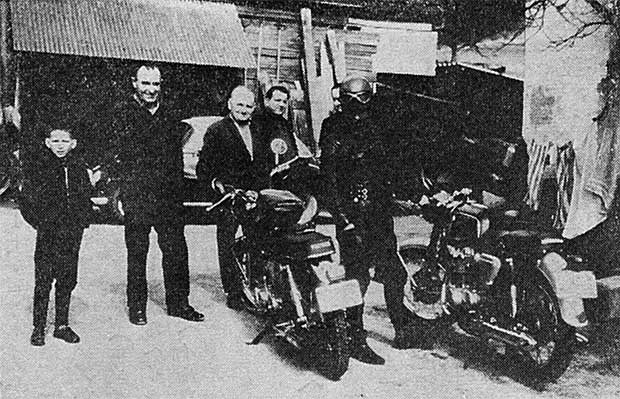
two friends from west germany
On June 5th, exactly one month after leaving G.P. in West Germany, I left for the Isle of Man with two of my German friends.A welder named Alfred owns a Honda 450cc.He was a huge fan of Japan and had a large photo of Japanese riders who had visited Hockenheim in his album.He was my best friend, but he spoke no English at all, only German.Even though I could barely understand German, within three months I was able to understand it thanks to him.
The other was a mechanical engineer named Hermann, who had a 6,000 yen BMW. He was involved in a serious motorcycle accident and underwent major surgery, and his left and right legs are now three centimeters apart in length. Even after such an accident, he is still obsessed with motorcycles.
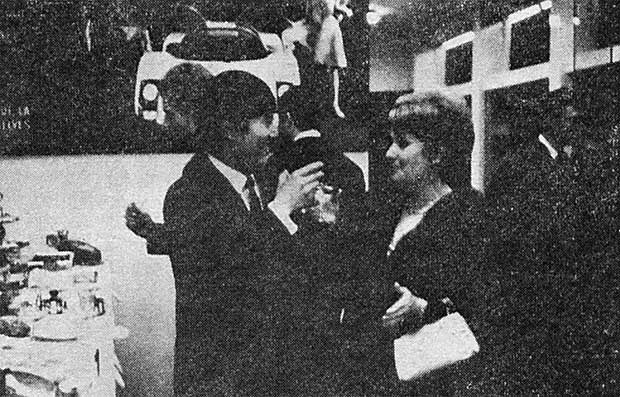
to uk
He crossed the Strait of Dover from Calais, France, marking his first steps into England. Pitch black clouds and cold rain awaited us. The ship was large and splendid, but Alfred, who was riding on a large ship for the first time, was feeling unwell after an hour and a half of motionless voyage.
At Dover, Hermann was joined by his English friend Haydon.He had Norton’s 6,000 yen with him and had come all the way to pick me up from Bridgent in Wales, 400 kilometers away.That day, I drove 400 kilometers from Dover to Haydon’s house, passing through London.There are no mountains in southern England, just a series of small hills.There are very few centrally separated highways compared to Germany.Still, the surface of the two-lane road is smooth, and you can drive up to 70 miles (112 kilometers) outside of town.As you know, in the UK we drive on the left, just like in Japan.It was my first time driving on the left in two years.The speed limit in the UK is set at 70 mph (112 km/h), both on highways and on non-speed designated roads.
I fell and hurt my right ankle again.
The day before I left for the Isle of Man, I went to Haydon’s motorcycle club and had a chat over some bad British beer.In England, by law, alcoholic beverages can only be sold until 10:30.
After that, we had to stand and eat potato chips and fried fish at the stand outside.
It is 350 kilometers from Haydon’s house to Liverpool. From Liverpool, we boarded a boat bound for the Isle of Man.
Today, June 9th, is the day we finally arrive at the Isle of Man. I left his house at 6 o’clock in the morning. Wales is a mountainous region, and there were sheep roaming around on the winding roads, so I was careful not to bump into them.
Fly at a speed of 70 to 80 mph (10 to 130 km/h) outside of town.With 70 kilograms of luggage, I could barely keep up with them on the unfamiliar road.Still, my Yamaha YDS-III ran well, unbeatable by the large displacements of Norton, BMW, and Honda.It’s a two-lane road with poor visibility, but even if you travel 130km, you won’t have to worry about people or cars jumping out, so you can drive safely.The four motorcycles continued to ride comfortably, all the way to Liverpool.
However, 30 kilometers from Liverpool, he had an unexpected fall.When I rounded a curve, there was road construction about 50 meters ahead, making the road one-way.Unfortunately, the light was red and a truck was coming from the opposite direction.Hayden, who was in the front, suddenly applied the brakes.I was running third, and to take advantage of the small engine displacement, I was running closely alongside Hellmann, who was second, to utilize the slipstream.Because I applied the brakes a fraction of a second later, my speed didn’t drop as much as the Hermann in front of me.When he turned the steering wheel to the right to avoid a rear-end collision, he fell over heavily.
I injured my right ankle again, which I broke in Canada. He was taken to the hospital by ambulance, where his left hand was removed and an X-ray of his right ankle was taken. Fortunately, there was nothing wrong with the bone, but the screw that was inserted into the fracture in Canada broke.
In the UK, all medical expenses are free, but if you have an accident, it’s only in the UK. This was a great help for me as I don’t have insurance.
Entering the Isle of Man with Bicco – being taken care of by the Yamaha Racing Team
After hearing from the hospital that an ambulance would take them to the ship, they went to the Isle of Man first. The next day, they will only take you to a nearby bus instead of to the ship. As I got off the bus in Liverpool and trudged my way to the port, a gentleman lent me his shoulder. There was only about 10 shillings (500 yen) short of sailing fare to the Isle of Man, but they kindly paid for it.
The ship was full of young people going to the Isle of Man.Hundreds of men and women in leather jackets lined up and boarded the ship one after another on motorbikes.Having lost my precious foot in motorcycles, I had to feel lonely all over again.After three and a half hours, we arrived at the port of Douglas, the main gateway to the Isle of Man.The motorcycle fans were thrilled and left the ship, leaving only the loud exhaust sound behind.I was the only one left behind.After waiting for a while, a car from the Yamaha racing team appeared instead of Alfred and his friends.They heard about the accident and came to pick me up.That day, I took it easy and slept and ate at a warm hotel with the racing team members.
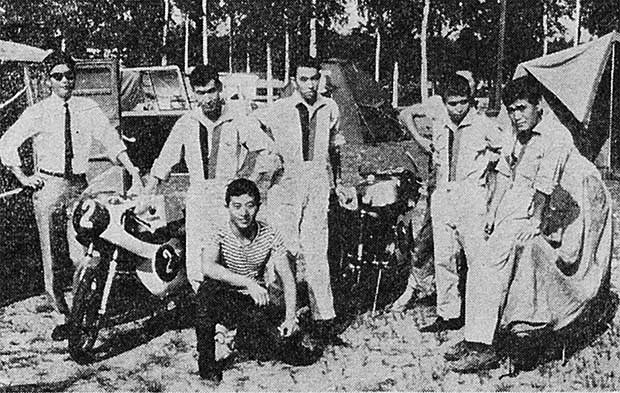
There are countless motorcycles on the island.
There are a huge number of motorcycles on the island. Hundreds of motorcycles line the road facing the coast. I take a walk at night while looking at these motorcycles, which is more interesting than visiting an auto show or a museum.
These British motorcycle enthusiasts don’t keep their motorcycles in the same condition they bought them. Everyone changes the seat, the tank, the shifter position, and the color to suit their taste, making the car unique no matter how you look at it.
I reunited with Alfred and his friends, then joined up with four of Hermann’s friends, making a total of eight of us, and pitched our tent at a quiet campsite on the outskirts of town. It was a fully equipped campsite with washrooms, showers, and a store, and it was free.
Dangerous Isle of Man courses
The course is 27.73 miles (60.37 km) long, and the road surface is rough, and I have tried running it myself, but it is a terrifying course with many elevation changes and dangerous curves. The steep ascent with hairpin curves known as goosenecks and the steep descent from Kepel Gut were narrow and had a stone wall on one side.
Yamaha’s Akiyasu Motohashi, who finished third on 125cc, was competing in the Isle of Man for the first time. He told me that this course was very difficult to use with the techniques used on ordinary courses, and that although the British riders were riding in an outrageous way, they were actually faster, and that it was a course where it was unclear how much of an advantage those who were familiar with the course would have.
The race was held every other day for a week, and this past week was T.T. Week, so it was like a festival. Fortunately, it was a sunny week with not a single cloud in sight.
Isle of Man T・T race progress
▽250cc class: Hailwood (Honda) took off from the start.I was watching the race coming down from the mountain, 34 miles from the starting point, and his cornering was amazing.He accelerates faster out of curves than anyone else.The time to open the accelerator is well before the middle of the curve.Reed (Yamaha), who had a bad start, was able to catch up and take second place.Ivy, who was running third, disappeared on the fourth lap and was replaced by Brians.
▽125cc class = Katayama (Suzuki) and Ivy (Yamaha) disappeared, and it was a one-on-one battle between Reed (Yamaha) and Graham (Suzuki). Graham fought hard, but Reed won by a small margin, with Motohashi (Yamaha) in third place.
▽350cc class (JUNIOR) = Hailwood (Honda) won.
▽50cc class = Graham and Anscheidt (Suzuki) take off. The pursuit of Katayama (Suzuki), who was about two minutes late after the start, was a sight to behold. On the third lap, I jumped to the top. However, the car did not last and Graham won. Stewart Graham, who lost his father Les Graham in this T.T. race, achieved his long-dreamed-of victory on the Isle of Man.
▽500cc class (SENIOR) = Agostini (MV)’s good fight shined. Leading Hailwood (Honda) from the start. Although the difference was only a few seconds, he held on to first place even after the fourth lap, and it looked like he was going to run away, but unfortunately his chain broke on the fifth lap. What would have happened if the chain hadn’t broken? Needless to say, Hailwood would have had a tough time.
The Road to the Dutch Grand Prix
Journey with Alfred
I parted ways with Hermann and Haydon, and was left alone with Alfred. I could barely grip the clutch with my left hand. Perhaps I had taken too much medicine given to me at the hospital, but my body was not feeling well and I felt dizzy every day. I didn’t have the energy to see the city, so when I arrived at my destination on my motorcycle, I just slept in a tent. Alfred, who doesn’t speak English, was always lounging around in his tent looking bored since I didn’t go out.
On July 21st, we crossed Dover and headed for Assen in the Netherlands.It was already ten o’clock at night when we crossed Dover on the ferry.Even though we would be passing through France in a few hours, we were forced to pay nine francs (630 yen) in insurance for two days.In all European countries, this insurance fee is paid upon entry.That’s a lot of money.A month’s insurance premium in cheap Germany is 10 marks (900 yen), and in expensive Scandinavian countries it is 70 marks (6,300 yen) a month, so it would be difficult to get by if you were paying decently.There were various holes, and I made full use of them.After driving for about an hour, I arrived at a cafe at eleven o’clock at night.Seeming as if they had nothing to do, French young people were making a fuss around the ball table and tabletop soccer table.As we, the Germans and Japanese, entered, there was a moment of silence, and people looked at us.They sat down at one of the desks, but their gazes never left their eyes.We order something to eat in Japanese, English, and Alfred’s German, but we can’t understand at all.Everyone started doing it, and eventually Coca-Cola and sandwiches caught on with them.France is one of the few campsites in Europe, so with our stomachs full, we pitched our tent on the side of the road in a rural village near the border with Belgium.
The roads in Belgium are not good. The Autobahn is also patchy in name only. The general roads are also uneven with many cobblestones.
When I arrived in the Netherlands, the roads became beautiful. Autobahns with good surfaces crisscrossed the country’s narrow territory. Old-fashioned windmills could be seen here and there in the green rural landscape, and it was truly idyllic. In the midst of all this, Alfred and I headed towards Assen at a speed of 111km/h.
When we stopped in a town on the way, Alfred found a motorcycle magazine with an article about me in a bookstore. When I was in Germany at the end of February, I visited a Dutch magazine called “Motor Sports” and sold articles about my travels.
I sold it in France as well, and it’s a great way to cover travel expenses. But if you don’t do it well, it won’t sell. There are many individual writers, so when something like this hits, they write articles and sell them all over the place.
We set up a tent at a campsite on the course, but the previous day’s practice was cloudy and it rained for the first half of the race day. The course is 7.7 km long and has many curves.
Dutch G/P race progress
▽50cc class = Katayama (Suzuki) won without a doubt.
▽350cc class = The rain becomes light and stops halfway.Agostini (MV) was in the lead and Hailwood (Honda) was closely following him.I didn’t think Agostini would be able to escape.Entering the middle stage, Hailwood took advantage of the group that was one lap behind to take the lead.It was at that moment that I saw firsthand his wealth of racing experience and his skill at maneuvering.After that, he pulled away from Agostini and scored.
▽125cc class = Lead (Yamaha) and Ivy (Yamaha) had a bad start and were over 30 seconds behind the others. Katayama (Suzuki) took the lead and won with a 50cc race, and as the only Japanese rider to race in the Grand Prix, he is extremely popular everywhere. In the second half, Reed and Ivy took the lead, and Reed won.
▽250cc class: Reed (Yamaha) comes out on top. Halewood (Honda), Bryans (Honda) and Ivy (Yamaha) follow in that order. On the second lap, the lead machine started to suffer and gradually fell behind, with Hailwood taking the lead and taking the win, while Ivey took second place, holding off Pliance.
▽500cc class = Hailwood was in top position from beginning to end. Agostini (MV) was having trouble with Pasolini (Benelli). Pasolini held second place until the end, but Agostini was now in second place with a slight difference.
The Road to the Finnish Grand Prix
Return to original solo travel
Alfred, who had been traveling with me all the way from Germany on a two-week vacation, returned to his village in southern West Germany when the Dutch G.P. ended. I broke up with him and went back to traveling alone.
From Hamburg, we headed straight north, passing through Denmark and the west coast of Sweden, before heading to Oslo, Norway.
The Scandinavian countries, with the exception of Finland, have virtually no borders with Denmark, Sweden, and Norway, and they don’t even have customs officials.
Sweden drove on the left, just like Japan.I have asked several times why Sweden, which borders Norway and Finland, is the only country on the left side, even if it is an island country like Japan and the UK, but I could not understand the reason, only that it has always been that way.Interestingly, even the homegrown Volvo, Saab, is left-hand drive.I couldn’t figure out that they drive on the left and drive on the left, but the answer seems to be that Volkswagen, the most imported car, drives on the left, and people have gotten used to it.Sweden is the only country where people drive on the left during the summer, when there are a lot of tourists, so there are many accidents.Because of this, the plan was to change to driving on the right in September.It costs a lot of money because everything has to be reversed.Ready right-hand traffic lights sat in bags all over town, waiting for September to come.
beautiful nordic nature
In Norway, I went back and forth from Oslo to Bergen on the west coast, and the scenery of the lakes, forests, and fjords was truly spectacular.There are high mountains near the fjord, and there was still four or five centimeters of leftover snow on both sides of the road.This region of fjords is covered with ferry boats.Although the fjords do not freeze even in the cold winter due to the influence of ocean currents, in this region where there is a lot of snow, cars cannot drive in the winter, so ferry boats are no longer needed.
After returning to Oslo, I immediately entered Sweden and headed north from Stockholm. The scenery of Sweden’s forests and lakes is beautiful, but the scenery is completely unchanged and boring. Far more pleasing to the eye were the rural girls working in the fields in bikinis, and the Swedish girls basking in the sun in bikinis in the garden.
It was on July 16th that I entered Finland from Sweden, headed north, passed through Lapland, and entered the Nordkapp, the northernmost point in Europe.
At a latitude of 71 degrees north, close to the Arctic Circle, there wasn’t a single tree in sight, just moss and a few grasses. The sun does not set even in the middle of the night, and the sun tilts to the north, and after a while it stands still, it begins to rise again, which is the midnight sun. It was like a fairyland, with a herd of reindeer living leisurely and eating a little grass.
Popular Japanese cars and motorcycles
The first thing you notice when you arrive in Finland is that there are many Japanese-made cars and motorcycles. Starting with Datsun, Toyota, Isuzu, and recently Mazda were also coming in. Japanese cars have a good reputation and are expected to continue growing in the future.
In unusual places, there were Soviet-made Moskvitch and Volga, Czech-made Skoda, and Polish cars, and there were also many Soviet-made motorcycles, Czech Yawa, and East German MZ.It seems that the number has been decreasing recently, but at one time it was a huge number.This is because they are extremely cheap, and the import companies use the slightly unthinkable method of taking cars from communist countries without paying them and paying them based on what they sell.In terms of performance, there were many failures, and many people avoided it even though it was cheap.
motocross world championship
Prior to the Finnish Grand Prix in Imatra, a motocross race was held on July 30th in the town of Hibinka, 100 kilometers north of Helsinki. In Scandinavian countries, motocross is even more popular than speed racing. Seeing a motocross race for the first time, I was surprised at how much dust there was. The majority were Swedish-made Husqvarnas, and there were also many Czech CZs.
I had a nice chat with world champion Torsten Holman (Sweden), who said he has been racing motocross since he was 11 years old.He races every week in Europe and America, and said he would love to go to Japan as well.I was asked if there were any Japanese motocross machines, and I couldn’t help but feel competitive with the Swedish-made Husqvarna, thinking that Japanese-made ones would soon appear in Europe as well.
The race consisted of two heats, with 20 laps around a 2km course. It was an intense race with another 20 laps after about an hour. The riders, who were covered in mud, said that their eyes were already blurry in the second half. That day’s race was won by fellow Swede Petersson. Holman finished second.
During the race, I was introduced over a loudspeaker, and I was allowed to run the course alone while the audience watched.I was once again surprised by the steep ups and downs of the course, which was covered in hot sand and large gravel.
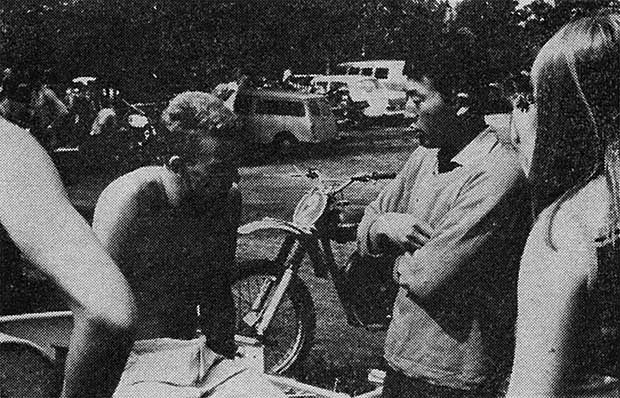
Chapter 6: Eastern Europe
Travel period = August 19th to August 30th, 1967
Total mileage = 3821 km
Refused Entry into the Soviet Union
What is the difference between cars and motorcycles?
The clear summer sky in Helsinki is a beautiful combination of green trees and a cove. From Helsinki, they began preparations to enter the communist countries.
The only hurdle is the Soviet Union. I went to the Soviet embassy, which is surrounded by woods near the center of town, and applied for an entry visa. However, the official told him that entering the Soviet Union alone on a motorcycle was not allowed.
It was what I expected. I had researched entry into communist countries in Geneva, Switzerland and Stockholm, Sweden, but both times I was told that it was not possible to enter the country alone on a motorcycle.
At that time, I couldn’t give up.I had a slight hope that if I actually went to Helsinki, I might have a chance, but I was still disappointed that I couldn’t go.The only way to enter the Soviet Union is by bus, train, plane, or car, following a designated route.Cars and motorcycles are the same vehicle, but motorcycles are too small to be monitored.
If the Soviet Union fails, it will come from Poland. Fortunately, a Polish coal ship was sailing from Helsinki to Gdansk, Poland. Immigration is also easy. When purchasing a tourist visa, you will need to book a hotel and exchange a set amount of dollars a day in advance.
However, a transit visa does not require any trouble. However, you can only stay for a maximum of three days to allow time for transit from Gdansk to the next country. I obtained a transit visa for six Eastern European countries: Poland, East Germany, Czechoslovakia, Hungary, Romania, and Bulgaria. Although Yugoslavia is in Eastern Europe, it is easy to enter the country; no visa is required, and all you have to do is go through simple procedures at the border.
A Journey Through Poland
Surprised by the black money mongering of customs officials
It was on August 17th that I was sent to the Forsbon family, a Yamaha distributor who had taken care of me in Helsinki, and boarded a coal ship in Poland. The 3,000-ton ship, blackened by coal dust, carrying my motorcycle and me, sailed across the Baltic Sea toward Gdansk.
Poland is famous for its strong vodka. They are called vodka. At night, I was teased and drank vodka in the small cabin, which large sailors often drink. One of them told me how strong they were in drinking.
“In Poland, if three people sit around a half-liter of vodka and two of them open it and one of them opens it, it’s still unnecessary.”
After a two-day voyage, we arrived at the port of Gdansk, which had a heavy exterior with dark buildings and blackened cranes.
At 8 a.m., the first customs official in the communist country arrived. You will be asked to write down your motorcycle, camera number, and amount of money on a piece of paper. They don’t even try to inspect my luggage. Although they are communist countries, the countries of Eastern Europe, with the exception of the Soviet Union, are polite to tourists.
For some reason, the customs officer decided to exchange the money for dollars. “If you actually exchange money at a bank, one dollar is 24 zoppis, but how about 72 zoppis per dollar?” This surprised me. Tax officials are black dollar dealers. Moreover, it is three times better than the prescribed route. I wanted so badly to change it, but I told myself that a trip to a communist country would not go well if I broke the rules from the beginning, so I refused.
relaxing gas station
The motorcycle was lowered onto the quay by a rope attached to a large excavator crane specially designed for coal.This is the beginning of our journey through the communist bloc.Cross the railroad tracks and follow the amazing road paved with large stones to the town of Gdansk.The houses are dull, dark brown brick buildings, and the streets are all cobblestone.People waiting for the streetcar.People are waiting in line at storefronts all over town.The number of cars driving in the town is small.In addition to Polish-made cars, you can also see many Soviet-made cars.Ah, I felt once again that I had entered the communist bloc.
I bought a postcard at a shop on the corner of town, but the dull color made it seem like I had bought it ten years ago. Cigarettes are just as bad. They didn’t use cellophane, the wrapping paper was old, and the box was dull. The name was “Extra”.
Stop at a gas station at the exit of town.I can’t imagine how many stands there are every kilometer on the way to Warsaw.First you have to fill it up.I thought it was normal for someone to come out and fill up the tank with gas when customers arrived, but that’s not the case.”Give me gas!” in German” Then someone inside said, “Wait!” came the reply.They told me to wait until they finished transferring the gasoline from the tanker truck.
Three cars and two Yawa motorcycles lined up behind me. Once the gasoline has been transferred, they will ask you to wait until they have finished smoking it. The people waiting didn’t say anything, just looking at my motorcycle with strange looks.
I filled up my tank with gas and headed straight for Warsaw, the capital.The road turns to asphalt once you leave the town.The road surface is rough and has waves.There are fewer cars and more motorcycles, bicycles, and pedestrians.Motorcycles made in the Czech Republic are popular.Everyone should wear a helmet.Everyone on the motorcycle is wearing a helmet, from the woman in a skirt to the small child clinging to the back of her father.The road surface is rough, so I keep my speed down to 80-90km/h, but it’s still much faster than other cars.Most cars run at less than 70km/h.
When you go into a town or village, you have to be careful about people.From daytime onwards, people gathered around town and chatted about something.The streets are filthy and the cleaning is not done properly.The only thing that young people wear is flashy and modern.Sometimes people would suddenly jump out.There was a time when I almost pulled over the geese I saw everywhere.The road is always rough with cobblestones as you enter the town, but once you leave the town, it becomes asphalt, and the road is lined with trees, making it look like you are running through a tunnel of trees.Horses laden with hay go by leisurely, and tractors can also be seen, but livestock still have a great deal of power.
Even though I committed a traffic violation, I had a motorcycle guide me to the campsite.
Although it is a short distance from Warsaw to East Germany, we still had two days to spare. A moped traveler who was with me at the camp in Warsaw told me, “Now that I’m in Poland, I must see the old town of Curacao,” so I ventured further east.
We headed to Curacao in the rain. The roads were better than the day before, and there were still a lot of wild motorcycles. When I stopped for lunch on the way, I met a group of six men and women riding Yawas. They were all cool-looking young people wearing jeans, jackets, and helmets.
Although they are familiar with Japanese motorcycles, this is their first time seeing them, so they look at them with a blank stare. Compared to their own monocoque, single-cylinder motorcycle, the pipe frame, two-cylinder Yamaha satisfied their dreams, and when they found two carburetors, their eyes lit up as if they were racers.
Since I couldn’t understand the language for 2-stroke and oil injection, I doubt if they understood it at all. Women seem to be more concerned about my belongings than their motorcycles. This is because you don’t need anything fancy. He keeps begging me to hand over the Erimaki that I went to great lengths to buy on the Isle of Man.
From Curacao, we headed towards East Germany along a road that was not marked on the guide map at all.Although not shown on the map, there are large industrial cities.I kept running, wondering if the course was suitable for tourists, wondering if the police might arrest me.When I arrived in the town of Kaobise and was wandering around the rotary in the center of town, I was grabbed by a police officer.I said in broken German and English that I was just looking for a campsite while looking at the signs, but no one understood me.A white motorcycle passed by, and it seemed to understand that I was “camping,” so he took the trouble to guide me to the accommodation.He must have thought he was a troublesome traveler, not only for committing a traffic violation, but also for having to escort him to his accommodation.
Almost safe! Arrived at the East German border two and a half hours before my visa expired.
While on such a carefree journey, I crossed the wrong border.According to the map I had obtained in Switzerland, I was supposed to pass through East Berlin and reach West Berlin at the border, but a soldier with a gun pointed me back, and I drove down a country road at night and arrived at Frankfurt, the border with East Berlin, two and a half hours before my visa was due to expire.I learned that in Eastern Europe, it is acceptable to travel on a whim and deviate from the tourist route.If this were the Soviet Union, it would be a big deal.
Visit to the Jawa Institute
After a stop at West Berlin, the island of freedom, we drove on East Germany’s autobahn again, heading from Dresden to Prague, the capital of Czechoslovakia. There, I happened to have the opportunity to tour the Yawa Institute. When I was talking with the campground staff, I told them that I wanted to go and see the Yawa factory, and they immediately called me and asked for permission. The reply was that they could not show me the factory, but I would like to show them around the research institute.
I rode a Japanese-made Yamaha to a research institute on the outskirts of Prague. The white-haired director, Joseph, sat at a desk at the front of a large, red-coated room and greeted guests from afar with a smile.
I couldn’t help but praise the company for its thorough research on Japanese motorcycles, which are its competitors in motorcycle production. Although the number of cars produced is much lower than that of Japan, it is well known not only in communist countries but also in the American market far from Western Europe. Mr. Joseph is
“Japan-made cars are popular as sports models, so we at Yawa would like to increase exports of practical vehicles,” he said of the current situation.
① Personnel: 6,000 people (factory), 300 people (research institute)
② Annual production: 100,000 units
③ Export 90%
④ Overseas technology export
It has factories in India, Türkiye, and Egypt. There are plans to build a factory in Iraq.
⑤ Oil injection
I made a plan once over ten years ago, but it didn’t work out, so I’m currently making another plan.
The laboratory has a variety of testing equipment, all of which are based on ideas developed in this laboratory. The engine was making a loud noise inside the triple-paned windows. We were able to see a lively and enthusiastic side of the rear cushion, frame, vibration test, etc.
The machine was being tested for a six-day trial in Poland. In addition to conducting various tests, this laboratory also manufactures factory racers.
After finishing the tour and returning to Mr. Joseph’s room, I asked him.
”In communist countries like yours, there is no domestic competition. I think competition in sales speeds up technological development, but isn’t there a disadvantage in communism?”
Mr. Yosef replied, “Of course there is no domestic competition, but there is competition abroad, so it’s the same thing.”
Mr. Yosef handed me a commemorative badge with the Yawa symbol on it and a hat, shook my hand firmly, and said, “I hope you will be careful from now on and that you can return to Japan safely,” and sent me on my way.
Motorcycles and Cars in the Communist Bloc
During my stay in Prague, I had another great experience. As I was walking through town, a Japanese flag suddenly caught my eye at a newspaper shop on a corner. I immediately bought a copy and looked through it to see two pages introducing Japan’s automobile industry. Although I couldn’t understand the text, I knew from the numbers that the article said that Japan’s automobile industry had become the second largest in the world after the United States.
When I left Japan, I thought that Japan was indeed in third place, ahead of Britain, but I never expected to find out this in a communist country. There were some photos of Japanese cars posted, but the new models made me realize once again how long my journey was.
I walked around and visited the newspaper’s publisher. About ten employees were working on the newspaper on the second floor of a small building.
I went there to ask him to tell me about motorcycles and car production in communist countries, but he didn’t have that much comprehensive data, so the editor-in-chief only told me what he knew.
As for motorcycles, there are scooters from Czechoslovakia such as Yawa, CZ and Povais. East Germany’s MZ and Swimson, the Soviet Union’s Izhu, Poland’s SHL, etc.
As for cars, the Soviet Moskvich, Volga, Zuir, Zaporozhetto and Chiaika. Water lilyna, Warsaw, Poland. Czech Skoda and Tatra. Trabant, Wartburg, East Germany. In addition, Italy’s Fiat has expanded into Yugoslavia and Poland, and is planning a technical partnership with the Soviet Union in the near future.
Of these, a considerable number of Czech Yava and Skoda and Soviet Moskvich are exported to Western Europe. Both cars have undergone model changes recently, and their styling has completely changed and become modern.
According to Finnish users, it is not durable and often breaks down. However, their appeal is their low price, which is less than two-thirds the price of cars made in Western Europe or Japan.
I got the impression that the gap in performance would not narrow unless there was technological competition within the communist countries.
Chapter 7: Africa
Travel date = September 23rd to October 25th, 1967
Total mileage = 7,920 km
Morocco Without Greenery
Our journey to Africa began by crossing the Strait of Gibraltar from Algeciras to Ceuta. The mountains are sloping and there is no greenery at all. When I saw men wearing djellaba (white clothes) and women wearing ruzem (veils), I tightened my loincloth again, thinking that I was finally in Africa.
A man is riding a donkey down a wide, treeless hill, carrying a rice bran bag on his head because it’s hot. The houses that sometimes appear are pure white and square.
The roads are narrow and uneven, only paved. hot! However, the motorcycle continues to run comfortably. Meet Moroccan children leisurely watching over sheep, cows and goats. A donkey carrying a large pile of grass goes by, breathing heavily. A dog is walking in the shadow under the donkey’s belly. The donkey hangs his head, and so does the dog.
I headed from Tangier to Fes. There are no trees at all. Cacti grow around a muddy farmhouse. They make cactus fruit an important food. The porgies at the festival had a pre-medieval feel. After finding a cheap hotel there and staying there for three nights, I headed to Algeria.
Touring Through the Desert
To the oasis town of Bousada in the Sahara Desert
When I arrived in Algiers, I immediately visited Mr. Bouziri, the Yamaha distributor. Mr. Boujiri, a man with a mustache and big eyes, welcomed me warmly, even though I didn’t have any letters of introduction.
It was supposed to be two or three days, but I ended up sitting there for ten days. After my motorcycle was serviced, I would work with them to fix the motorcycle they had been repairing.
On Sunday, I decided to go to Busada, an oasis town 300 kilometers into the Sahara Desert, with my friends from the agency.
There are five cars in total, four Yamahas and one BMW. There are no Kaminari people in Algeria. The five motorcycles raced through the town like lightning. For about 30 kilometers from Algiers, we drove along a flat road lined with vineyards.
When the vineyard was cleared, they went into the mountains. It’s a narrow, rough road with sharp curves, steep climbs, and deep valleys. The mountain pass was high. After crossing the mountain pass and descending the steep slope, we found ourselves on flat ground, the entrance to the Sahara Desert. We passed through several small towns, but there were huge crowds of people. There are so many children. Men in turbans, life is bad.
We are finally in the desert. A single stretch of rough asphalt sticks out in the hot, flat desert. Just open the accelerator fully and drive at a speed of around 130km/h. The wind from a motorcycle is hot enough to the point where you need a leather jacket.
It was already evening when we arrived in Busada. The oasis in the desert is large and has become a tourist destination with several hotels. This evening I was in Busada, staying at the nicest hotel. Since it was a French colony, most of the tourists were French. Tourists, of course, fly in from the capital, Algiers, just to fly across the desert.
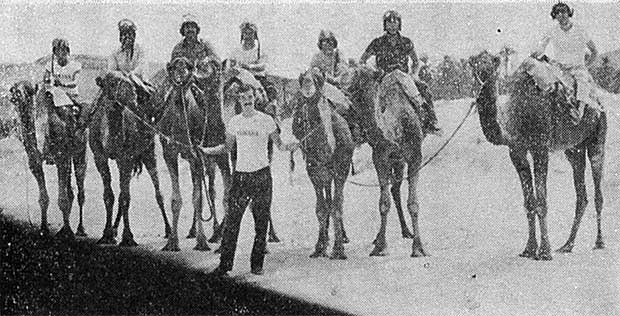
Busada can’t see women in town
At night, in Busada, men wearing turbans and white clothes hang out by the roadside. Children are running around between them. Not a single woman could be seen.
The morning in the desert is refreshing. Donkeys and carts rush by. Breakfast was served at a cafe with cafe au lait (coffee milk) and udon flour. All stores are full.
When I left the town and went to the desert, I saw that the Sahara desert beyond Busada was a land that I could never imagine. After looking at the desert for a while, we decided to take a dip in an oasis near the town. Boujri, Azzedine, and Soudahamed all frolicked in the blue, cold water, all wearing just their underwear.
It got quite hot in the afternoon. The shade doesn’t cause much heat, but the direct sunlight is intense. Ten people eat couscous. I stepped into the large wash basin. Couscous is a uniquely Arab dish, and is commonly eaten here in Algeria, Morocco, Tunisia, and North Africa.
The wheat is made into a powder similar to Brazilian manjoca (taraimo flour), and then carrots, daikon radish, paprika, mutton, and whatever else you like are poured over it to make a soup.
Today I used rabbit meat instead of sheep meat. We drank cold beer and had delicious melon for dessert. Fully satisfied, we left Bousada at 2 o’clock, and the five motorcycles headed straight back to Algiers.
A Close Call Entering Tunisia
Entry refused! Tunisian country name not written on passport
Algeria’s coastline is covered in beautiful greenery. I was supposed to have an eight-day visa for Algeria, but Mr. Boujiri and others were so insistent that it lasted fourteen days, but the immigration officer let me leave the country without saying anything.
Reassured that no visa was required, Tunisia handed over his passport to the immigration officer. They looked at my passport for a while and told me I couldn’t enter the country. The reason was that the name of Tunisia was not included in the names of the countries they visited.
“That’s not true!” I said, trying to find Tunisia among the names of nearly 70 countries.
”do not have!”
That can’t be true. Tunisia was definitely included in the plan I made two years ago. It is impossible to go from Algeria to Libya without passing through Tunisia. It had slipped away due to some oversight. I was already using my third passport. His first passport did not even have the country name “Tunisia.” I gritted my teeth that I had carried it around with me for over two years and not noticed it.
“If you don’t have a country name, you won’t be able to enter. Please go back to Algiers, go to the Japanese embassy, and add your country name,” the two immigration officers say.
That’s easy to say, but it’s a 1,500km round trip, and just having the word “Tunisia” written on my passport and the gas costs alone are too much.
I explained the purpose of my trip and asked them to let me in as it was an oversight and to call the Japanese embassy in Tunis. Tunis is only 200 kilometers away. One of the immigration officers yelled at my repeated requests.
”Go to Algiers and add your country name! This is Tunisia. Unless you have a country name, you can’t stay in Tunisia even for a second. Now grab your stuff and leave!” He grabbed my bag and pulled me by the shoulder, trying to get me out. I waved his hand away and yelled back.
”I’m just heading to Libya. I’m not going to move until you let me in!”
He walked out, and the other immigration officer, who didn’t speak English, also retreated to the back. I sit on a dirty bench and wonder if there’s anything I can do. I look at my passport over and over again, but I can’t seem to find the words Tunisia. In the meantime, several people had passed through the border. Each time, the immigration officer says, “Get out!”
I am prepared to sit down until I can enter the country…but the sun is setting.
Three hours have passed. There was plenty of sunlight. Returning to Algiers would take more than two days and cost a lot of gas. It’s well worth it, even if it lasts a night or so. I resolved not to move until he let me through. The immigration officer ignored me and spoke in a quiet manner.
“I’ll call the Immigration Bureau Headquarters at the Ministry of Foreign Affairs, and please follow their reply.” That’s all they can do. That was all I had again.
I blurted out my reply. Would the headquarters forgive someone whose passport does not have a country name? The immigration officer was already on the phone. While I was thinking, “What should I do if they refuse at headquarters?” the immigration officer asked me to give him my passport.
Pon! They will give you an entry stamp. It was sticky. However, he was a stubborn immigration officer. No, I was more stubborn.
Rain Falling on the Desert
Nomads, camels and the desert
I pitched a tent in an empty lot next to the police stations in Tunis and Tripoli.
The exit from Tripoli town is lined with date palms and cacti for several kilometers. It’s important food for them. Nomads travel through the desert with their sheep and camels and donkeys pulling carts. Nomadic tribes can sometimes be seen setting up tents in the desert. What are you eating? Is there water? I’m worried about everyone.
At night, you have to be careful not to hit the camels. A camel resting on the side of the road is startled by the sound of a motorcycle’s exhaust and starts running. I was blinded by the headlights and didn’t know which way to run. I had to slam on the brakes several times because the camel jumped out.
Sand is also dangerous. In some places, sand blown by the wind deeply covered the road surface. If you push hard without slowing down, the motorcycle will not move at all.
It feels good to know that no matter how far you go, there is nothing beyond the horizon. After driving through the Libyan desert for about 700 kilometers from Tripoli, a high gate came into view. This is the administrative division point between Tripoli and Benghazi. Five police officers were on duty. They were so serious that this place was the most important in the world in all aspects, both politically and culturally.
Shai (tea) with a glass of whiskey
It’s eleven o’clock at night. After showing my passport, I decided to sleep again near the hut.
This place, far away from town, seemed like a completely quiet and mysterious world. One person, wearing pajamas and with mucus in his eyes, started playing an old radio. Gah gah, that was as loud as the noise.
For them, drinking chai (tea) is the happiest moment. I take a bucket of water and wash a small iron kettle. Wash small glasses. Pour the washing water into the bowl and wash the bowl. Water is precious. Start a charcoal fire in an empty can and boil hot water. Pour in plenty of tea. Then bring to a simmer.
I crawled into my sleeping bag on the sand and watched every movement. I was offered some Shai, so I got up and drank it, but it was a dark, dark Shai in a small glass like a whiskey glass. I fell asleep looking up at the beautiful starry sky without a single cloud.
Abandoning the journey across Africa
I was woken up in the middle of the night by the rain hitting my face. By then, I was soaking wet through my sleeping bag. I never expected it to rain in such a desert. This rain was the only one in North Africa.
The desert continued.Benghazi is a town I drove 1,400 kilometers after leaving Tripoli to arrive at.The sea was blue, the sky was blue, but the town was full of dust.Pass through Benghazi and head to Apollonia.Explore the beautiful coastline of Egypt.The plan was to cross Africa again, but I was once again prevented from doing so.It is not possible to enter Sudan from Egypt.Due to the conflict in northern Sudan, travel south from Egypt was limited to flights.For someone like me who doesn’t have a lot of resources, this is something I have to give up on.I decided to abandon my dream of traveling across Africa and head to the Middle East.
Chapter 8: The Middle East and Asia
Travel period = October 26, 1967 to January 6, 1968
Total mileage = 12,563 km
Two Days of Servicing the Yamaha YDS-III
On October 25, 1967, I boarded a ship from Alexandria, Egypt, and arrived in Lebanon, located at the western tip of the Asian continent. If we continue overland, we will be able to travel through the countries of the Middle East to India. If you go to India, Japan is just around the corner. When I thought of that, my heart jumped and I became nervous.
Anyway, I stopped by a Yamaha dealership in Lebanon and had my motorcycle, which is my most important leg, serviced over two days. It used to run all the way here, loaded with heavy luggage. I couldn’t help but call out to him, telling him to do his best because he was almost there. So far, I have covered a distance of 84,712 km. That means he has circumnavigated the earth more than twice.
Jordan on a War Footing
Camping in front of King Hussein’s Palace is refused.
Lebanon, a commercial country, was the richest of the Arab countries.As it is a free trade port, there are many cars from all over the world.As soon as you leave the city of Beirut, you will cross a high mountain.There are vineyards and apple orchards, and farmers line the roads with apples and grapes to sell.The mountain road was steep and quite long, and we could see far into the city of Beirut.The descent was steep and long, but I managed to get down the winding road in about 100km.I got a flat tire just as I was cutting it off.I was relieved that if I had been on my way down, there would have been no one left.
He ran through the Bald Mountains and entered Damascus, the capital of Syria.
The road from Syria to Amman, the capital of Jordan, was the site of fierce fighting with Israel. Amid the rolling desert, soldiers are preparing for battle. It looked like the Israeli army was about to attack. Large trucks were parked at regular intervals over a wide area of the desert. Tents were pitched, and anti-aircraft guns were mounted on the high points, pointing in the direction of Israel.
There are many soldiers in the town, and there are check points in various places. The soldiers were so taken aback by my strange appearance that they forgot to call out to me. I always try to pretend I don’t know. This is because when you stop, you have to wait to see your passport. I looked at each of the three passports from page to page.
As I was wandering around Amman, not knowing where the center was, I came across King Hussein’s Palace.A soldier with a gun stands solemnly.I asked him how to get to the center of town, but he didn’t answer.”Can you let me stay here?” I gestured to him, and he looked astonished, saying, “This is ridiculous.”The town center was close to the Palace.It’s a town with a lot of flashy, cheap neon lights.The city center is located in a valley, and the houses are built toward the top of the mountain.Square stone houses are crowded together, and there is only a small amount of green space.
The third floor of the small three-story building is a hotel. All cheap hotels are like this. There are two beds, one for 300 yen and the other for when someone comes over.
The next morning, I got up and left the trashy town before the sun even came up. As you climb the mountain, you can no longer see the center, and you can see the densely packed residential area that extends all the way to the top of the mountain.
When I left the town, the same battle structure as yesterday continued. If an Israeli plane were to fly in, this place would burst into flames and turn into a battlefield. In the previous war, this place was also used as a battlefield and was attacked by Kotenkoten.
A Photography Incident
At first it’s for military reasons, but eventually it’s no good in areas that aren’t dirty.
After driving maybe 30 kilometers from Amman, I entered a market in a small town.Arab clothing also differs slightly depending on the country.A good place to take pictures of Jordanian clothing is in places where there are a lot of people, like markets.There are fig sellers, sandwich sellers, fruit sellers, vegetable sellers, and many women with baskets.She’s wearing pure white, beautiful clothes.When I asked the sandwich vendor if I could take a photo with him, he nodded his head.I set up my camera thinking that if I included women in the bakery and surrounding area, I would be able to get some really good photos.
Then, among the people who had been following me from behind, about three people stood in front of me and said, “You’re not allowed to take pictures here!”
”Why?” I asked.
“The police officer will arrest me and I will go to jail,” he said.
”No, I haven’t heard anything like that. Why can’t I take pictures?”
”I’m sure you’ll take the photos you took here and show them to Israel, America, and England.”
”I’m a Japanese tourist. I wouldn’t do that. Even if I showed you, what would you lose?” I asked.
They asked me to go to the police.He goes to the nearby police station, but a crowd of people from Kuroyama follows him.One person went to call.The policeman who came out to the public immediately changed his face, took off his belt, and started waving it around like a madman, not at me, but at the group.He seemed completely insane to me.Shaking his head and putting all his strength into it, he worked his butt off.People fled in small pieces.
When I extended my hand to the policeman and asked him to shake his hand, his face changed to a calm one, as if he were a completely different person. I asked him again if I could take a photo, but he didn’t answer. The policeman ignored him and the three men from earlier went on.
“I’m going to take pictures of this dirty place and then go back to Japan and show them what I’m going to say about it.”
”That’s not the problem. It’s different from Japan. It’s very different. Even when it comes to clothes, there’s nothing wrong with selling sandwiches. The women’s clothes are also really beautiful, aren’t they?”
The way they criticize me has changed.At first, they said it was because we were at war, but now we’re saying it’s a dirty place and we shouldn’t take pictures of it.The government prohibits the taking of photographs because it is related to the military.The market I was trying to spread had nothing to do with the war.However, he didn’t seem to know what the group would do to him if he contracted the virus.Their emotions in a state of war are by no means normal.
A Desert Tent Beset by Sandstorms and Ants
Rapidly changing desert climate
We pitched a tent in the desert near the Rutba border. As I was setting up my tent, relying on the starlight, thinking I would be in Baghdad tomorrow, I felt something prick the palm of my hand. I was shocked for a moment. It’s a scorpion!
When I looked at the palm of my hand, I didn’t know what it was, but an insect had bitten me and wouldn’t let go. There’s no point in panicking anymore. I struck a match and was relieved. It was just a big ant.
Desert weather can change rapidly.It was a quiet night when I set up my tent, but I was awakened in the middle of the night by a strong gust of wind.They came together as if they were all one piece.The tent hooks at the legs came loose, and the tent started flapping wildly.If I had been a moment too late, the tent would have been blown away.Immediately, I grabbed the edge of the tent and pulled it under me.Now I can’t move anymore.The sand was blowing relentlessly, not only on my face but also inside my sleeping bag.I lie on my stomach, close my eyes, and do my best to hold down the tent, praying for the wind to stop.It was my first time facing such a gust of wind.After about an hour, the wind suddenly stopped.It’s completely quiet.I brushed off the sand, fixed the tent, and climbed back into my comfortable sleeping bag.
When I woke up the next morning, I found a huge ant nest next to my tent. Last night, not only was there a gust of wind, but I was also bothered by ants that crawled into my sleeping bag and started ticking.
Gasoline costs cheaper than water, rich Kuwait
The journey continued from the hot Baghdad to the oil kingdom of Kuwait.The roads are in good condition even in Iraq, although the surface is bad.When I entered Kuwait, I found a fine American-style road running through the desert.Many of the cars are large American cars.Gasoline costs 60 yen a gallon, so a liter costs 15 yen.It is no exaggeration to say that it is cheaper than water.From Kuwait to Tehran, Iran.Wherever the heat goes, it’s cold in the Iranian plateau.It must be cold.There is snow on the surrounding mountains.People’s clothing changed to black and thick clothing.
John, Whom I Met in Iran
Racing Through the Darkness, Numb with Cold
On November 10th, we passed through the town of Tehran and headed for Meshad. There are no trees at all on Bald Mountain.
This is a road with a high proportion of bus and truck traffic. This is the third winter this year. The weather looks like it’s going to start snowing at any moment. Cold rain fell from the low clouds. The snow is falling halfway up the mountain. Sometimes there are tunnels that cut through the mountain.
There is no electricity, and once you enter the tunnel, it becomes pitch black with only the light of your headlights.After traveling nearly 100 kilometers along such mountain roads, we entered the rural Taira region on the coast of the Caspian Sea.This verdant region is an important breadbasket for Iran.The Caspian Sea was barely visible in the cloudy sky.From Gorgan, it runs about 300 kilometers along the Soviet Union’s Turmen Republic to Bozhnurd.It was a paved road surrounded by greenery all the way to Bozinuld, but beyond that it became a pitch-black gravel road that was difficult to climb.At some point, the dense forest road turned into a desert.The moon and stars, symbols of the Arab world, covered the cold night sky.
cold. I run and run, but there is no village. I miss the lights even more when touring on a cold night. No cars came at all. I wondered if I had made a mistake on the road, since I hadn’t met a single person even though I had been running for two hours. I tried shouting out loud or muttering something to disguise my feelings of sadness and loneliness. I must have driven about 150 kilometers after the last light.
A light appeared between the mountains in the distance.The faint light I saw made me feel a hundred times more energetic.I was looking forward to it, wondering if there would be any hot drinks or food.The small light was getting closer little by little.It’s hard to reach.tantalizing.It flies frantically down the rickety road.I went to a small village.There are about ten houses on both sides of the road, one of which is a restaurant and a rest area for long-distance buses.
I can’t stop shaking from the cold.I had a cup of chai in the empty dining room and took a breather.When I asked the man at the restaurant if there was a place to stay, he offered to let me stay for 20 riyals (95 yen) a night.Twenty riyals is cheap.In an eight-tatami-sized hut behind the dining room, two other men were sleeping wrapped in blankets on the concrete.I put my luggage to the side, put on my leather pants, and crawled into my sleeping bag.The next day, I left the rest area just as the sun rose.It’s a refreshing morning, but it’s bitterly cold.
To Meshad with John
After driving about 100 kilometers on a gravel road, a gas station appeared. It was my first gas station since Bozinuld. A BMW caught my eye. A man covered in mud fixes a flat tire. The number was a German number. He’s British, and he bought a BMW in Germany and traveled all the way here. The tall, blond-haired Englishman was named John. He is planning to go to Australia and work there.
We both love motorcycles. They hit it off right away, and even though they were lonely traveling alone, they ended up traveling together with John for a while.
We filled up with gas and headed to Meshad. The road is wavy and uneven, with thick gravel. On gravel roads, it’s easy to lose your wheels, causing the rear wheels to slide to the right or left. On this gravel road, my heavily loaded Yamaha was faster than John’s twice-larger BMW.
John has a large rick sack on top of the gas tank, which reduces the load on the rear wheels and prevents them from sliding.There are no steep climbs anymore, and the only thing that bothers me is the mud smoke from trucks and buses as they pass each other.The two motorcycles ran side by side.Even the motorcycles are covered in mud and smoke.Even though I started running early this morning, I only managed to cover 400 km.As the evening glow of Meshad began to appear in the distance, the road turned to asphalt.
As we stopped the motorcycle and were about to watch the sunset behind us, we looked at each other and started laughing.Both of them were covered in mud from head to toe.I had never noticed it myself until now.Each looked at the other’s terrible appearance and imagined their own pitiful appearance.Then he laughed out loud.The mud seeps in through the goggles, and my eyes are covered in pea-sized lumps of mud.They took off their gloves and dusted each other off, congratulating each other on a good fight.
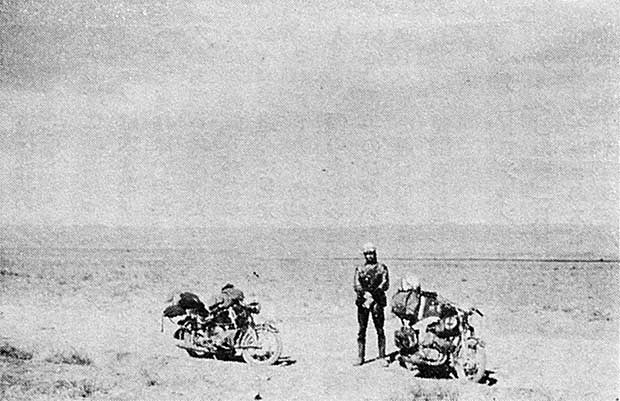
We bid farewell to John in Herat.
The second day of my trip with John was from Meshad to Herat, the western tip of Afghanistan.We drove at a speed of 60km/h on the same gravel road as the day before.After dark, we crossed the border between Iran and Afghanistan.There are cheap hotels in Herat for tourists.Over a dozen Europeans and two Japanese travelers were staying there.Most people traveling to the Middle East and Asia pass through Afghanistan.The road, which spreads out over several courses in India in the east and Iran in the west, becomes a single road here in Afghanistan, which is why it attracts many tourists.
The inn, which cost 100 yen per night, had two beds and had no decorations at all, but it was clean and well-maintained. After carrying my heavy luggage, I went to the restaurant attached to the inn and got some leftovers. It was already past ten o’clock and the dining room was closed. We received rice and mutton and drank water. This water wasn’t good.
I was so tired that I fell asleep, but when I woke up the next day, John was exhausted and his eyes were rolling.
“I kept going to the bathroom last night,” he says, exhausted.
I immediately realized that it had been exposed to water. I thought it would be okay to drink the glass of water I drank at dinner, but I ended up drinking it because I was thirsty. But did that really do it for me? What happened to John is just as bitter as what happened to him.
“I took the medicine, but I can’t hear it, but I’m fine now. It’s finally calming down,” he said, and after a while John seemed to finally fall asleep.
John also woke up at noon. We brought lunch for two to our room, but although John’s diarrhea had subsided, he had no appetite. John is okay now. However, he plans to rest here for a few days. I decide to move on. We’ll be taking the same course anyway, so we’ll probably meet again somewhere. We promised to meet again, shook hands, and left Herat before dark.
Drugs, Drugs, Drugs…
A haven for hashish (marijuana) addicts
Fly over stunning desert roads with no traffic at all. Running along rocky mountains. Sometimes there are only small mud houses with cupolas. There are no towns within 570 km of Kandahar. It got dark before we were even halfway there. Before I knew it, the rocky mountains turned into flat, easy-to-follow roads in the desert.
I passed the British jeep that had left Herat earlier and approached Kandahar. When the town came into view in the distance, as if it were studded with stars, I transferred the gasoline from the reserve tank to the tank. Worried about running out of gas, I drove slowly to Kandahar. The town was already asleep.
I knocked down the inn and found an empty room in the second one. The guard came out rubbing his eyes and led me up the worn stone stairs to my room. Two hitchhikers were sleeping soundly in their sleeping bags.
After the keeper received Hyakuyenya’s rent, he lay down on the wooden bed in the hallway, just as he had before I came.
I was brushing my teeth in the bathroom downstairs when a small black-haired man came down. As we talked, I realized that he was from New York, but from the look on his face I thought he was of Spanish descent who had immigrated from Puerto Rico. He is washing the syringe. “Why does he even have a syringe?” I thought to myself as I brushed my teeth, and the conversation stopped for a moment. The man who finished washing
”Have you ever smoked hashish?” I asked.
”No.”
“Come hang out in my room. They’re all interesting people.” He smiled mirthlessly and went up the stairs. I had heard about hashish. Hashish is a type of drug that is native to Afghanistan and Tibet. Some Western drug patients have migrated eastward in search of cheap drugs, feeling like they have found heaven in Afghanistan and Tibet. In Southern Europe and North Africa, it was sold in kasbahs and other places as marijuana.
Offered Hashish
Perhaps that man’s room was a drug patient’s residence. Then it might be worth a look. With that in mind, I knocked on the room in front of my room where the black-haired man had entered.
”Come in!” came the reply from inside. When I opened the wooden door, I felt a jerk for a moment. This is not the face of a living person. The gazes of the five men, all with unsteady eyes, gathered together. The man from earlier says “Come in!” again. As I entered the room, I said, “Good evening!” She didn’t reply, but she looked relieved.
They were all lying on the bed, their eyes glazed over, their cheekbones sticking out and their faces pale and their arms sticking out of their sweaters like bones and skin. The room was filled with the distinct smell of hashish.
One of them said, “Smoke it!” and handed him some hashish in a hookah. Normally, people would mix it with cigarettes and smoke it, but here, probably because it’s cheap, they only smoke hashish. I have a plastic bag full of hashish. I took the hookah and tried smoking it. I smoked it a couple of times as if I were smoking a regular cigarette, but I didn’t notice anything special. It just leaves a bad smell in your mouth.
The way they smoked was amazing. The hashish smoke you inhale doesn’t stay in your mouth, but passes straight into your lungs.
“Ah! That’s how you smoke it, you’d probably fall flat on a cigarette, so there’s no way you could imitate it with hashish,” he gave up.
I learned how to use a syringe. A man with a loach beard takes a syringe from a black-haired man and puts some kind of drug in it. He was wiping his thin arms with cotton soaked in alcohol. There are so many marks on my arm from the injection that I can’t even look at it.
The loach-bearded man who received the injection has his eyes raised and his face difficult to believe to be human. It looks like he’s holding back something, perhaps because he’s holding back his pain. When the needle was removed, he had a sullen look on his face.
”What will happen when they run out of money? They ask for drugs with faces even more frightening than the ones they make when they give an injection. Drugs, drugs, drugs… They must have nothing of the natural scenery or humans that they used to come across.”
With these thoughts in mind, I quickly returned to my room and fell asleep, thinking that there was no need to stay long.
Poor India
Indian moped in partnership with Yamaha
Pakistan is reached by climbing up the Khyber Pass, a difficult part of the Silk Road, from Kabul.
Due to the hot climate of the basin, Pakistan’s roads are also completely paved through Lahore.
Pakistan is unstable due to the Kashmir conflict. Fortunately, we were able to cross the Indian border. India, a country of poverty, is completely different from what you hear and what you see. More than just being filthy, I was disgusted by how bad the people were.
In my first town, Ludeana, I visited Mr. Kantibhehir of Pearl Scooter. He manufactures mopeds by importing engines from Yamaha.
The president’s house, which was built at the entrance to the factory, was a fine and well-maintained house. Ordinary Indians you see in town or in the countryside are thin and dark-skinned, but he is a fat, dark-skinned Indian you would see in Japan.
In this country, where the caste system still exists, the rich and ordinary people are completely different races.
There were many servants in the president’s house.A servant who cleans the floor can only wash the floor, and a woman who washes can only wash.They can only do the work they are assigned to do.The president’s younger brother Satish gave me a tour of the factory, and the large factory was buzzing with activity.Almost everything except the engine is made in India.The finished moped is still cheaper than the one made in Japan.In India, where finished products cannot be imported, this moped with a Japanese-made engine sells well from where it is made.The problem is that the government limits the number of engines that can be imported, making it impossible to increase production as desired.
Satish said that average factory workers earn a monthly salary of about $13 (4,680 yen). Still, people who have a certain job are better off. A well-educated schoolteacher’s salary is thirteen dollars, which is not bad at all.
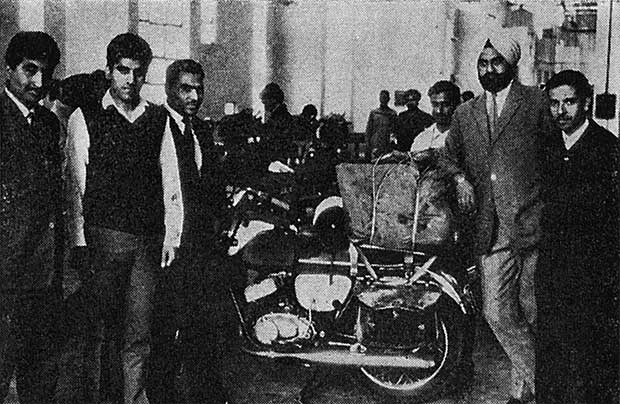
Caste system, Hinduism, population of 400 million and cows
You can see just by walking around town how many people don’t have jobs. What will the future hold for India, a country with a population of over 400 million people, entrenched in the caste system and bound by Hinduism?
Since India was a British colony, all major roads are paved. However, the pavement is narrow and the pavement is only wide enough for one truck to pass, so when you pass a car, you either stay on the asphalt and force the other car to move out of the asphalt, or you get swept into the mud outside of the asphalt. There are a lot of people and cows in the town, so you have to be careful.
Toilets are only for the rich class
Proceed eastward through the idyllic rural landscape. Poverty cannot be covered. There are monkeys dotting the trees along the road, and they sometimes cross the road. I think people who like animals should come to India. Peacocks, large yellow-green parakeets, are flying everywhere. Camels, mongooses, squirrels and rats roam the roads. It is rare to find a country where so many wild animals roam freely.
People work in groups of two or four to draw water. A rope is attached to the basket, and the water is successfully pumped from the river to the fields. It is common to see cows being used to pump water from wells to fields. Fetching water is a difficult task because there is no motor.
At night, it’s completely quiet.There is no electricity in the small village, only the dim light of lamps.Illuminated by the light, a figure with his butt exposed begins to appear.There are usually two or more people in line.An aluminum pot filled with water was placed beside it, and it sparkled as it reflected in the light.After defecating, they wash the aluminum with water, but they don’t seem to dig any holes.The dry air removes the moisture, and the wind carries it away.People who have latrines are people who are well-off.
He traveled to Madras, New Delhi and Calcutta, and from Madras he took a boat to Penang in Malaya.
Chapter 9: Australia
Travel period = January 12th to February 4th, 1968
Total mileage = 6963 km
January Is Midsummer in the Southern Hemisphere
disinfected motorcycle
In Singapore, the country of eternal summer, I took a 20-day rest to wait for a ship to take me to Australia. At the end of the year, on January 12, 1968, I landed on the last continent, at Frementor, on the west coast of Australia. January is midsummer in the Southern Hemisphere, and as we disembarked the ship, the sun was shining down on us.
Temperature 160 degrees Fahrenheit (41 degrees Celsius). It must be hot. Another problem with the heat was flies. That fly is different from the average fly. It’s persistent. It stops on my face and doesn’t leave when I turn my head. When I brush it off with my hand, it flies between my hands and lands on my face again. It doesn’t matter if it’s your eyes or your mouth, it stops without any hesitation.
It took me a while to bring my motorcycle in again.In Singapore, I thought I was removing dirt from the Middle East and India, but the customs officer felt the back of the motorcycle’s fender and found a small amount of dirt.It was considered unclean.As a result, I was forced to pay a large sum of five dollars and completely disinfect the area with steam.Another piece of fox fur that was used as a motorcycle seat, which he had acquired in Afghanistan, was taken to a furrier because it might contain insects.
I often thought that I didn’t have any complaints. It was judged that the wearer respected human rights while wearing clothing that was not too revealing.
He received a warm welcome and ran in front of the spectators at the Perth race.
I visited Ken George, a Yamaha agent, and that evening he took me to see a speed race in Perth.Motorcycles, cars and sidecars roar around the oval-shaped mud circuit.This race, which is held every Friday, is not about betting, it’s just about enjoying the speed, and it seems to be one of the most enjoyable recreational activities for the people of Australia.Race cars made specifically for mud circuits are inspected by people from young to middle-aged, covered in oil.
At this circuit as well, they were welcomed by the organizers and introduced to the audience. An announcement was made throughout the venue, and I was the only one on a motorcycle riding onto the mud circuit, which was quiet, contrary to the race. He was greeted with thunderous applause and slowly made his way around the venue.
Since they were rare visitors from Japan, they gave us a generous round of applause.
Crossing the Australian Continent
I set off on a solo trip of 4,500 km in 5 days.
The next evening, I left Perth early and set out on a journey across Australia. I had already booked a boat from Sydney on the east coast to New Caledonia. In order to reach the ship in time, they had to cover about 4,500 kilometers from the west coast to the east coast in five days.
Although his physical strength had fully recovered from the rest he had taken in Singapore, the motorcycle was already about to be ridden for 130,000 km. Even though some parts may have been changed along the way, the whole car is quite tired due to the heavy load on it. “It may be impossible for me to run 900 km a day for five consecutive days, but if I run this long, I’ll be in Japan! Good luck!” I prayed.
Proceed east along the green, sparsely hilly road. After driving for about 60 miles (100 km), the house disappears, and after running for several tens of miles, they pass through a village. Since it was Saturday evening, all gas stations were closed. There are no people.
The warm care of the 7th Pump Station couple
At twelve o’clock in the evening, after driving 640 kilometers, I arrived at Pump Station No. 7. This pump station is a place where water is pumped along the way to increase the water pressure in order to pipe water inland from Perth.
It is the seventh pump station from Perth, meaning there is a pump every 100 kilometers. The pump station was in a small village, so I went in, hoping to find something to eat. There was only a water tank and a few houses in the darkness. I was lucky enough to cross paths with a man there. I’m on the night shift and I’m about to go to work at the pump station.
“If you like, you can set up camp in my garden!” he said, and took me to his house.
“Camping is a pain, so let’s sleep here!” I said, pointing to the balcony and heading off to work.
Although it was twelve o’clock at night, the two elementary school children were still awake. As I sit on the balcony and smoke a cigarette, I start to sweat. The heat of the day does not subside even at night. A child brought us tea and bread. That’s a blessing. I stuffed two pieces of bread with ham into my empty stomach and fell into a sound sleep.
I woke up at 6:30 in the morning to the rays of the sun hitting my eyes.
As I was preparing to leave, my wife, who hadn’t shown her face yesterday, came out and let me go to the dining room. While serving me tea and ham sandwiches, I talked about various hardships I had had since immigrating to Australia from England.
“We immigrated from England twelve years ago.I’ve been working at this pump station for four years now.My husband works night shifts and has to sleep during the day, but he doesn’t want to sleep at all because of the heat.Even at night, the children are too hot to sleep.It’s far away to go shopping, and prices are high.The only good thing about water is that I work at a pump station, so I can use it as much as I want and it doesn’t cause any inconvenience.”
The look on his face showed that he was grateful for all the hard work he had put in. Come to think of it, compared to the dry and grassless surroundings, this house’s garden was lush and green.
Although I couldn’t get one for each of my two children, there was a shirt in my luggage that I had received in Singapore that was bright blue with a bright white “YAMAHA” logo on it. As a thank you, I handed one to my two children, thanked my wife politely, and moved on.
The Nullarbor (Australia’s Desert)
Endless water pipes leave inland Australia without water
Kalgoorlie was a thousand kilometers from Perth and was the last proper town in the west. It is now said to be one of the world’s leading gold mining towns, and was once crowded with people during the gold rush. The mechanized gold mines have turned into dead quiet towns.
A thick pipe runs from Perth to this town, and a thin pipe continues to Norseman, 300 kilometers away. The people of Kalgoorlie can make a living because of that pump. For them, water pipes can truly be said to be a lifeline. In Australia, water is the biggest issue. There is no water inland. All of the scattered lakes are salt water lakes, and water cannot be found in simple wells.
The scorching sun! Useful jute bag water
After passing Norseman, the Nullarbor, Australia’s desert region, begins. There are no villages at all anymore. The heat during the day was not as hot as Perth’s 41 degrees. We just drove on and on, with only the occasional truck passing by.
In this desert area, the linen water bag I received from Ken George in Perth came in handy. Five-liter jute sacks are a relic of pioneering times and are still considered the best way to store water in hot regions. These gunny bags were often caught on the fenders of cars passing between Perth and Kalgoorlie.
When you go to the desert, water is the first thing you need. The water that oozes through the hemp of the hemp bag absorbs the heat of vaporization when it evaporates. The water in the jute bag is deceivingly cold as it oozes out little by little.
I left my bag hanging on the carrier, and the five liters of cold water relieved my heat and reinvigorated me. On the way, I stopped at a well near a gas station.
Animals also become active at night due to the heat.
The desert, which was quiet during the day, becomes active as the sun sets in the west. The main characters are a kangaroo, a rabbit, and an imu (firebird). During the day, the heat is intense, so they crawl into a hole and hide in the shade of a tree. Dead kangaroos hit by cars were constantly seen on the side of the road. A kangaroo with a big tail and two thick legs jumps across the light of a motorcycle.
A large imu, which resembles an ostrich, is also startled by the light. Today I was walking to see the gold mines in Kalgoorlie and only managed to cover 639km.
Around noon on the third day, the pavement broke and the road became sandy. The asphalt of the Nullarbor is a narrow road with poor surface conditions, but there is no traffic at all, so you can easily reach speeds of 90 to 100 km/h.
Sand roads are not easy to drive on. The surface is covered with fine sand, with large holes hidden here and there underneath. I trudged through the desert, where it was easy to lose control of the steering wheel.
just keep distance
At a gas station along the way, I buy some bread and some ham, run until I feel sleepy, and then crawl into my sleeping bag under the stars. I just felt like I was trying to increase the distance between us.
The sand road ran 450 miles and ended. As we approached the eastern town, the farmland became greener. By the time I arrived at Port Augusta, it started to rain, which I had never expected in the Nullarbor. Driving in the rain is unpleasant, but this time I was thankful for the rain. I’m sorry for that burning Nullarbor sun.
1,618 Kilometers in One Day
Forced march to arrive in time for the ship’s departure
It was the fourth day after leaving Perth on the west bank when I arrived in Adelaide. The calculation of 900 km a day was only on paper, but in reality he only covered 2,968 km. It was necessary to arrive in Sydney on the morning of the 18th at the latest. Little did I know that I would have to run the longest distance on the last day to get to Sydney, the de facto end point of my long journey.
We left Adelaide at 7:30 in the morning on the 17th. The flat asphalt with little traffic has good visibility. It headed east at a speed of 100 to 110 km. Easy to run. It’s a really easy road to walk on. In Australia, even though it is a highly populated area, there are only ranches and few homes. After driving 752 kilometers, we arrived in Melbourne just as the sun was about to set.
At night, large trailers start rolling out. Large trailers that cannot be driven on national highways during the day are running with great energy. If something like this were to happen in Japan, it would immediately become difficult to distribute goods. The road at night becomes a road for large trailers. You have to be very careful when passing long trailers.
This area is full of curves and gentle up and down hills. I can’t help but feel sleepy in the middle of the night. I was getting tired, so my speed had already dropped below 80km/h. In all my long journeys, I have never felt so much pain while riding a motorcycle.
Twenty-Three Hours of Continuous Riding While Fighting Drowsiness
“It doesn’t matter if I miss the boat, I just want to lie down on the side of the road.” That’s all I thought. I feel like falling asleep sometimes. The surrounding woods startled. After repeating this several times, I mustered up the courage to stop the motorcycle. It is no ordinary thing to shift to the movement of stopping just one step before falling asleep.
It’s two o’clock in the morning. I took out the stove and rice cooker from my luggage and brewed some strong coffee. Sitting down by the roadside, sipping coffee and looking at the map, I looked at the route I had to take to get to Sydney and made a mental decision.
The drowsiness subsided somewhat. Slowly but steadily I increased the distance.
“Motorcycle, please move all the way to Sydney without anything happening,” he begged the motorcycle.
Night fell just before the capital, Canberra. That’s when I’m the sleepiest. Slow down and keep running.
It’s been 23 hours since Adelaide. We arrived in the town of Sydney at 9:30 a.m. after covering 1,618 kilometers. By the time I arrived in Sydney, I felt strangely sleepy, but on the contrary, my eyes were clear.
Epilogue
Back to My Beloved Homeland, Japan!
Total mileage: 135,230 km
From Sydney, we traveled to Nouméa, New Caledonia, and from Nouméa, we boarded Nippon Yakin’s ore carrier Tamaryumaru and headed for Japan. The thought of returning home for the first time in two years and eight months makes the 15,000-ton ship feel slow.
The vast expanse of the Pacific Ocean was just as majestic as it was when we headed toward Canada.
On February 19th, the nostalgic mountains of Japan came into view amidst the snowstorm. The Gyokuryu Maru passed slowly through Kanmon Kaisho, moving like a leaf through the turbulent Sea of Japan. After 20 hours of struggle, with the mountains in the shadow of the mountains faintly visible through the snow, we entered Miyazu Port, a quiet inlet in Wakasa Bay.
Thus, my long journey of two years and eight months came to an end.
Strong Japanese-made motorcycles
Japanese-made motorcycles were strong.The data from over 200 motorcycles I recorded during my travels definitely shows this.It has endured all kinds of natural conditions, including American highways, the rough roads in the deep mountains of Colombia that require 4000 rpm or more in low gear, the Andes in the depths of winter, the roadless roads to the Amazon, the endless Sahara desert, and Australia’s Nullarbor with temperatures exceeding 40 degrees Celsius.
7,445 liters of fresh gasoline, 260 liters of oil, 16 tires, 68 plugs, 10 chains, 9 sprockets, and 4 sets of clutches.
Total mileage: 135,230 km. I will never forget the people of the 63 countries I met on that long journey and the magnificent nature.
Finally, I would like to express my sincere gratitude to Yamaha Motor President Kawakami, teachers, friends, family, and everyone else for their extraordinary cooperation and support.
―Complete―
Source
The adventurer who ran around the world Part 3 pages 191-322
Yaesu Publishing Co., Ltd.
Published July 25, 1969 (Showa 44)
This work is published by Goodloop Co., Ltd. with the permission of Shigeru Yoshida, the copyright holder, and Yaesu Publishing Co., Ltd., the publishing rights holder. Unauthorized reproduction or reproduction is prohibited.