
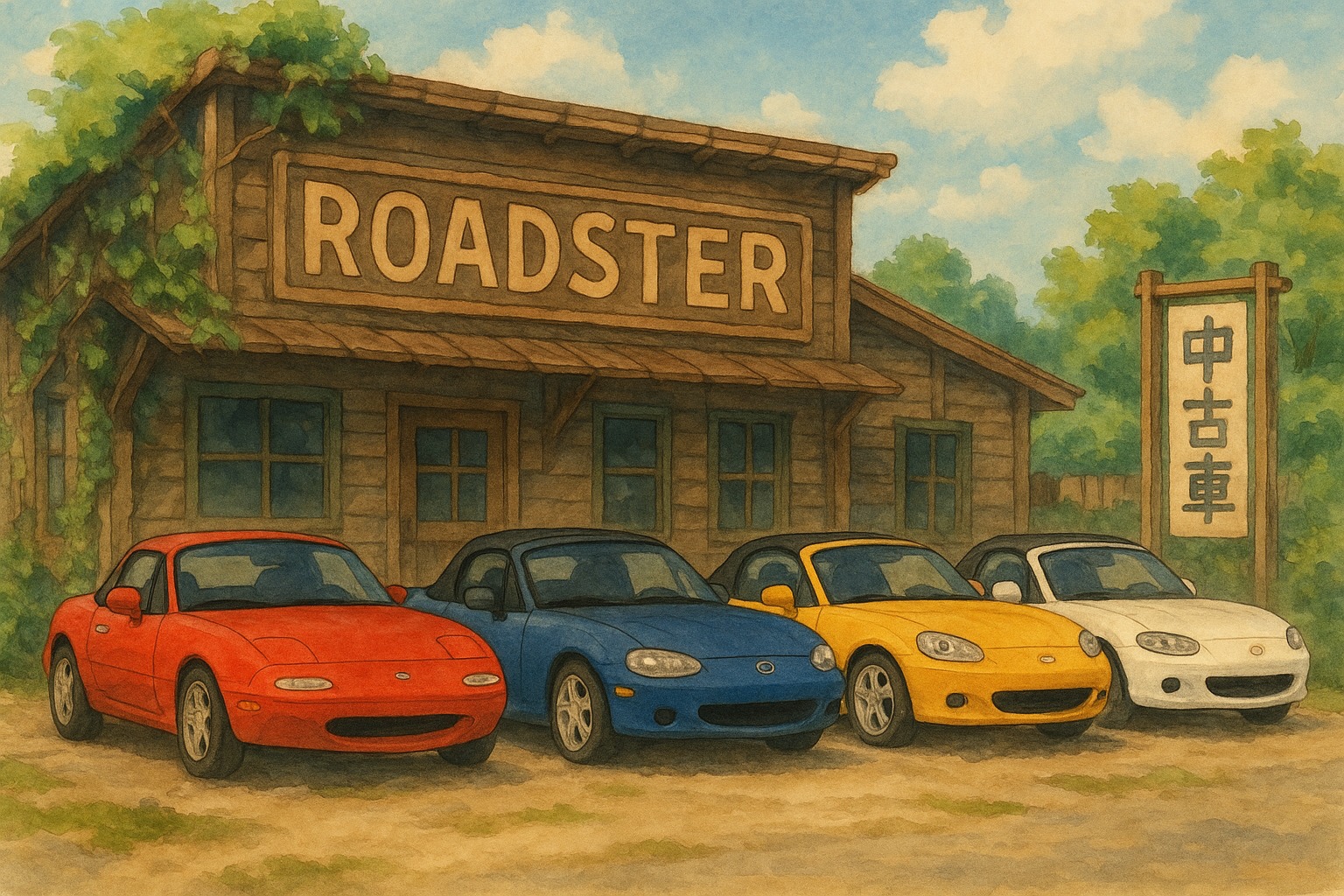
First-generation NA-type Roadster (1989–1997): The revival of lightweight sports and the “Jinba-Ittai” spirit
Born in 1989 during the height of Japan’s bubble economy, the first-generation Roadster (Eunos Roadster) brought back the joy of a small open sports car for the modern era. The development team embraced the concept of “Jinba-Ittai” (the unity of horse and rider, a sense of control where driver and machine become one), adopting a genuine sports car layout: a lightweight body weighing 940 kg, double-wishbone suspension front and rear, and a power plant frame that integrated the engine and differential. Through these efforts to create an “affordable and enjoyable sports car,” they achieved a pure driving feel where “driving is simply a pleasure,” and that DNA has been passed down continuously to today’s ND-type model.
At the time, stricter safety and emissions regulations had driven small open sports cars toward extinction, but the NA Roadster became a global hit as soon as it went on sale. It was sold as the “Mazda MX-5 Miata” in North America and “Mazda MX-5” in Europe, and by 1990, automotive magazines were unanimous in praising it with lines like “you won’t regret buying it.” Within ten years of its release, by May 2000, cumulative production surpassed 530,000 units, and it achieved the remarkable feat of being recognized by Guinness World Records as “the best-selling two-seater small open sports car in the world.” Production numbers continued to climb afterward, and in April 2016, cumulative production broke through one million units, celebrated with commemorative events. The NA Roadster, which opened up a new frontier as an affordable, reliable sports car with easy access to parts, was truly a phenomenon worthy of the word “miracle.”
Second-generation NB-type Roadster (1998–2005): Steady evolution and refined excellence
The NB-type Roadster that debuted in 1998 inherited the fundamental design of the first generation while refining the details. The headlights became fixed, the styling gained more pronounced character and a more robust appearance. The soft top’s rear window evolved from vinyl to glass, trunk capacity increased, and everyday usability improved.
The engine lineup expanded to 1.6L and 1.8L, with the 1.6L engine making a comeback after disappearing in the late NA era. The 1.8L received a variable intake system and later S-VT (variable valve timing), and options now included a 5-speed manual transmission (1.6L), 6-speed manual transmission (1.8L), and 4-speed automatic, offering a wide range of configurations to meet diverse customer needs. Although the chassis retained its basic structure from the NA-type, reinforcements throughout the body and changes to suspension geometry optimized the roll center and improved handling. In short, the NB-type preserved the first generation’s “nimbleness” while enhancing rigidity and refinement.
Third-generation NC-type Roadster (2005–2015): Adaptation to the times and new directions
The NC-type Roadster, launched in 2005, represented the first major overhaul of the basic platform. It adopted a newly designed platform that shared part of its chassis with the RX-8, and the overall width expanded to 1720 mm. In Japan, it became a 3-series model for the first time in Roadster history (overall width exceeding 1700 mm), meeting enhanced crash safety standards and improved interior space. In design, the “waist” or coke-bottle curve between the front and rear wheels that had been a tradition through the NB was discarded in favor of a smooth, sculpted surface that leveraged the wider track.
The engine lineup also changed, shifting from the conventional B-series to the new-generation “L-type” engine. Engine displacement became 2.0L across all markets, including Japan. The Japanese-market version offered a newly developed 6-speed manual transmission, as well as a 5-speed manual and 6-speed automatic for diverse buyers. Tire size was also expanded to 17 inches as standard, and the rear suspension changed from the traditional double-wishbone to a new multi-link design while the front suspension retained its double-wishbone configuration.
In 2006, a retractable hardtop became available as an option—the “Power Retractable Hardtop” (commonly called RHT)—which could open and close in just about 12 to 13 seconds. This broadened the appeal to buyers hesitant about open bodies and successfully expanded the market. The late 2000s are sometimes called the “winter season” for lightweight open sports cars, and many Japanese domestic models (such as the Toyota MR-S and Honda S2000) were discontinued, but the Roadster adapted to the times with the NC-type and continued production, sustaining this segment.
Fourth-generation ND-type Roadster (2015–present): Return to origins and fusion with latest technology
The current ND-type Roadster, which debuted in 2015, is an ambitious project guided by the development team’s goal to “bring back the sensations of the first-generation NA for the modern age.” The vehicle concept was thoroughly reinvented, introducing Mazda’s new-generation “Skyactiv” technology and design theme “Kodo” (soul of motion) to the Roadster. It achieved a dramatic weight reduction of over 100 kg compared to the previous NC generation, while body dimensions reverted to a compactness approaching the NA-type.
The powertrain uses the latest-generation direct-injection gasoline engine, the “SKYACTIV-G.” The initial Japanese-market model features a 1.5L inline 4-cylinder DOHC engine with a 13.0 compression ratio, paired with either a 6-speed manual or 6-speed automatic transmission. Design-wise, a low, assertive nose and a sleek fastback silhouette create “proportions that let the driver stand out,” and from its launch, it generated significant buzz as “shedding light and hope on the modern lightweight sports car segment.”
At the end of 2016, a new derivative model called the “Roadster RF (Retractable Fastback)” was added to the ND lineup. Featuring a power-operated hardtop and a sleek roof line reminiscent of a coupé, this model attracted major attention both domestically and internationally from the moment of its announcement. The roof mechanism was further refined from the previous-generation RHT, with a unique structure where the central roof section retracts electrically, combining the best of both open and coupé designs. The Roadster RF is prized for minimal wind noise and high refinement during driving, winning support from long-distance touring enthusiasts and opening up new Roadster customer segments.
Derivative models in the spotlight: The Coupé and RF today
Finally, let’s take a look at two distinctive limited and derivative Roadster models that shine with their own character: the “Roadster Coupé (NB-type based)” and “Roadster RF (ND-type derivative),” examining their attention level and presence in the used-car market.
Ultra-rare vehicle: Roadster Coupé (NB-type based)
The Roadster Coupé was displayed as a concept at the 2003 Tokyo Motor Show, after which limited sales began in October of that year. Based on the NB-type Roadster but fitted with a fixed roof as a two-door coupé body, development and production were handled by Mazda E&T, Mazda’s special vehicle division. Total production across four model variations was a mere 179 units, making it an exceptionally rare model. The new-car selling price at the time was approximately 2.35 to 3.10 million yen depending on trim, but today on the used-car market, a premium above the original retail price has attached itself due to its rarity. The circulation of used units is extremely limited, and listings on used-car information sites don’t always show inventory available—a truly “phantom car.”
A semi-open breakthrough: Roadster RF (ND-type derivative)
In contrast, the Roadster RF, which appeared in the ND generation lineup, debuted as a mass-produced model and is now widely available in the used car market. The RF (Retractable Fastback) is, as mentioned earlier, an electric hardtop Targa-top style model that launched in the winter of 2016. While the roof rear has the shape of a fastback coupe, the concept of having “the best of both worlds”—where the center roof retracts at the push of a button to provide an open-air feeling—gained support. In practical terms, it also offers advantages that a soft top lacks, such as improved body rigidity and high levels of security and quietness, earning it a new fan base as an “easy-to-use-daily Roadster.”
Because the Roadster RF is not a limited edition, there are relatively abundant inventory numbers in the used car market. Looking at used car prices, around 700 units have been traded over the past year, with the main price range being 2.2 to 3.2 million yen.
The “Miata” culture spreading overseas: why it continues to be loved and famous sayings
The Roadster (Miata) has built its own car lifestyle culture not only in Japan but also overseas. Particularly in America, its largest market, it has gained overwhelming support as an “affordable and fun sports car.” When it first launched, American automotive media universally praised the Miata, and many enthusiasts chose it as their “first sports car in life.” As a result, the Miata became so popular that it was Guinness certified as the “world’s best-selling sports car,” and a joke emerged: “if you’re unsure what to answer, just say Miata.” In fact, the internet slang phrase “Miata Is Always The Answer,” which became famous, is said to have become established overnight. This is evidence of just how much the Roadster became the “byword for an affordable, reliable sports car that anyone can enjoy.”
The MX-5 (Roadster) is also greatly beloved in Britain. The UK was once the home of small-displacement sports cars, but after the decline of its own manufacturers like MG and Triumph, the MX-5 was welcomed as an inheritor of that spirit. Among longtime Roadster enthusiasts in Britain, there are many voices saying “the Miata perfectly inherits the lightweight spirit we once loved,” while some have jokingly remarked that “a sports car that hardly ever breaks down lacks charm.” However, on the whole, the more prevalent positive opinion has been “removing the risk (of breakdown) from the romance (fun) is simply the best,” and the MX-5 is loved by men and women of all ages in Britain. In fact, MX-5 Owners’ Clubs in the UK and other European countries are extremely active, regularly hosting large-scale meetings and touring events. For example, at the MX-5 30th Anniversary event held at Laguna Seca in the US in 2019, owners from around the world gathered, and a performance was conducted where they formed their prized Roadsters into the alphabet “MX-5” and the number “25” (commemorating the 25th anniversary). In this way, the Roadster/Miata is a “symbol of happy car life” that is common worldwide, and it has many fans among celebrities. The late actor Paul Newman is known to have driven a race Miata, and former F1 champion Jenson Button was known to have owned an NB model for personal use. The reason the Roadster continues to be loved in various countries comes down to the fact that “pure fun that never betrays car enthusiasts” is recognized as a universal value.
Contribution to grassroots motorsports: one-make racing and expansion of entry-level users
Another major value created by the Roadster is that it “created an environment where anyone can easily enjoy motorsports.” With its affordable price and easy-to-handle characteristics, the Roadster is ideal as an entry-level machine for Sunday races, gymkhanas, circuit driving events and the like, supporting grassroots motorsports around the world.
In Japan, there is a JAF-sanctioned one-make race called the “Roadster Party Race,” which started in 2002. This is a racing series that uses the Roadster’s motorsports-exclusive grade “NR-A” and competes with vehicles bearing public road registration numbers. It has gained popularity due to its accessibility—despite being a sanctioned race, you can participate with a vehicle that passes inspection—and it continues to be held through the 2020s. The Roadster Party Race is said to have the longest history of any one-make race in Japan, with annual series races taking place at Tsukuba Circuit and Fuji Speedway. There have been events where as many as 54 Roadsters filled the grid, and due to this thriving scene, it has been featured in automotive media as a “traditional race.” Grassroots races called “Roadster Cup,” organized by regional clubs, are also held throughout the country, and Roadster races with registration numbers have long been enjoyed as a category of the Fuji Champion Race.
Overseas, there is also a major Roadster racing scene. Among these, America’s “Spec Miata” is famous—a clubman race competed in with Roadsters (NA/NB models) that have undergone minimal modifications. It exploded in popularity due to its affordability and close-racing excitement, and Spec Miata has grown into the most-participated club racing category in the entire United States. At races held by major organizations such as the SCCA (Sports Car Club of America) and NASA (National Auto Sport Association), entry numbers consistently rank among the highest classes, and it has been called “America’s most popular amateur racing series.” In fact, the Spec Miata class at the 2024 SCCA National Championship Runoffs had a record high of 88 entries, with only the top 72 qualifying cars able to start the final race—that’s how fierce the competition was. In this way, the Roadster has become “the best choice for people who want to start racing” around the world, and many professional drivers actually come from Roadster Cup backgrounds. With its low cost, durability, and abundant tuning information, the Roadster is truly the foundation of grassroots motorsports culture.
Rising asset value of the first-generation NA Roadster and comparison with rival models
The first-generation NA Roadster, which debuted over 30 years ago, has been experiencing a gradual rise in used-car values in recent years. The NA, once the “go-to affordable used sports car,” is now appreciating in price as well-conditioned examples become scarce and collector demand grows. For example, in North America, low-mileage NA Roadsters in pristine condition have fetched over $30,000 (roughly ¥4,000,000) at auction sites, sometimes exceeding the price of a new MX-5. According to a survey by insurance giant Hagerty, the transaction price for NA Roadsters in top condition (the so-called “Concours” level) reached close to $32,000 as of 2021, with analysts noting that “the first-generation Miata is no longer entering the ‘affordable’ category.” That said, tongue-in-cheek analysis also notes that “if you don’t look too hard, you can still buy beat-up examples for around $1,500 (tens of thousands of yen),” making it “still a relatively accessible classic” compared to other 1980s–1990s Japanese sports cars.
The appreciation of NA Roadster prices is equally pronounced in Japan. According to one source, the average hammer price at dealer auctions for NA models as of 2024 is approximately ¥1,410,000, with a median of ¥1,370,000. The average mileage is about 90,000 km, but for single-owner, low-mileage examples in pristine condition, asking prices above ¥2,000,000 are not uncommon, and some vehicles command premium prices exceeding the original retail price at launch (around ¥1,800,000). Mazda itself responded to this enthusiasm by launching the “NA Roadster Restoration Service” in Japan in 2017. This paid service restores customers’ NA Roadsters to like-new condition at Mazda’s headquarters, including body repair and repainting, interior refresh, and engine overhaul. While the cost is not insignificant at approximately ¥5,000,000, the stream of applications demonstrates that an increasing number of owners view the first-generation Roadster as a “classic car with asset value” worthy of careful preservation.
This NA Roadster reappraisal is particularly interesting when compared with other Japanese sports cars of the same era. Take Honda’s S2000 (launched in 1999): owing to its limited production numbers, used prices have been rising steeply from early on. According to specialist dealership reports, early S2000 models (AP1) rarely sell for under ¥2,500,000, while later models (AP2) routinely command ¥4,000,000–¥4,900,000, with some reaching ¥5,000,000–¥6,000,000. It commands a premium price in the domestic sports car market, an entirely different category from the Roadster NA. With used S2000 prices running more than three times higher than the Roadster, the Roadster’s value for money stands out as an “affordable open sports car.” Meanwhile, Toyota’s MR-S (launched in 1999) is a mid-engine two-seater contemporary with the Roadster, but due in part to weak sales when new, its used prices have remained relatively low and stable. As of 2025, the average used price for an MR-S is around ¥1,120,000, lower than the NA Roadster average (mentioned above as around ¥1,400,000). While the MR-S enjoys support among enthusiasts as a “hidden gem,” it has not achieved the broad popularity of the Roadster, and production ended in 2007, so future appreciation is expected to be gradual. This comparative analysis with other models underscores just how much the first-generation Roadster’s rarity value and brand strength have come to the fore in recent years.
Latest Roadster generation-by-generation price report
1. Introduction
Beloved for over 35 years from the first-generation NA to the current ND.
Good Loop has independently compiled data on approximately 3,600 vehicles traded at national auctions over the past year. Here we offer a compact overview of generation-specific price trends and “buying tips.”
| Generation | Units traded | Average price | Median price | Average mileage |
|---|---|---|---|---|
| NA (1989-97) | Approximately 100 units | ¥1,410,000 | ¥1,370,000 | 89,000 km |
| NB (1998-05) | Approximately 200 units | ¥600,000 | ¥530,000 | 93,000 km |
| NC (2005-15) | Approximately 600 units | ¥840,000 | ¥750,000 | 78,000 km |
| ND (2015-) | Approximately 2,000 units | ¥1,900,000 | ¥1,910,000 | 39,000 km |
| ND RF (2016-) | Approximately 700 units | ¥2,230,000 | ¥2,180,000 | 34,000 km |
2. Generation highlights
■ NA type (1989–1997)
- Collector demand on the rise year after year.
- 1.6 L vs. 1.8 L: average +14%.
- 5-speed MT with low mileage plus limited color and trim command ¥2,000,000–¥3,000,000.
- AT models hold steady in the budget range (¥800,000–¥1,100,000).
Best bet: 1.8 L V Special with high originality.
■ NB type (1998–2005)
- Affordable with plenty of inventory still available.
- RS (6MT 1.8 L) holds steady around ¥1,000,000.
- AT / over 100,000 km: from the ¥300,000 range.
Best bet: RS and SP 6MT models with under 80,000 km.
■ NC type (2005–2015)
- Prices split by roof type.
- Soft top: ¥400,000–¥900,000
- Power retractable hardtop: ¥800,000–¥1,400,000
- 6MT averages ¥380,000 more than AT.
Best bet: RS RHT 6MT with factory BBS wheels (good potential for future appreciation).
■ ND type (2015–)
- Price spread of approximately ¥400,000–¥600,000 depending on trim (S series / NR-A / 990S).
- Early models have dipped toward ¥1,600,000 due to higher volume, while 990S models remain firm.
Best bet: low-mileage NR-A / 990S. - RF ranges approximately ¥2,200,000–¥3,200,000, 6MT adds ¥200,000 over AT
Best bet: RS 6MT
3. Summary – Buying guidelines
| Purpose | Recommended generation | Price range* | Key considerations |
|---|---|---|---|
| Collection / Asset value | NA 1.8 L limited edition | ¥2,000,000–¥3,500,000 | Originality and under 50,000 km |
| Weekend hobby + future appreciation | NB RS 6MT | ¥800,000–¥1,200,000 | History, undercarriage rust, factory condition |
| Value-focused, daily use | NB AT / NC AT | ¥300,000–¥700,000 | Service history, engine condition |
| Latest model with newest features | ND | ¥1,700,000–¥2,600,000 | Warranty transfer, no accident history |
*Prices are rough guidelines based on hammer price trends. Individual vehicles vary; please inquire for details.
Conclusion: The endless story woven by the Roadster
The Mazda Roadster (MX-5 / Miata) has upheld the concept of “an affordable sports car anyone can enjoy” across four generations, and its very existence has secured a place in automotive history. While each generation has evolved in response to the demands of its era, the core philosophy of “the joy of lightweight sports driving” remains unchanged—a reason for its worldwide appeal. The lightweight open-top trend that the Roadster revived influenced competitors, spawning many followers from the 1990s onward (examples include the Toyota MR-S, BMW Z3/Z4, and Honda S2000). Yet the Roadster was ultimately “the one that lasted,” setting a milestone of over 1.2 million units produced cumulatively and continuing to add to that record.
In recent years, the first-generation NA model has been reevaluated as a classic car, and the Roadster shines with dual appeal both as a new vehicle and as a used car. While factory-restored NAs command premium prices, the current situation where the latest ND models can be acquired at bargain prices tells the story of the Roadster’s depth of character. From young people newly taking the wheel of a Roadster to veterans who lovingly restore and cherish the classic NAs of old, the fact that people of all ages can engage with it in their own way speaks to the beauty of Roadster culture.
More than 35 years have passed since the 1989 miracle of “the revival of lightweight sports cars.” The Roadster will continue to symbolize a happy relationship between people and automobiles—in garages around the world, under the open sky, on the racetrack. Its story is not yet finished. The Roadster remains that one car that is “always the answer for car lovers of every era.”
Good Loop owns Roadster models as research and development vehicles, and you can consult with us about detailed specifications and tuning for each model. Feel free to contact us for information on the latest used car market prices as well. We will propose the perfect car to match your preferences and budget.