
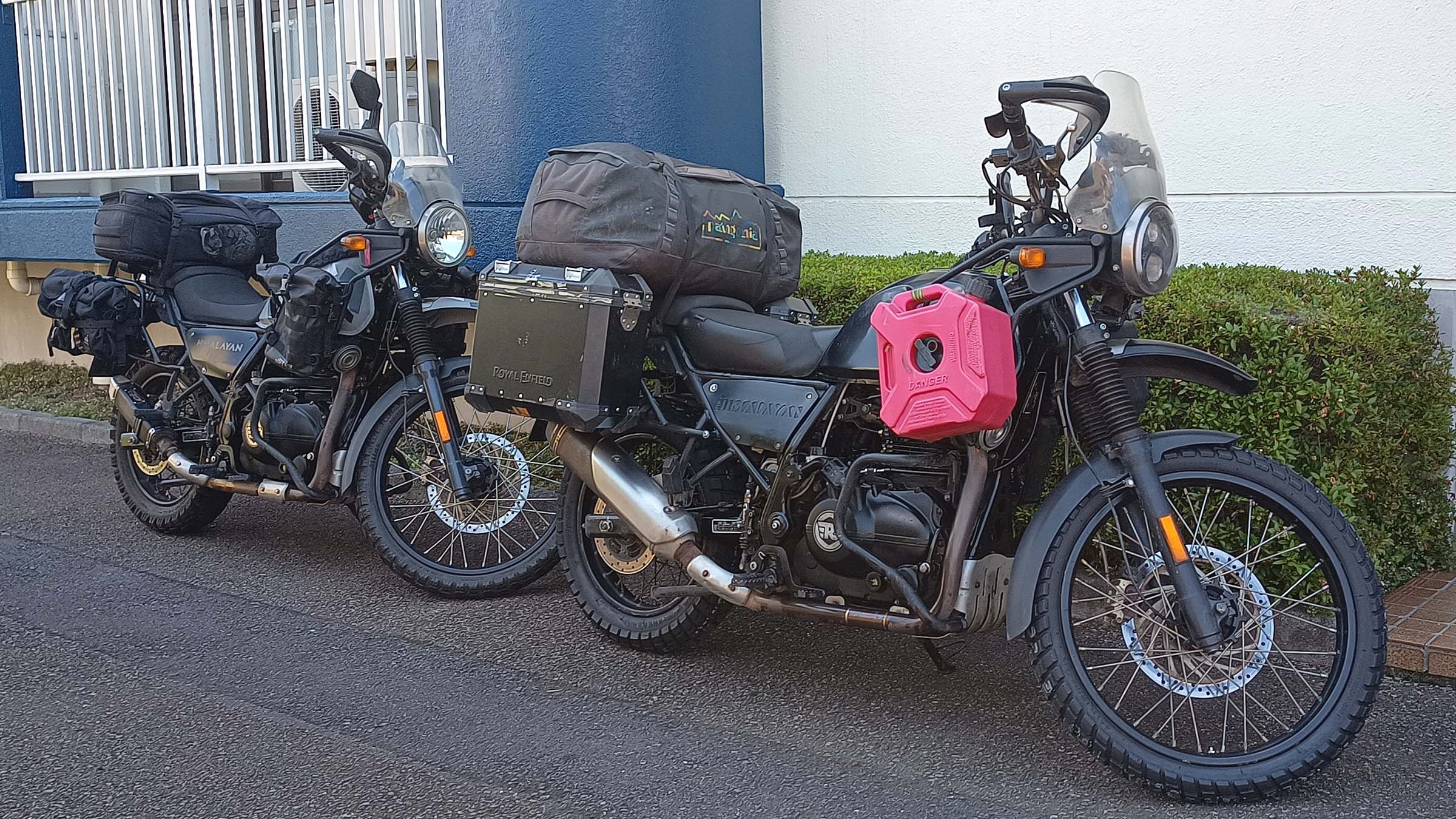
Not long ago, Good Loop received an interesting request. A rider who had ridden a Royal Enfield adventure motorcycle, the Himalayan, all the way from Europe to Japan wanted to export the beloved machine to his home country. Witnessing a motorcycle that had completed a great continental crossing (a journey of intercontinental scale), I have to admit I was genuinely surprised: “How on earth did he cover all that distance on such an old-fashioned bike?” Because I usually ride high-powered, lightweight machines like the KTM 690, I had preconceived notions about the Himalayan being retro and underpowered. But when I actually took it for a test ride, I discovered that the motorcycle possessed far more unique charm than I’d imagined. In what follows, I’d like to introduce the appeal of the Himalayan to riders pursuing a great journey, both objectively and with genuine enthusiasm.
The Royal Enfield Himalayan is a serious dual-purpose model with a single-cylinder engine that debuted in 2016. India’s storied manufacturer, which had stayed the course with classical styling until then, made a complete 180-degree turn to release this bike, distinguished by its simple and sturdy style that stands in stark contrast to heavyweight adventure motorcycles that rely on excessive electronic controls. With a reasonable price point, low maintenance costs, a full lineup of genuine accessories, and a well-thought-out luggage system for safely carrying cargo, it attracted considerable attention when it first launched. After the initial buzz died down, riders began to emerge who purchased this bike and set out on long journeys, and their firsthand accounts tell the real story of how it’s valued. This article explores what the Himalayan means for riders with a great journey mindset—that is, riders aiming for large-scale overland travel—drawing on the experiences of those who have actually tackled continental crossings on this bike, and delves into its appeal and realistic capabilities.
Why India loves it and the world is paying attention
Any discussion of the Himalayan must include its enormous popularity in India, its birthplace. Royal Enfield is now headquartered in India and holds a world-class market share in classical mid-displacement motorcycles. The Himalayan in particular has established itself as India’s “everyday adventure touring bike,” receiving enthusiastic support from Indian riders since its launch. During my own travels through India, I was struck by the sight of Royal Enfield motorcycles everywhere, from city streets to the foothills of the Himalayas. In fact, the Himalayan has become a major success in the Indian market and is now one of the nation’s iconic motorcycles, with its reputation spreading overseas in recent years.

The reason the Himalayan is so beloved comes down to what I mentioned earlier: it offers comfort that doesn’t tire you out over long distances and the capability to handle rough terrain, while remaining accessible in price—an “life-size” adventure bike, if you will. It’s unpretentious and easy to handle, which suits India’s road conditions well, and it gives many riders a sense of familiarity: “with this machine, I can make a journey happen too.” In fact, Royal Enfield itself hosts the Himalayan Touring Events (such as the Himalayan Odyssey), which draw participants from India and abroad, positioning the Himalayan as “a welcoming bike that gives you the push to begin an adventure”.
From India to Europe: Itchy Boots’ 36,000-km great adventure
Dutch woman rider Noraly Schoenmaker (nicknamed Itchy Boots) purchased a Himalayan in India and set out on a journey from northern India through Southeast Asia to her home in the Netherlands. In eight and a half months, she covered 25 countries and 36,000 kilometers, and the “Itchy Boots” nickname became widely known among adventure riders. Noraly herself says “no major breakdowns occurred during the journey,” but that doesn’t mean there were no minor troubles. For example, after 17,000 kilometers of riding in the Iranian mountains, she burned out the clutch plate, but fortunately she was carrying a spare and was able to replace it easily herself, as she recalls with pride. Some factory parts do seem to have weaknesses: the steering head bearing needed replacement at 8,000 kilometers, and then loosened again about 9,000 kilometers later, so she replaced it again. During the second replacement, she was in Kazakhstan, but she managed to find a compatible bearing in the local market and got through without incident. As for tires, she felt the stock Indian tires (CEAT brand) had weak grip and weren’t up to the job, so she switched to new ones after 1,100 kilometers, then continued with her favorite Pirelli MT60 (which comes standard on Himalayans sold in Europe and North America). She also mentioned complaints like “the seat is too soft,” “the windscreen is too low,” and “the main stand reduces ground clearance,” but she says “those are minor issues, nothing serious.”
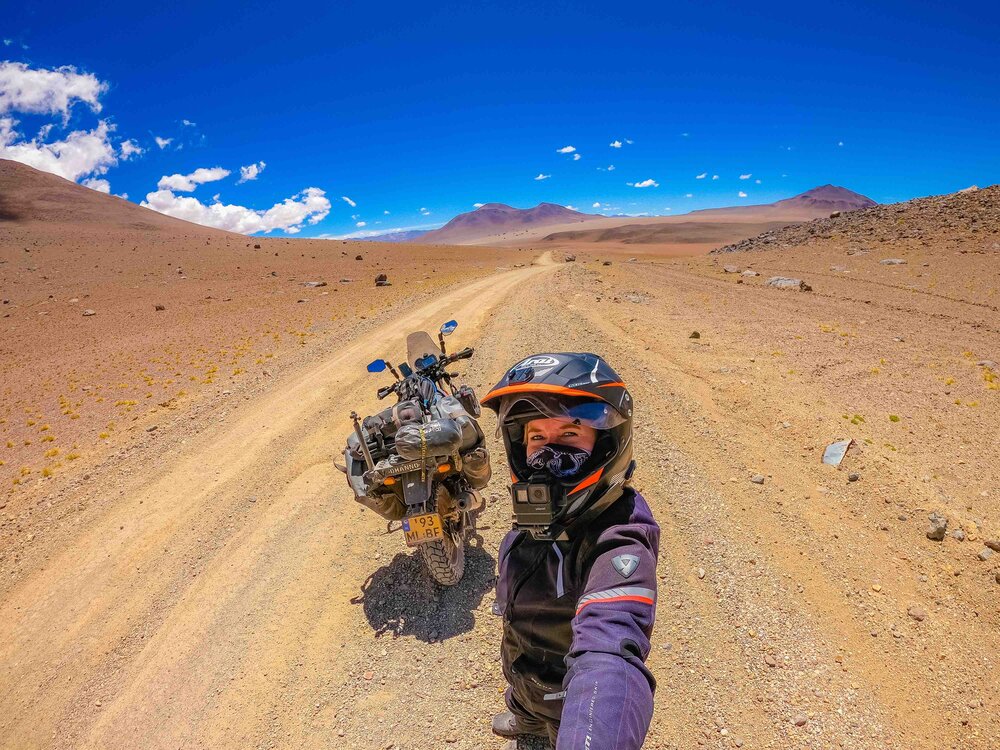
Noraly was attentive to maintenance and care, covering roughly 40,000 kilometers of rough road with zero critical failures. Her meticulous maintenance routine—”replace parts before they break,” “change engine oil every 3,000 kilometers even in remote places where only poor-quality oil is available”—helped keep the machine running strong. Her reason for choosing the Himalayan was straightforward: first, “it’s affordable.” You don’t need to sink a fortune into an expensive large-displacement adventure bike; with this one, you can travel just as far, and the money you save can go toward more adventure. Additionally, the fact that it’s “tough and easy to handle” was crucial. Even though she dropped it several times, it was light enough for her to pick up herself, and it was durable enough for any remote area and easy to maintain. Because of its low-tech structure that doesn’t rely on electronic controls, “even a mechanic in a back alley in a foreign land won’t hesitate to open up the engine”—this was a major source of peace of mind during the continental crossing. On the other hand, it’s not ideal for trips focused on highway cruising, and she frankly admits “sure, I wish there was more power. If you were only going to ride on highways, you’d be disappointed.” Yet she adds “if you’re taking back roads, the current output is no problem at all and really enjoyable,” and indeed her actual journey was completed on this one machine, traveling endless local roads from the Himalayas through the Middle East to Europe.
A young British rider circumnavigates the world on the Himalayan

This British rider named Jack departed from London in July 2019 at age 21. He crossed the European continent, passed through the Balkans into Turkey, and continued on to Central Asia. He crossed the Caspian Sea by ferry, rode through Turkmenistan, Tajikistan, and Kyrgyzstan, and took on the legendary Pamir Highway route. During his crossing of China, he battled through complicated travel procedures (the so-called red tape), but made it all the way to Laos, Thailand, and Malaysia in Southeast Asia. In the second half of his journey, he also crossed the Australian continent. During the Australian summer, he was exposed to forest fires said to occur only once in several decades, pushing forward from the Nullarbor Plain to Sydney through scorching air. It was an extreme situation where the rider himself had to pour water over his head to continue, but the Himalayan still carried on as his companion. He then traveled to South America, spent a month traversing Patagonia, and headed north from Argentina along the famous Route 40 along the Andes into Bolivia. When he reached La Paz, Bolivia at an elevation of 3,400 meters in March 2020, a wave of global pandemic swept the world and rumors of border closures began in various countries. He hastily headed to Peru and slipped into Cusco, the ancient capital of the Incan Empire, but immediately after, a nationwide lockdown was imposed, forcing him to stay put. He then endured about nine months of waiting in Cusco, but without giving up, he resumed his journey from the end of 2020. With the help of the British Embassy, he passed through Peru, Ecuador, and Colombia, traversed Central America, and headed north to Mexico. He skipped North America (the United States) due to the situation and instead returned to Europe first, and in 2021, completed his final leg running with his father and triumphantly returned to London, achieving his round-the-world trip. When viewed in global coordinates, this route circles the earth perfectly, and the Himalayan supported his challenge to the very end over two years.
Fortunately, during Jack’s grand journey, no serious mechanical troubles with the Himalayan were reported. The Himalayan he purchased secondhand before departure was thoroughly equipped, and maintenance to withstand the long journey appeared to be meticulous. There was a strange accident that occurred before departure—being thrown forward while gripping the handlebars (the front wheel lifted and he crashed at Dover in England just before departure)—but with only light injuries, he righted the machine and continued the journey. Although total mileage has not been published, his route spanned all six continents except Africa and North America, effectively proving that the Himalayan is capable of enduring a round-the-world endurance test.
The appeal of the Royal Enfield Himalayan as told by adventurers in Vietnam

In Southeast Asia too, the Himalayan is supported as a “just-right companion.” Stewart, who is involved in running a tour company in Phu Yen in central Vietnam, saw the actual motorcycle after the Himalayan’s release and immediately decided to purchase it, thinking it was “perfect for what I was looking for.” He has ridden the Himalayan over 4,000 kilometers, and says it “runs without issue on any terrain,” including unimproved logging roads and jungle dirt tracks. Some comment that “the seat is too soft,” but since he has a lean frame with little natural cushioning, he actually finds “that softness perfect.” In reality, compared to dual-purpose bikes from other manufacturers that tend to suffer from “plywood-like hard seats,” the Himalayan is comfortable enough to “ride all day,” and he jokingly praises it as the true “savior of the backside.” He also trusts the Himalayan’s neutral handling, saying that on both pavement and dirt, it traces the intended line firmly, and in corners it turns with ground-hugging stability. “The weight isn’t excessive, and the bike simply goes where you want it to. There’s absolutely no anxiety even off-road,” he says, and for him, the Himalayan is an ideal partner for enjoying Vietnam’s spectacular routes (such as the Ho Chi Minh Trail).
Meanwhile, Donovan (nickname Hawkmoon), who also works as a tour guide and instructor in Vietnam, chose the Himalayan among the many bikes he has ridden. “Since I took the plunge and bought the Himalayan four months ago, I haven’t regretted it once. It’s the best bike for riding in Vietnam,” he states flatly, and says he arrived at this bike after deciding he needed a single bike with consistently high performance across all regions of the country. In Vietnam, road conditions change dramatically over short distances, but the Himalayan “is comfortable on long-distance tours and off-road sections alike, and handles all road surfaces well,” he says with confidence. He’s also impressed by its practicality as a travel bike, noting that it comes standard with rear racks that can firmly secure luggage front and rear, and he has even fabricated additional side racks himself to mount waterproof saddlebags. He says he only replaced the headlight with a xenon lamp because it was too dim, but otherwise needed no modifications, and he speaks contentedly about the styling: “The look and sound are my absolute favorite.”
The value discovered by a veteran in Australia
David, a veteran rider residing in Australia, had been riding on-road bikes exclusively for many years, but when adventure touring became a boom among his friends, he began to feel “I want an adventure bike too.” However, the mainstream large models generally had high seat heights and heavy weight, which became the deciding factor for a concern he had long held. Around that time he had several opportunities to ride Royal Enfield motorcycles, and his experience touring Rajasthan (India) on a 500cc Bullet helped turn his interest toward the company’s newcomer, the Himalayan. After thorough information gathering, he learned that a specialized magazine in Australia was conducting a long-term test of the Himalayan, and he arranged to purchase the vehicle after the test concluded. The used Himalayan he acquired this way had low mileage despite having many practical custom modifications already applied. For example, it had been upgraded with quality off-road tires, fitted with hand guards, had additional DIN-standard power sockets installed, and was equipped with tank bags, side bags, and LED turn signals—all the travel-oriented improvements were included. After purchase, what he added himself was putting on a wool seat cover, refastening the side stand that had loosened and was about to fall off during riding, and repairing and replacing the stator coil (AC generator) that had seized and become unable to generate power. This stator coil burnout is an occasional issue seen in early-model Himalayans, but with proper parts replacement it didn’t become a major problem, and there have been no troubles whatsoever with major components like the engine or clutch.
David says that many of his friends ride premium adventure models like big-displacement BMWs and Triumphs. But he knows the Himalayan’s modest power well enough, and he laughs about it: “I’ll just let my buddies go ahead on the highway.” The Himalayan is most comfortable at a cruising speed of around 80–90 km/h, and it’s not good at anything faster than that. So on long straights David does fall behind the larger bikes, but he says with confidence: “In exchange, once we hit dirt roads, I’m the one who has the last laugh.” While the heavy big machines struggle in rough terrain, his lightweight Himalayan catches up. Speaking about his days with the Himalayan, he says he’s satisfied: “Life on a 411cc adventure motorcycle is wonderful.” Because of its small displacement, it gets good fuel economy and runs on regular gasoline anywhere, and the load capacity is more than adequate. He also feels that the freedom of riding hard without worry on rough roads makes the journey itself more free. One day he wants to circle the Australian continent on the Himalayan and “prove that it’s possible on this bike too,” he says, talking about his next adventure.
Conclusion: The companion for the great journey seeker
What emerges from the stories of riders who have traveled the world on a Himalayan is this bike’s solid reliability and approachability. It’s not a machine for high-speed long-distance runs, but its construction is simple and tough, and its mechanics—easy to fix on the spot if something does go wrong—are a great source of security for a traveler riding solo through unknown lands. Indeed, Noraly has run nearly 40,000 km through severe off-road riding with no major trouble, dealing with all necessary maintenance herself or with help from local mechanics. The ease of handling and comfort that many riders point out are also important points that support a great journey. The seat that doesn’t tire you even on long rides, the engine tuned for mid-to-low torque, and the bike’s weight of about 191 kg—lighter than large adventure bikes—give the rider confidence on both paved and unpaved roads. The Himalayan isn’t a high-horsepower bike by any means, but its modest power can sometimes keep the pace of travel steady, and as a result it brings peace of mind to enjoy the views and encounters along the way. Most of all, as Noraly said, “This bike is enough, and it’s because of this bike that I want to travel”—the Himalayan teaches the joy of traveling the world through a different approach than expensive cutting-edge machines. For riders with great journey aspirations, the honest appeal of the Himalayan is as rich and deep as the journey itself.
Reference materials: Experiences of riders who have ridden the Himalayan around the world
- Four Adventure Bikers Share their Experience of Life with a Royal Enfield Himalayan
- On the ODO: 20.000 km – When the world stopped spinning
- Circling the Globe on a Royal Enfield Himalayan
and related information