
Introduction
This article has been completely rewritten with information current as of October 2026. It covers both people sending motorcycles from Japan abroad and people bringing motorcycles into Japan from overseas and then taking them out again.
Let me start with costs. A temporary export-import round trip between Japan and Europe for one motorcycle costs roughly €10,000 in total. Even one way, the Japan-side expenses from Yokohama to Rotterdam run ¥500,000–600,000, with local costs around ¥200,000. International motorcycle shipping involves heavier costs and procedures than most people imagine.
There is one more thing I want to convey in this article. Japan’s export customs clearance involves operational practices that you cannot understand simply by reading the law. In particular, there is almost no accurate information about the Motor Vehicle Temporary Export-Import Declaration Form (C5014) used on international ferries and the CPD carnet (自家用自動車通関手帳). This article focuses on facts that our company has confirmed through actual dealings with the customs, ferry companies, and customs brokers.
Shipping methods and cost estimates
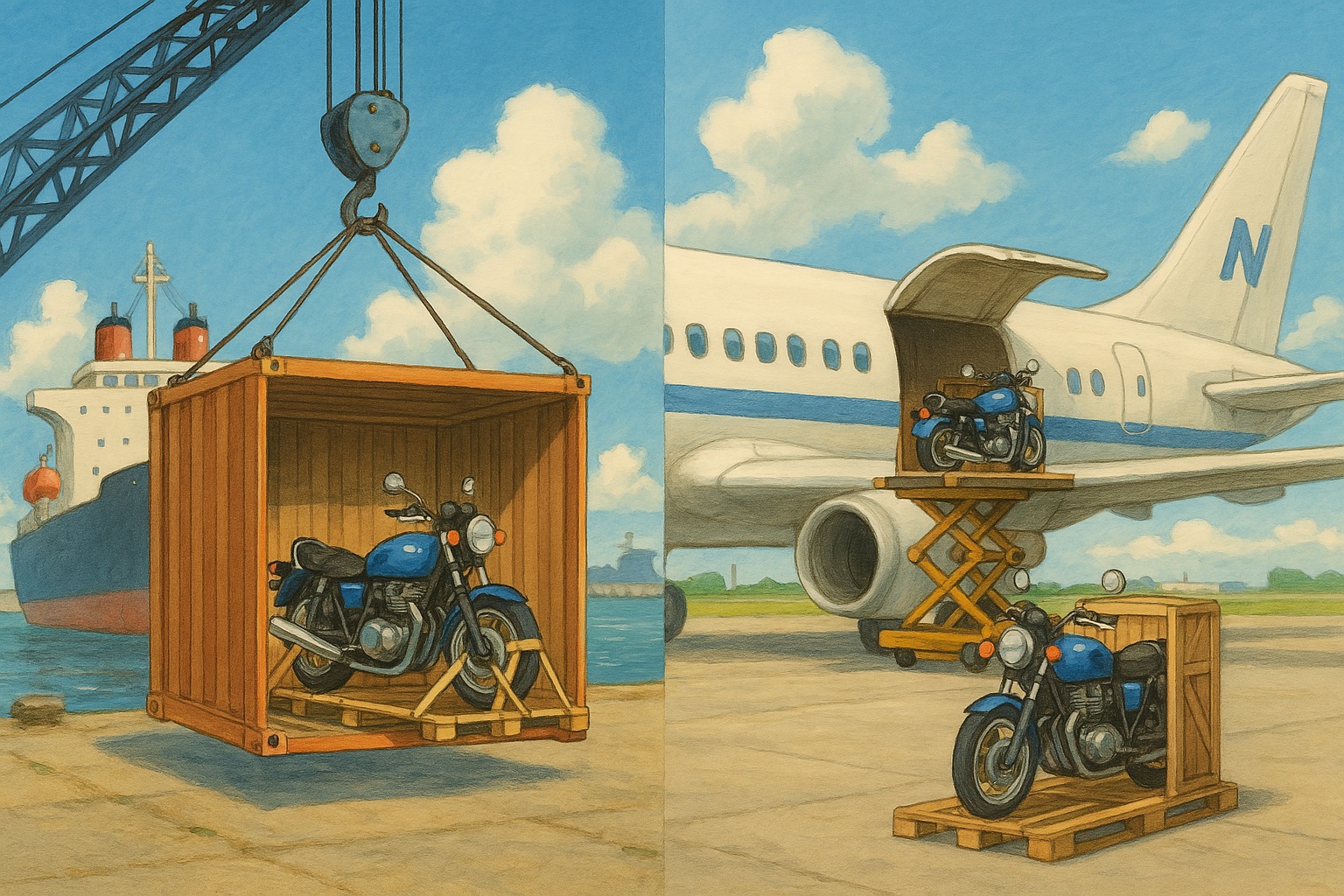
There are four realistic methods for international motorcycle transport: LCL (less than container load), FCL (full container load), international ferries, and air transport. Ro-Ro ships (car-only ships), which are standard for passenger vehicle exports, are almost never used for single-motorcycle shipments.
| Category | LCL (Less Than Container Load) | FCL 20ft (Full Container Load) | International Ferry | Air Transport |
|---|---|---|---|---|
| Cost estimate | Japan side ¥500,000–600,000 Local side approx. ¥200,000 (Yokohama to Rotterdam example) | Approximately 1,200,000 yen per van (if you load 5–6 motorcycles, the shipping cost per motorcycle is 200,000–240,000 yen. Fixed costs are separate.) | Inquire with each company | ¥1,000,000+ per unit ex-Japan |
| Lead time | Over one month to Europe (two weeks or more from arrival to shipment) | Same as above | 1–2 days | Several days |
| Packaging | Wooden crate packing | Fixed in container | Not required (self-drive) | Wooden crate or pallet |
| Features | Possible from one unit. Customs brokers often decline. | More economical when consolidating multiple units | Korea and Russia routes only. Temporary export-import via C5014 possible | Fast but expensive. Vehicle height significantly affects the estimate |
LCL (Less Than Container Load)
This is the standard method for sending a single motorcycle abroad. The motorcycle is packed in a wooden crate and loaded into a container with other cargo. Japan-side costs include wooden crate packing, collection and inland transport, CFS (Container Freight Station) intake, port fees, export customs clearance, and ocean freight. On the receiving end, costs include obtaining a D/O (Delivery Order), import customs clearance, and terminal fees.
The lead time to Europe is over one month. With two or more weeks just from intake to loading, calculate backward from your planned departure date with a generous buffer.
Consolidation exports of used motorcycles are declined by many customs brokers. They are unpopular due to the slim profit margin relative to effort, especially for individual shippers. We maintain partners who can handle this type of shipment, so please contact us if you cannot find a broker.
FCL (Full Container Load)
One 20ft container runs approximately ¥1,200,000. With a capacity of about 5–6 motorcycles, when consolidating, the freight per unit comes to ¥200,000–240,000. However, lashing costs to secure vehicles in the container add separately depending on the number of units, so it is not a simple division. Still, it usually works out cheaper than LCL and suits group tours or when consolidating multiple vehicles headed the same direction.
International Ferry
International ferries connecting Japan with Korea and Russia have routes where motorcycles can be self-driven aboard. Routes and fares vary, so please contact each company directly.
- Sakaiminato–Donghae (Korea)–Vladivostok: Eastern Cruise & Ferry (Eastern Dream)
- Hakata–Busan: Camellia Line
- Shimonoseki–Busan: Kansai-Busan Ferry
- Osaka–Busan: Panstar Ferry
The main conditions for temporary export via international ferry from Japan are as follows:
- Round-trip reservations are mandatory; open-jaw bookings for the return trip are not available. Temporary export-import procedures are possible only on the same route.
- Cargo other than vehicle equipment and accessories is treated as separate freight. Upon entry and exit, all items in the vehicle may be removed and inspected.
- Upon return to Japan, your vehicle undergoes random X-ray inspection. You pay the actual cost of transporting the vehicle to the inspection site.
- Reservations should be made one month before boarding, and document submission should be two weeks before.
Fares are determined by cabin class and vehicle type, with customs brokerage fees on the Japan side, duty-free procedure fees on the Korea side, and Korea’s automobile insurance premiums added.
International ferries have a system (C5014) that allows temporary export-import without using a carnet. However, operational restrictions apply, and it may not be available if you are not making a round-trip crossing. For details, see “Temporary Export-Import Systems and Actual Operations” below.
Air Transport
Delivery in several days, but costs ¥1,000,000+ per unit from Japan. If your vehicle does not fit within air container (ULD) height, it requires dedicated freighter handling, and the estimate jumps significantly. Tall vehicles like adventure bikes need special attention. This is an option for emergencies or when time takes priority over cost.
Temporary Export-Import Systems and Actual Operations
A vehicle used for overseas touring is handled as a “temporary export-import”—sent abroad for a set period and returned to the home country later, not exported permanently. The two relevant systems involving Japan are the CPD carnet and the Motor Vehicle Temporary Export-Import Declaration Form (C5014). I will first explain their legal position, then their actual operation.
CPD Carnet (Carnet de Passages en Douane)
The CPD (Carnet de Passages en Douane) is a customs document based on the “Customs Convention on the Temporary Importation of Private Motor Vehicles” (1954, New York). Under FIA/AIT guarantee, vehicles moving between signatory countries can be temporarily imported duty-free. Japan’s domestic law is the “Law on Special Provisions concerning the Tariff Act in Implementation of the Customs Convention on the Temporary Importation of Private Motor Vehicles” and its enforcement ordinance.
- Japan’s issuing authority is the JAF (Japan Automobile Federation). The issuance fee is ¥30,000 for a five-voucher book and ¥46,000 for a 25-voucher book (¥6,000 discount for JAF members). Issuance normally takes about one month from application.
- The validity period is one year.
- Foreign issuing authorities by country can be checked at carnetdepassage.org.
- If you enter Japan on a CPD carnet issued abroad, JAF certification is required. Certification is by advance reservation. JAF certification window list (English)
Motor Vehicle Temporary Export-Import Declaration Form (C5014)
Private motor vehicles crossing between Japan and foreign countries on international ferries can be temporarily exported and imported duty-free using Customs Form C No. 5014 “Motor Vehicle Temporary Export-Import Declaration Form” separately from a carnet. The basis is the Notice “Customs Procedures for Private Motor Vehicles Exported and Imported Using International Ferries” (Customs Notice No. 849).
- Temporary import: Create two copies of C5014 and file them with customs. Upon approval, one copy is issued as an import permit, which you will need for re-export.
- Re-export: Submit the import permit as an export declaration. It receives an export approval stamp and becomes an export permit.
The schedule to the notice defines the range of spare parts, attachments, and equipment that may be brought in duty-free as follows:
| Item | Description | Quantity |
|---|---|---|
| Spare parts | Wheels (with tire) | The quantity the motor vehicle normally carries as spares |
| Consumable spare parts such as spark plugs, fan belts, and fuses | One (or, where the same item is used simultaneously in multiples, up to the number used at the same time) | |
| Accessories | Head rests, safety seat belts, and the like | Items for the safety protection of occupants that are mounted on a passenger vehicle |
| Air conditioners, heaters, radios, televisions, stereos, and the like | Items incorporated into a passenger vehicle by means such as snap-fitting or screw attachment | |
| Equipment and other items | Tools necessary for maintenance and upkeep of the motorcycle (including jack, tire gauge, etc.) and other items (car washing brush, feather duster, wax, etc.) | 1 item or 1 set (tools) |
| Items necessary for safe operation of the motorcycle (warning lights, flares, etc.) | 1 item | |
| Cushion, floor mat, seat cover, etc. | Items in use | |
| Automotive fuel | Fuel in the built-in tank (up to tank capacity) and auxiliary fuel container (18L), approximately 1 |
The ATA carnet and CPD carnet are different things
There are two types of carnet customs documents: the ATA carnet and the CPD carnet. Many people in the logistics industry have only handled ATA carnets and are not familiar with how to use CPD carnets. Even if a business says “we understand carnets,” they may not know the procedures specific to the CPD. When requesting a business to handle your shipment, always make sure to tell them it is a CPD carnet.
| ATA carnet | CPD carnet | |
|---|---|---|
| Governing Treaty | ATA Convention (1961), Istanbul Convention (1990) | Customs Convention on the Temporary Importation of Private Motor Vehicles (1954) |
| Coverage | Commercial samples, professional equipment, exhibition and event goods | Road-going private vehicles (motorcycles, cars, camper vans) |
| Japanese Issuing Authority | Japan Commercial Arbitration Association (JCAA) | JAF (Japan Automobile Federation) |
| International Guaranteeing Organization | International Chamber of Commerce (ICC/WCF) | FIA/AIT |
| Typical Vehicle Examples | Racing vehicles or display vehicles shipped back and forth as cargo | Travelers temporarily export and import vehicles they ride themselves |
Rally Japan competing vehicles are a typical example of vehicles imported under ATA carnet that travel on public roads. The vehicles are imported as cargo and require a separate temporary operation permit (temporary license plate) to drive on public roads. For travelers who ride into the country and ride out, you use the CPD carnet.
Practical operation (1): Treat C5014 as exclusively for round-trip ferry use
Customs Notice No. 849 defines procedures for vehicles that “are exported and imported using international ferries.” Customs explained to us that it is “in principle, for entry and exit by ferry.” In practice, these points are critical:
- If the vessel is not used for a round trip, the customs branch will require a CPD carnet. If you plan to enter by ferry and then leave from a different port by container or air freight, C5014 may not be accepted at the time of entry. Ferry companies provide guidance in accordance with directions from the customs branch.
- Operations differ by customs office.Kiyonago Customs Office does not permit temporary imports under C5014 on the assumption of re-export by means other than ferry. At other ports, there is a record of operations being permitted where a vehicle that entered under C5014 is exported with a regular export declaration attached to the C5014, and tax exemption is confirmed by having the customs office at the export location notify the customs office at the entry location. Our company has experience exporting vehicles that entered by ferry using this operation with containers. However, decisions are made on a case-by-case basis, and approval is not always guaranteed.
- You may be asked to provide collateral.Under the provision of Article 13, Section 3, applied by Article 17, Section 2 of the Tariff Law, collateral can be omitted except when the customs director determines it necessary according to official guidance. If required, you deposit cash at the Legal Affairs Bureau and receive a refund after export permission is granted.
Here’s the bottom line. If you’re not leaving Japan by ferry from the port where you arrived, get a CPD carnet before you come to Japan. You’ll find accounts online saying “the law doesn’t require leaving by ferry, so it’s fine,” but the customs office asking for a CPD carnet is an operational fact. Even if someone has negotiated their way through, you can’t count on the same result happening again.
Operational reality (2): Customs will stop your export if equipment isn’t listed on the CPD carnet
When exporting a motorcycle from Japan on a CPD carnet, there have been cases where a customs broker refused to process the export because equipment like pannier cases, bags, and tools weren’t listed on the carnet. This happened with a Dutch rider who imported on a CPD and was trying to export by container.
The reason is a difference in how the issuing organizations operate.
- The CPD issued by the JAF has a list of personal items and spare parts attached as a separate sheet to the final page, with an official stamp impressed on it.
- This practice of attaching a separate list is not standard at issuing agencies overseas.
- When importing by ferry, the person and vehicle enter the country at the same time, so baggage is treated as personal effects. No record is kept of what was imported within the carnet’s scope.
- The scope of the carnet is determined by the customs office at the point of export. It is not decided by the customs office or customs broker at the point of entry.
Under the law, accessories not listed are not necessarily excluded from the carnet. Article 2, Section 1 of the Special Law defines “vehicles” to include “parts and normal accessories and equipment imported together with them.” Article 9, Section 3 of the Convention does not require special notation for normal equipment, while Section 4 allows notation to be required for accessories not recognized as normal equipment. Article 2 of the Enforcement Regulation requires notation for spare parts costing 10,000 yen or more, air conditioning equipment, television receivers, and other accessories costing 10,000 yen or more.
In the case described above, we consulted with customs and received confirmation that accessories and spare parts costing less than 10,000 yen per item can be exported within the scope of the carnet even without being listed in it.
Clothing and camping gear and other personal belongings are not subject to the carnet in the first place; they enter duty-free as traveler’s baggage under a separate system (Customs Tariff Bureau Notification No. 627). However, the distinction between items that entered as baggage and items that entered as vehicle accessories is not recorded at the time of entry. If the traveler does not carry these items with them and instead exports them in a container together with the vehicle, they fall outside the scope of the carnet for export declaration purposes and must be declared as separate cargo instead. When a customs broker says “we cannot export this because it is not listed on the carnet,” they do not mean it is legally impossible to export; they mean it cannot be processed using the carnet alone.
That said, the determination rests with the customs authority of the export destination. When you have a CPD carnet issued overseas, either have the equipment listed in the “Other particulars” field, or have the issuing authority attach a separate equipment list bearing their official stamp. This alone will help you avoid trouble at export.
Practical operations (3): It is not realistic for a non-resident to make an export declaration themselves
If you leave by ferry, you go through customs with your motorcycle. However, when you send the motorcycle alone as cargo by container or air freight, an export declaration is required. The declaration documents are in Japanese. While it is not impossible for an individual to do this, it is not realistic.
Moreover, mixed-cargo exports of used motorcycles are refused by most customs brokers, and those with experience handling CPD carnets are even rarer. If you’re shipping a vehicle as cargo from Japan, secure a broker who knows CPD carnet procedures well in advance. We have a track record of arranging export declarations using CPD carnets and C5014.
Operational reality (4): Marine insurance does not cover scratches
Marine insurance for used vehicles can be taken out under ICC (C) conditions. Exterior scratches and paint peeling are excluded even under ICC (A) conditions for used vehicles. What insurance covers is major damage such as maritime accidents or total loss.
Comparison of carnet and permanent export
| Item | CPD carnet (temporary import/export) | Permanent export |
|---|---|---|
| Cost | Issuance fee and security deposit (refundable if conditions are met) | Shipping fees and tariffs/taxes in the importing country |
| Customs clearance | Tax-free on temporary import | Taxed and registered in the importing country |
| Validity period | 1 year | No limit |
| Registration | Travel under the original country’s registration plate (subject to receiving country regulations) | Re-register in the importing country |
| Suitable for | Overseas touring, rally participation | Moving abroad, selling, regular use locally |
Pre-export preparation checklist
- Vehicle inspection: confirm that oil, coolant and other fluids are not leaking. Charge the battery and adjust tire pressure.
- Cleaning: remove mud and plant seeds from tires and bodywork. For shipments to Australia and New Zealand departing between September and April, fumigation or heat treatment to control stink bugs is mandatory, and you will bear this cost.
- Fuel: keep it as low as possible. For air transport, empty the tank and ventilate it.
- Battery: insulate the positive terminal with tape. Lithium-ion batteries require a UN3481 label and may be refused for carriage.
- Accessories: remove mirrors and screens to reduce packing volume. Send expensive cameras or GPS units separately or pack them in carry-on luggage.
- CPD carnet: Confirm that equipment is listed in the “Other particulars” field or on a separate sheet bearing an official stamp.
- Documents:
- Temporary export/import: CPD carnet, or for ferry transport, C5014 import permit
- Permanent export: Export cancellation provisional registration certificate or export notification certificate
- List of included items
Permanent export procedures and required documents (Japan side)
- Export cancellation provisional registration (at the Transportation Bureau or the Light Vehicle Inspection Organization)
- Customs documentation preparation: Invoice, packing list, bill of sale
- Export declaration to customs and export permission
- Bill of lading issuance and marine insurance procurement
Customs clearance and taxation in the importing country (for permanent imports)
- Tariff: 0–20% of vehicle value
- Excise tax / displacement tax: Most countries levy this for engine displacement over 750cc
- VAT / GST: 12–25% (based on CIF value including tariff)
- Environmental and safety standards: emissions regulations (Euro 5, etc.), lighting standards, mandatory ABS, and others. Japanese-specification motorcycles cannot obtain compliance certification as-is, and may require individual approval or replacement of lights, muffler, and ECU.
How to collect your motorcycle locally
- Collection at CFS: the most affordable option. After local customs clearance, you pick it up yourself.
- Door-to-door: includes local customs clearance and delivery. Additional fees apply.
- Collection at the airport: for air freight. You can choose an airport near your touring starting point.
Ports and airports have free storage periods (free time). After this period expires, you’ll be charged daily storage fees. Once you receive notification of arrival, proceed promptly with customs clearance and collection.
Frequently asked questions (FAQ)
Q1: I want to import a motorcycle by ferry to Japan and export it in a container from Yokohama. Can I enter the country on a C5014?
A: It may not be permitted. If the trip is not a round trip, the customs office will require a CPD carnet. Procedures differ by office, and there are cases where entry by ferry and exit by container have been approved, but this is not permitted in Sakaiminato. If you want to be certain, obtain a CPD carnet before departure.
Q2: I found a blog post saying “you can get through by negotiating even without a carnet.”
A: Those are exceptional cases approved for individual situations. If the trip is not a round trip, it is standard practice for the customs office to require a CPD carnet. Claiming a right based on something not written in the regulations has no reproducibility. Also, it could cause problems for travelers who come after you.
Q3: Pannier cases and tools are not listed in my CPD carnet. Will that be a problem?
A: Customs brokers may point this out when you export. Legally, accessories and spare parts under ¥10,000 per item do not need to be listed, but the customs office at your port of export makes the final call. It’s safest to ask the CPD carnet issuing organization to add them to the “Other particulars” field or to provide a separate list with their stamp.
Q4: How much does shipping insurance cost?
A: A rough estimate is 0.1–0.8% of the insured amount (the vehicle value plus freight and other charges). Scratches and paint damage on used motorcycles are not covered.
Q5: Is it cheaper to buy a bargain motorcycle locally instead?
A: In most cases, yes. With shipping, customs, and insurance included, a one-way trip to Europe costs ¥700,000–¥800,000 when you add Japanese and local expenses together. If your motorcycle costs less than that, buying a used one locally will be cheaper. If you’re importing it permanently, you’ll also pay customs duties and value-added tax.
Q6: Is an estimate free?
A: Estimates are charged. Use the amounts in this article as a rough guide. For an individual estimate, you need to confirm costs separately with the freight forwarder, customs broker, and packing company. If you place an order with us, we will deduct the estimate fee from your order costs.
Treaties, laws, and notices referenced
- Customs Convention on the Temporary Importation of Private Motor Vehicles (1954, New York)
- Law on Special Provisions to the Tariff Law and Other Laws in Connection with the Implementation of the Customs Convention on the Temporary Importation of Private Motor Vehicles
- Order for Enforcement of the Law on Special Provisions to the Tariff Law and Other Laws in Connection with the Implementation of the Customs Convention on the Temporary Importation of Private Motor Vehicles (in Japanese)
- Tariff Rate Law (in Japanese) (Articles 13, 17)
- Customs procedures for private motor vehicles imported and exported using international ferries (Customs Bureau Directive No. 849) (in Japanese)
- Handling of “OECD Council Decision and Recommendations on International Tourism Policy” (Customs Clearance No. 627) (in Japanese)
- Temporary Export/Import Declaration for Motor Vehicles (Customs Form C No. 5014) (in Japanese)
- Customs: Export/Import Procedures Using CPD Carnet (Carnet de Passages en Douane) for Private Motor Vehicles (Foreign Carnet)
- Guide to Motor Vehicle Carnet (JAF)
- Carnet de Passages (FIA/AIT)
What we can help you with
Based in Yokohama, Good Loop arranges international shipping for motorcycles, mainly for riders heading out on overseas tours. The actual transport is handled by our partner freight forwarders, customs brokers, and packing specialists; Good Loop coordinates everything and handles the documentation.
- Arranging consolidated container, dedicated container, and air freight shipments, plus wood-frame packing
- Export customs clearance using CPD carnet or C5014
- Consulting on re-export of vehicles that entered Japan on international ferries (including C5014 operations)
- Temporary imports from overseas and collection/land transport from ports within Japan
- Temporary storage of the motorcycle before departure
- Arranging marine insurance
When you contact us, please let us know the motorcycle type, departure and destination points, preferred timing, whether it’s a temporary or permanent export, and whether you have a CPD carnet. Individual quotes are charged.
→ The arrangement process, cost estimates, and information needed for a quote are summarized in International Transport (Motorcycle Import/Export).
Abbreviations and Terminology
| Abbreviation | Term | Meaning |
|---|---|---|
| CPD | Carnet de Passages en Douane | CPD carnet (Carnet de Passages en Douane). A carnet for temporary import of travelers’ motorcycles. |
| ATA | Admission Temporaire / Temporary Admission | ATA carnet. A carnet for temporary import of commercial samples, professional equipment, and exhibition goods. |
| C5014 | Application for Temporary Export/Import of Automobiles (Customs Form C No. 5014) | Declaration form for duty-free temporary export and import of privately owned vehicles crossing by international ferry |
| LCL | Less than Container Load | Consolidated container shipment |
| FCL | Full Container Load | Full container rental |
| Ro-Ro | Roll-on/Roll-off | Specialized vehicle carrier ship with self-loading and unloading |
| CFS | Container Freight Station | Container freight distribution center |
| B/L | Bill of Lading | Bill of lading |
| D/O | Delivery Order | Delivery order |
| ULD | Unit Load Device | Air cargo container and pallet |
| ICC(A)/(C) | Institute Cargo Clauses | Marine insurance coverage terms. (A) provides the broadest coverage, while (C) is more limited |
| CIF | Cost, Insurance & Freight | Cost, Insurance & Freight |
| VAT/GST | Value Added Tax / Goods and Services Tax | Value Added Tax |
| UN3481 | ― | United Nations number for equipment containing lithium-ion batteries |
| JAF | Japan Automobile Federation | Japan’s CPD carnet issuing and certifying authority |
| FIA/AIT | International Automobile Federation / International Touring Alliance | International guarantee authority for CPD carnets (Carnet de Passages en Douane). Not related to ATA carnets |
| JCAA | Japan Commercial Arbitration Association | Japan’s ATA carnet issuing authority |
Please contact us here