
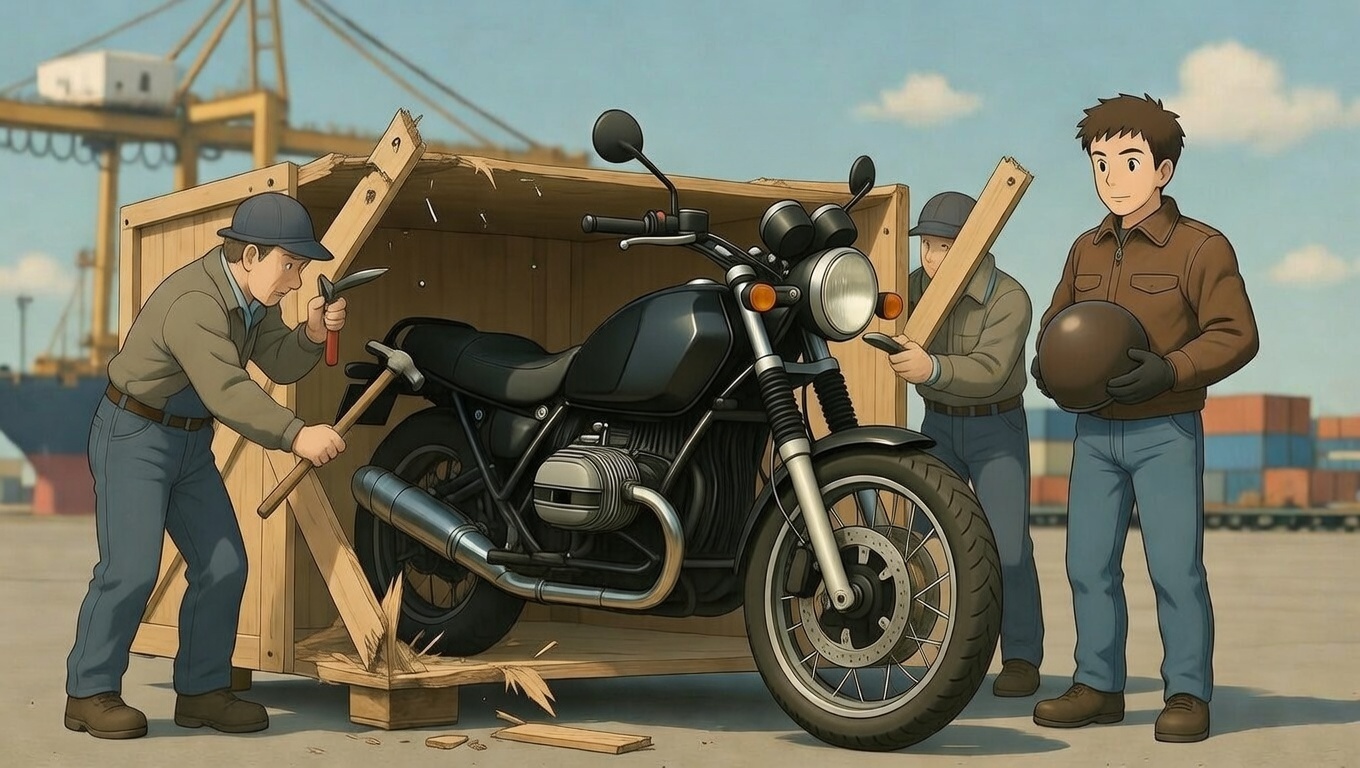
There are several ways to ride a motorcycle in Japan. You can rent a motorcycle. You can buy one in Japan and ride it.
But there are people who say, “I want to ride my own motorcycle.” A bike you’ve owned for years, set up to fit your body just right. Or someone on a round-the-world trip who wants to stop by Japan too.
Or maybe you found a vehicle that only exists in Japan. A JDM you spotted at an auction, a bike you met at a shop—you just have to bring it back to your country.
For people like that, we handle the arrangements for international transport.
Overseas to Japan, Japan to overseas. We pick the shipping route, arrange packing, organize documents, and coordinate with partners. When you try to do it yourself, you hit the wall of “I don’t know where to start”—we take all of that on.
Which one applies to you?
Depending on your goal, the information you need and the bottlenecks change.
- Touring — Send your motorcycle, ride in Japan, and have it sent back
- Purchase/Export — You bought a vehicle in Japan and want to ship it overseas
- Import/Relocation — You want to bring your own vehicle from overseas to Japan
If you’re unsure, get in touch first. We’ll listen and figure out where to start together.
Rough costs
International motorcycle transport costs more than most people imagine. Here are the numbers upfront.
- Yokohama to Rotterdam, one motorcycle, container consolidation: 500,000–600,000 yen on the Japan side. Another roughly 200,000 yen on the local side.
- Japan–Europe round trip (temporary import/export): About 10,000 euros total.
- Air freight: 1,000,000 yen and up per motorcycle, departing Japan.
This is an estimate as of October 2026. It varies by departure point, arrival point, and timing. If you think “this should be cheaper,” check the cost breakdown in the guide article. You’ll see what each part costs.
Shipping methods
There are four methods that actually work for motorcycles. Which one suits you depends on budget, schedule, and route.
| Container consolidation (LCL) | Full container (FCL) | International ferry | Air freight | |
|---|---|---|---|---|
| Cost | Japan side 500,000–600,000 yen per unit (to Europe) | About 1,200,000 yen per container. Splits across 5–6 units | Contact each carrier | 1,000,000 yen and up per unit |
| Duration | Over a month to Europe | Same | 1–2 days | Several days |
| Good for | Sending one motorcycle | Sending with a group | Riding via Korea or Russia | Prioritizing speed |
| Caution | Wooden crate packing required. Customs brokers often refuse used motorcycles | Fixed costs apply separately depending on quantity | Round-trip ferry passage is assumed | Quote jumps based on vehicle height |
Ro-Ro ships, which are standard for passenger vehicles, are almost impossible to use for a single motorcycle.
What we handle
Selecting the shipping route
Air freight or ocean freight. Which port or airport to use. We propose a realistic route balancing cost and time. Depending on the combination of departure and arrival points, your options may be limited. Organizing this is our first job.
Arranging packing
Whether a wooden crate is needed or a pallet will do. Whether handlebar width and case dimensions fit the standard. What the hazmat conditions are for fuel and batteries.
These things need to be confirmed beforehand, or you’ll hear “we can’t send it” and have to start over. We confirm with partners and iron out the problem areas in advance.
Organizing documents
Export cancellation, invoice, packing list, CPD carnet, temporary import/export declaration for international ferry.
International transport comes with a lot of paperwork, but you don’t have to do it all yourself. We clarify upfront what’s needed, what we can arrange, and what we’ll ask you to handle.
Arranging customs clearance
This is the place where you get stuck the most if you do it yourself.
Container consolidation for used motorcycles is refused by most customs brokers. Even fewer have experience with CPD carnets. We have partners who can handle this type of job.
Pickup and delivery
Collecting the vehicle on the Japan side, transporting it to the port or airport, taking delivery at the destination. Whether you can pick it up at the airport yourself or drive it to the port is something we work out case by case. We can also store your vehicle temporarily until departure.
If you’re importing temporarily to ride in Japan
When you bring your own motorcycle from overseas to ride in Japan and take it back out, it’s a “temporary import” procedure. There are two systems.
CPD carnet
The Carnet de Passages en Douane. With this, you can temporarily import duty-free. You get it from your country’s automobile federation, and in Japan you get JAF certification and declare it to customs. If you’re shipping your vehicle by container or air freight, this is the standard.
There’s one common problem. If equipment like pannier cases or tools aren’t listed on the carnet, customs brokers may hold up your export. Ask the issuing authority to write them in the “Other particulars” section or provide a stamped list of equipment.
If you’re using an international ferry
When you take a ferry from Korea or Russia to Japan, you can do duty-free customs clearance with a “Temporary Export/Import Declaration for Motor Vehicles (C5014)” without a carnet.
But this system is for round-trip ferry travel. If you come by ferry and try to leave from a different port by container, the customs office will ask for a carnet. If you don’t leave by ferry from the port you entered, get a CPD carnet before you come. Some travel reports say “it’s not written in the law so it’s fine,” but results aren’t consistent.
→ The system and actual operations are detailed in the guide to exporting motorcycles from Japan overseas.
Common concerns
“Won’t it break during transport?”
We photograph the vehicle condition before packing. We confirm the packing method with partners and ensure it meets transport specs. We can also arrange marine insurance. Insurance premiums typically run 0.1–0.8% of the insured value.
To be honest, insurance on used motorcycles doesn’t cover scratches or paint damage. What it covers is major loss like maritime accidents or total loss. So confirming details like where and how to secure things and how to protect them matters more than insurance.
“What if it doesn’t arrive?”
We can check shipping status through our partners. If delays occur, we’ll let you know as soon as we find out.
International transport can miss its schedule due to weather, customs, and port congestion. For Europe, just loading and shipping takes over two weeks. We propose a schedule with margins, and we’ll tell you upfront if there are delay risks.
“I have no idea what this will cost.”
Cost varies widely by vehicle size, departure–arrival points, and shipping method, so we can’t post a flat rate table. Use the figures on this page and in the guide article as a rough estimate. Custom quotes are charged. We need to check costs with the freight forwarder, customs broker, and packing company separately. If you place an order, we subtract the quote fee from your invoice.
“If the vehicle is cheap, wouldn’t it be better to buy it locally?”
In most cases, yes. One-way to Europe costs 700,000–800,000 yen combined on the Japan side and local side. If the vehicle price is less than that, buying locally is cheaper. But if it’s “I want to send this one bike,” that’s a different story.
Things to watch on the importing country side
Even if you export from Japan, the receiving country has procedures and costs.
- Tariffs: 0–20% of vehicle value (varies by country)
- Commodity tax/displacement tax: Many countries add weight for engines over 750cc
- VAT/GST: 12–25% (based on CIF value)
- Environmental and safety standards: Emissions regulations (Euro 5, etc.), lighting standards, ABS requirements, and more
Import procedures on the destination country’s side are handled by a local customs broker. Once we know which country you’re shipping to, we can let you know what to watch out for in advance.
Pricing
Arrangement fee + actual expenses (payments to partners) is the structure.
Factors that affect pricing:
- Departure point to destination (country/region, port/airport)
- Shipping method (air / sea / ferry)
- Vehicle size and weight
- Whether and how to pack
- Timing and urgency
Things to know
Getting in touch early is an advantage
International shipping can take longer than expected. Sea freight to Europe takes over a month, and it can be delayed further during busy seasons. Getting a CPD carnet also takes about a month.
We recommend working backward from when you want to start riding or when you’re coming home, and building in plenty of time.
What we handle
- We are not a shipping company. All transportation is done by our partner freight forwarders, customs brokers, and packing companies. We handle the arrangements and document coordination.
- We do not handle domestic land transport or ferry reservations in Japan (international shipping only).
We make it clear from the start who does what and how far things go.
For more information
- Guide to exporting motorcycles from Japan overseas — Comparison of shipping methods, breakdown of costs, actual use of CPD carnets and C5014
- Guide to exporting cars from Japan overseas — When to use Ro-Ro ships and containers, temporary import/export of camper vans, JDM
Information needed for a quote
Basic information (required)
- Shipping direction (overseas to Japan / Japan to overseas / round trip)
- Departure and destination points (country/city, port/airport)
- Desired schedule (desired arrival date / departure date / desired pickup date)
- Temporary import/export or permanent export
Vehicle information (required)
- Vehicle type (manufacturer / model), year, country of registration
- Vehicle identification number (VIN / frame number)
- Operating condition (can run under its own power / can be pushed / non-running)
Information that speeds up quoting
- Dimensions (length, width, height) and weight
- Photos (front, side, rear; showing the whole vehicle)
- Fuel condition, battery type (whether lithium-ion or not)
- Whether you want to ship with cases or bags attached
- Scope of services (pickup, packing, storage, pickup after arrival)
Additional information by purpose
- Touring: planned arrival/departure dates, ports of entry and exit, whether you have a CPD carnet and which organization issued it
- Purchase/export: vehicle location, status of export deregistration, destination country
- Bringing in/relocating: country and city of origin, area where you’ll stay after arrival
Contact us
Please contact us using the form below.