
Why Does the Hiace Never Lose Value? Strong Asset Value Explained: Motorcycle Transporter Vans, Overseas Popularity, and Commercial Demand
The Toyota Hiace is a quite unusual presence in Japan’s used car market. It’s not a luxury car. It’s not a sports car. Yet even as the model year advances, its price doesn’t fall easily—and it continues to hold the power of being thought of as something people want, even if it’s old.
According to 2026 resale value data, the Hiace van has a five-year residual value rate of 78.65%. This is among the top levels in the minivan and one-box vehicle class, ranking just below the Alphard and Vellfire. The Hiace wagon also shows 66.82%, which is quite a strong figure for a utility vehicle.
What’s interesting about this vehicle is that the reason for its strong value retention isn’t just one thing. Domestically, the Hiace is strong as a commercial vehicle, and in the hobby world it’s supported as a motorcycle transporter van and as a camper van base. On top of that, it’s also highly regarded overseas as a “sturdy van that lasts a long time.” In other words, the Hiace isn’t just a “workhorse.” It’s a vehicle trusted as a tool around the world, and that trust translates into strong used market prices.
First, the conclusion: the Hiace is likely to sell for a high price even 10 years later
The current 200-series Hiace is a long-selling model that debuted in 2004 and already has substantial secondhand circulation records. For this reason, it’s easier to discuss “10 years from now” with the Hiace than with the Alphard or the current Jimny.
Looking at the buyback prices as of March 2026, the Hiace van’s 2021 model ranges from ¥1,934,000 to ¥3,081,000, the 2020 model from ¥1,775,000 to ¥2,825,000, and even the 2018 model from ¥1,451,000 to ¥2,158,000. Across the Hiace lineup, 2021 models range from ¥2,352,000 to ¥3,382,000, and 2018 models from ¥1,329,000 to ¥2,906,000, showing a high level overall.
Additionally, average buyback prices show 2025 models at ¥3,394,000 to ¥4,073,000, and 2021 models at ¥1,330,000 to ¥2,602,000. While specification differences are large, you can see a trend where prices hold up solidly even as the model year advances.
Based on this trend, it wouldn’t be surprising if the Hiace maintained a residual value rate of around 45–60% even 10 years later. There are differences depending on grade, use, diesel versus gasoline, and 4WD versus 2WD, but it’s clearly a vehicle class that doesn’t depreciate as easily as a typical commercial van or minivan.
Why is only the Hiace in a class of its own?
When explaining the Hiace’s strong value retention, it’s easy to end with “because it’s popular.” But that won’t reveal this vehicle’s real strength.
1. First, it’s hard to replace at work
The Hiace has been used for years in professional settings—field work, delivery, shuttling, and as a base for commercial customization. The reliability and durability built up over a long time form the center of its support.
Work vehicles often seem to have weaker market prices than hobby vehicles. But the Hiace is the opposite. That’s because for people who use it for work, practical value—”it doesn’t break,” “it can carry things,” “it runs,” “it’s easy to fix”—comes first, and it’s met those requirements at a high level. On the used car market too, it’s valued not as a “cheap van” but as reliable equipment for business use.
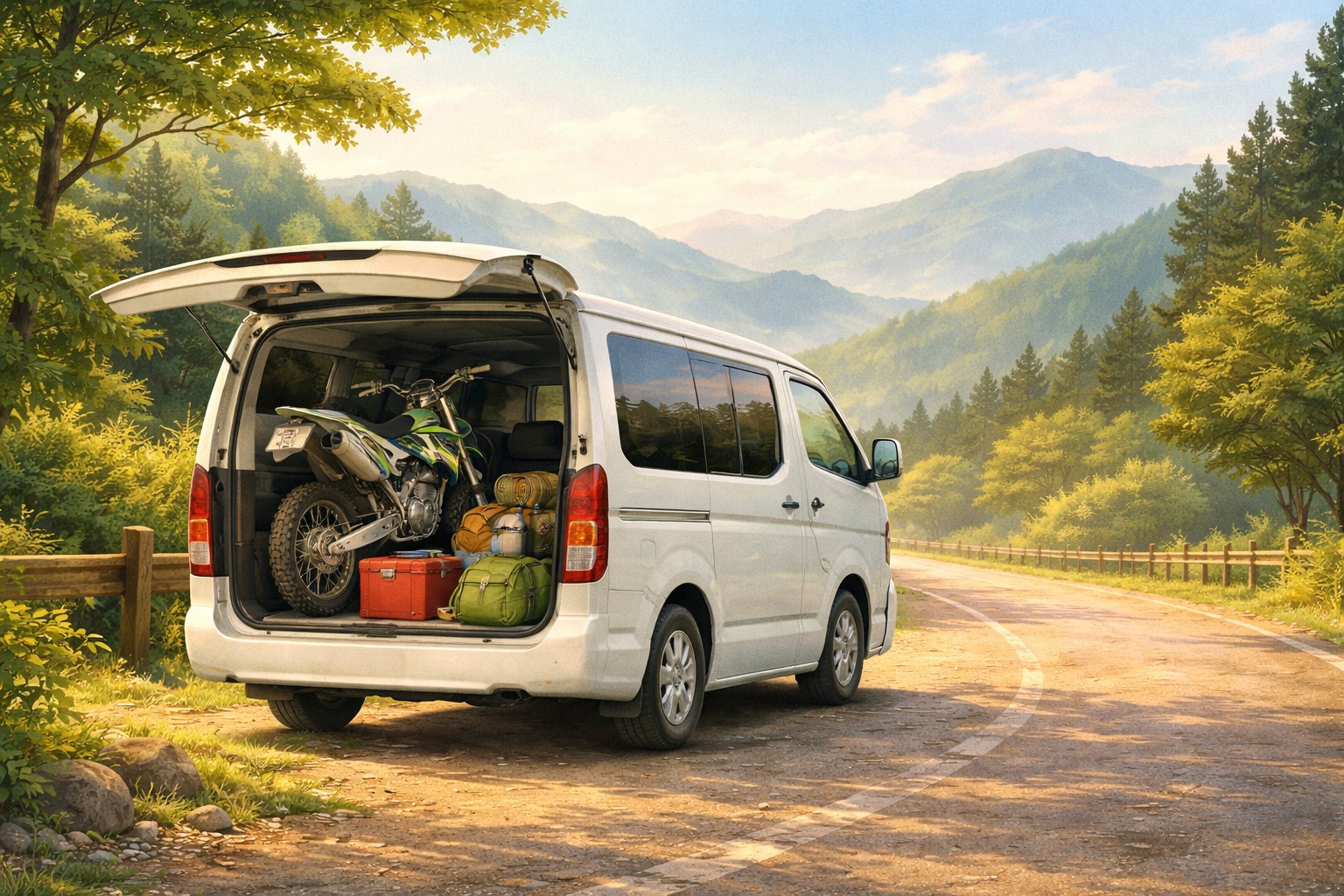
2. In the hobby world it’s overwhelmingly strong as a motorcycle transporter van
The Hiace isn’t just a work vehicle. For people who carry motorcycles, it’s actually the representative motorcycle transporter van.
Offroad bikes, minibikes, road bikes, toolboxes, generators, camping gear, changes of clothes, and makeshift beds. You can haul all these things and use the vehicle as a base for expeditions, races, trail riding, or touring. And what’s more, while it’s a cargo vehicle, it can carry people too. This versatility is quite powerful.
Vehicles with strong motorcycle transporter van demand have a market different from mere commercial vans. Even used, the Hiace isn’t “a vehicle retired from work”—it has room to be re-evaluated as a base vehicle for hobbies. The existence of this “second life” is a major factor supporting its market value.
3. Camper van and van life demand overlaps with this
The Hiace is strong because motorcycle transporter van demand overlaps with camper van demand. It doesn’t just carry motorcycles—it can sleep in, can become a simple living space, and can serve as a base at travel destinations. This is the decisive difference from an ordinary commercial van.
Of course, there’s competition like the NV350 Caravan. But the Hiace is overwhelming in base vehicle information resources, the abundance of custom parts, and long-standing track record. Buyers purchasing used think “the Hiace has lots of know-how,” “parts are easy to find,” “dealers are used to working with it.” This surrounding ecosystem strength has quite an impact on value retention.
Why the Hiace is popular overseas
When discussing the Hiace’s asset value, overseas demand cannot be left out. The Hiace is popular not just in Japan—it’s a vehicle needed in work sites around the world.
In overseas markets, value is strongly placed not on how new it looks, but on whether it lasts a long time, whether it breaks down even under harsh conditions, whether it can haul a lot, whether it can transport both people and cargo, and whether it’s easy to repair. The Hiace fits exactly those criteria.
Because of this, even used vehicles with an older model year in Japan tend to hold their price, supported by export and overseas demand. The core of the Hiace lies in durability, reliability, and commercial suitability.
The Hiace’s price resistance also has reasons on the supply side
Looking at the Hiace market from 2025 through 2026, you can’t overlook supply-side factors alongside demand. When demand is high but new car supply sometimes lags, the used car market can become supported all at once.
This means the Hiace tends to enter a state of “people want one right now, but new cars aren’t stably supplied”. There are many vehicles with strong used market prices, but the Hiace not only has “lots of people wanting one,” it also has the structure where “even a slight disruption in supply instantly props up the used market.” In this respect too, it’s a vehicle that resists depreciation.
What kind of Hiace sells for higher prices?
Not all Hiaces command the same high price. If you’re thinking about asset value, there are points where the difference is quite substantial.
Strong conditions
- Hiace van
- Popular grade
- Diesel
- 4WD
- Super GL class
- No accident history
- Mileage not excessively high
- Modifications reasonable for motorcycle transporter or camper van use
- Interior and exterior in good condition
While the Hiace van’s five-year residual value rate is 78.65%, which is extremely high, the Hiace wagon is 66.82% and the Commuter is 64.21%. In other words, “all Hiaces are the same” doesn’t apply—rather, the specification with the thickest market is the strongest.
Conditions to watch out for
- Vehicles that appear to have been heavily used for work
- Vehicles with significant undercarriage damage or rust
- Poor-quality interior fabrication work
- Excessive customization
- Specifications too limited in use
While the Hiace is excellent as a custom base, what’s broadly valued at resale time is still a condition that’s easy for the next owner to use. A motorcycle transporter van version that’s built cleanly tends to be evaluated favorably, while one with too strong a character narrows the market range.
We should also look at the Hiace’s weaknesses
The Hiace is a strong vehicle, but it’s not without weaknesses. If you’re looking purely at comfort, passenger minivans are superior. In terms of quietness, ride quality, rear-seat comfort, and advanced features, it can’t match the Alphard family or passenger SUVs. Also, while it’s convenient to use flexibly depending on your work or hobbies, if your priority is “driving the whole family in comfort every day,” it’s hard to call it the optimal choice.
However, looking at this from another angle, it means that the Hiace is chosen for reliability and suitability to purpose rather than comfort. And that way of being chosen doesn’t change much even after 10 years. That’s why it holds its asset value so well.
Conclusion: The Hiace is strong because it’s “a vehicle trusted too much as a tool”
There isn’t just one reason why the Hiace holds its value so well.
- Domestically, it’s favored as a work vehicle
- In the hobby world, it’s favored as a motorcycle transporter van or camper van base
- Overseas, it’s favored as a durable work vehicle built to last
- When supply becomes unstable, the used car market supports prices even more
Because of this multi-layered demand, the Hiace is strong. If the Alphard is “a luxury car that doesn’t lose value easily,” the Hiace is “a vehicle that doesn’t lose value easily because it’s trusted too much as a tool”.