
🇷🇺🇰🇵🇯🇵 Eurasian Riders’ Complete Guide to the “Far East Border Crossing”
From Vladivostok to Japan: Four entry points and when you can use C5014
“I want to cross the Eurasian continent by motorcycle and return to Japan (or get there for the first time).”
For riders with this goal, the final challenge is crossing the Far East Asian border. China’s barriers, South Korea’s expressway regulations, and Japan’s temporary import procedures. This article explains three routes from Vladivostok to Japan and what happens at Japanese customs, based on facts our company has verified through actual projects.
Here’s the conclusion first: Japan has a system called “C5014” that allows temporary import without a CPD carnet, but this is a system for vehicles that make a round trip by international ferry. If you plan to enter Japan by ferry and then leave from a different port by container or air freight, get a CPD carnet before you come. There are articles on the internet saying a carnet is not necessary, but as of October 2026, that is not how the system operates.
🗺️ The overall picture: There are four entry points to Japan
Ferries from China to South Korea currently do not allow motorcycles to ride on under their own power. For this reason, going from Vladivostok to Donghae, South Korea, is the starting point for reaching Japan from the continent.
From there, the route splits four ways.
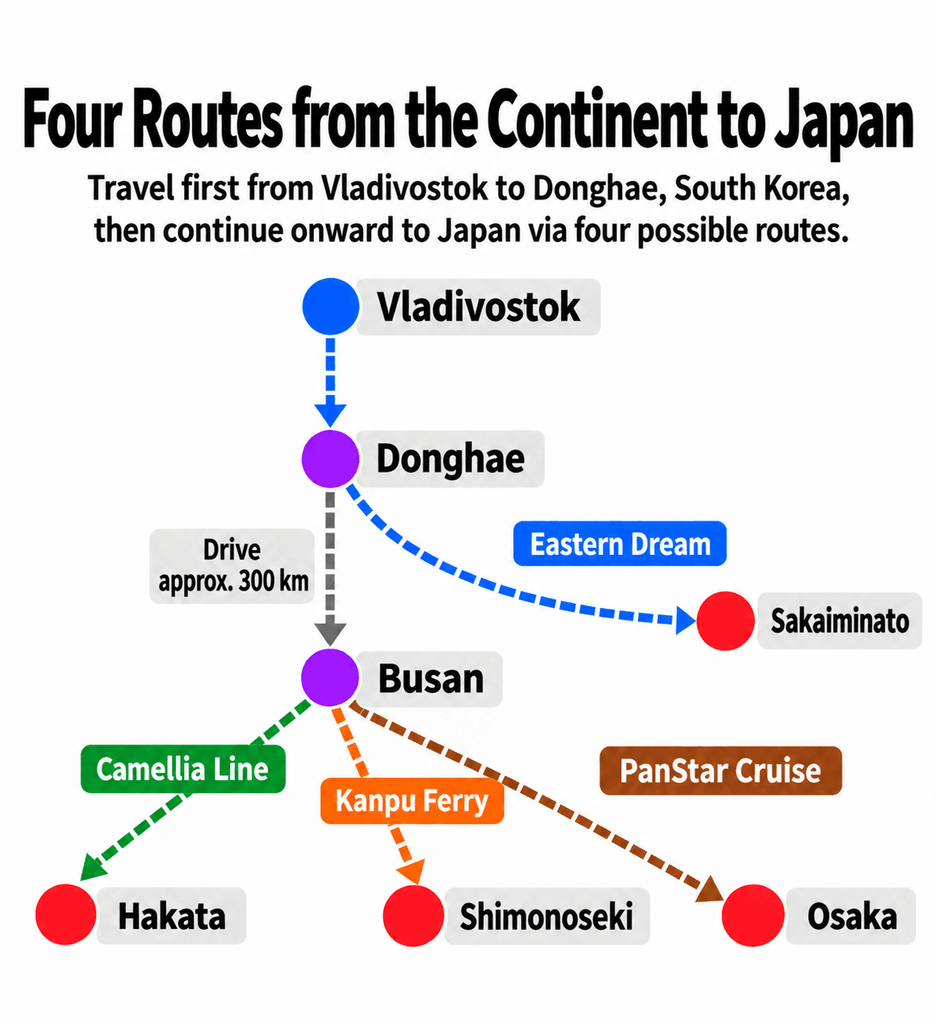
🟢 Route A: Donghae → Sakaiminato (direct on Eastern Dream)
The Eastern Dream that carries you from Vladivostok continues all the way to Sakaiminato, so you can enter Japan without riding through South Korea. This is the fastest and least complicated route.
🟩 Route B: Donghae → (about 300 km by road) → Busan → Hakata
Traverse South Korea north to south, then sail to Fukuoka on Camellia Line. For riders who want to make riding through South Korea part of their journey, or those who want to begin touring from Kyushu.
🟨 Route C: Donghae → (about 300 km by road) → Busan → Shimonoseki
After traversing South Korea the same way, cross to Honshu directly on the Gwangju-Busan Ferry. For riders who want to head straight into the Chugoku region or Kansai.
🟪 Route D: Donghae → (about 300 km by road) → Busan → Osaka
After traversing South Korea the same way, sail to Osaka on Panstar Cruise. For riders who want to start touring from Kansai or enter directly to the central Honshu region.
The key difference is whether you set foot in South Korea. If you take Route A and pass through without unloading your vehicle in South Korea, you avoid the entire burden of South Korea’s temporary import customs clearance, guarantee fees, compulsory insurance, and the 300 km ride on roads where expressways are prohibited.
🚳️ Step 1: Board Eastern Dream in Vladivostok
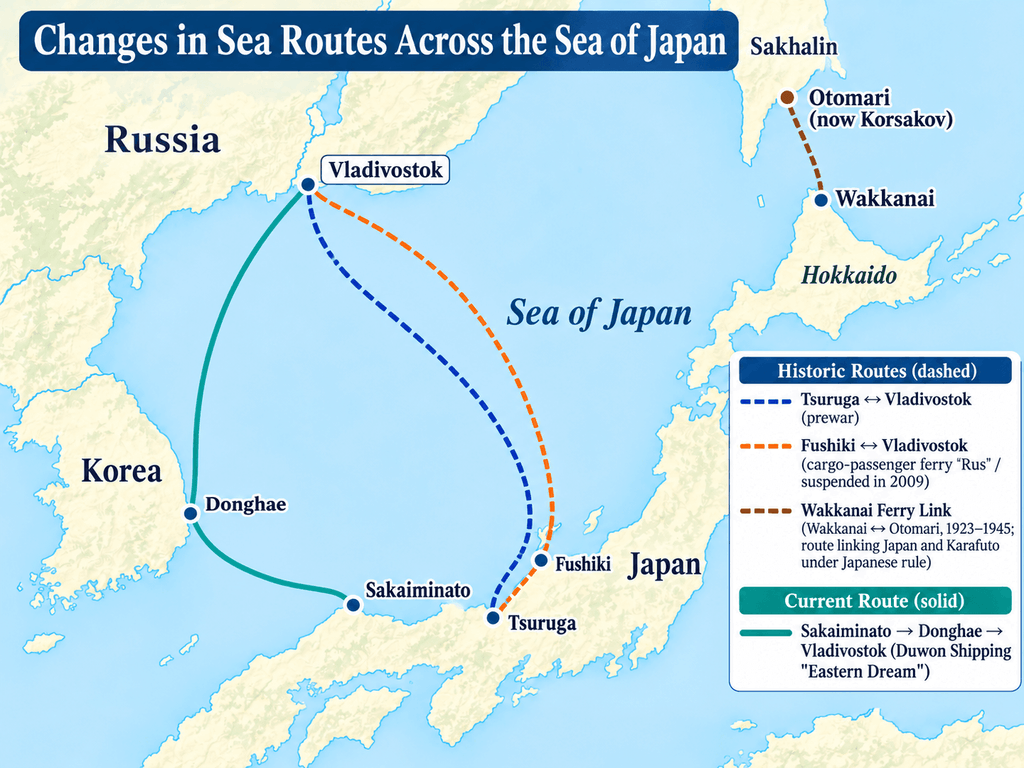
The ferry service between Russia and Japan began with the pre-war Tsuruga–Vladivostok route and the Wakkanai–Otomari ferry connecting Sakhalin. After the Soviet collapse, the cargo-passenger ship “Rusi” connected Toyama’s Fushiki Port to Vladivostok, backed by used car exports, but suspended service in 2009 due to tariff increases and other factors. That same year, DBS Cruise Ferry launched the Sakaiminato–Donghae–Vladivostok three-nation route as an international service via South Korea, and it has continued operations through a transfer to Duwon Shipping.
1. Ferry used
- Vessel name: Eastern Dream (operated by Duwon Shipping, Japan-side contact: Eastern Cruise & Ferry)
- Route: Vladivostok ⇔ Donghae ⇔ Sakaiminato (triangular route)
- Published rates and quotation basis (confirmed October 2026):
- Passenger fare
- Vladivostok → Donghae: Economy standard one-way fare from the official route rate schedule is 380 USD (passenger only). Confirm vehicle companion discounts and the applicable fare and payment currency when ticketing in Russia with the Russian-side office. Fuel surcharge 63 USD and Vladivostok terminal fee 27 USD are separate.
- Vladivostok → Sakaiminato: Through-passenger fare requires a quote. The economy standard one-way fare for the Donghae–Sakaiminato section is 173 USD, fuel surcharge 33 USD, Donghae departure terminal fee 2 USD (official rate schedule). This is the rate for Donghae–Sakaiminato only, not the through fare from Russia.
- Motorcycle shipping, Russian-side customs and port fees: Individual quote. The Duwon official guide states that vehicle fare and temporary import/export conditions must be confirmed with the responsible office. Passengers traveling with their vehicle should have their ticket reserved through the contact person.
- Passenger fare
2. Sailing schedule (fixed by day of week)
Since one vessel makes the circuit, the day of the week is fixed. Planning your itinerary around this day of the week is the fundamental principle for the Far East crossing.
| Departure point | Destination | Day of week | Check-in | Departure |
|---|---|---|---|---|
| Vladivostok | Donghae | Wednesday | 09:30〜12:00 | 13:00 |
| Donghae | Sakaiminato | Thursday | 16:00〜17:00 | 17:30 |
| Sakaiminato | Donghae | Saturday | 16:00〜17:30 | 18:00 |
| Donghae | Vladivostok | Monday | 12:00〜14:00 | 15:00 |
Note the continuity of Wednesday and Thursday. The ship departing Vladivostok on Wednesday arrives in Donghae on Thursday and then departs the same Thursday evening bound for Sakaiminato. The schedule can change, so always confirm when making reservations.
3. Customs agent in Vladivostok
Vehicle customs clearance at Vladivostok Port (temporary export) requires documents prepared in Russian, and is practically impossible for an individual to handle. Always use a local agent.
- Recommended agent: Links Ltd contact Yuri Melnikov. Many riders use him, and he arranges everything from customs procedures to shipment.
- We have a direct business relationship with Yuri. If you place your request with us for both the Japan-side and Russia-side arrangements, we can coordinate everything through us.
🟢 Route A: Go direct from Donghae to Sakaiminato
The ship departs Donghae at 17:30 Thursday and arrives in Sakaiminato the next day.
Advantages
- No need for South Korean temporary import customs clearance (if your vehicle stays on the ship). You save on guarantee fees and compulsory insurance.
- No need to ride 300 km through South Korea where expressways are prohibited. You can avoid a long ride while still tired from the sea voyage.
- No lodging costs or waiting days for a connection. Going via Busan requires at least one or two nights in South Korea.
- Right after landing, you have access to the Sanin Coast, Daisen, and mountain passes in the Chugoku region.
Disadvantages and things to note
- Only one ferry per week, so if you miss the day you wait a week.
- Sakaiminato is a regional port, so transportation access and supply options are more limited than Hakata.
- The Sakaiminato Customs Branch does not recognize C5014 temporary import for vehicles that do not make a round trip by ferry. If you plan to leave Japan by container or air freight, a CPD carnet is essential (see below).
🏍️ Routes B, C, and D: Ride through South Korea (Donghae to Busan)
Procedures for landing in South Korea, riding north to south, and then crossing to Japan from Busan.
1. South Korean entry customs (Temporary Import)
In South Korea, CPD carnets cannot be used; the standard method is temporary import with payment of a guarantee fee at customs.
- Guarantee agency fee, etc.: Rates applicable at entry to Donghae in 2026 require a quote. Provide the engine displacement, registration country, and customs clearance method, and confirm with the Donghae representative. Camellia Line’s public table lists two-wheeler guarantee fees of 120,000/160,000/240,000 won, but these are reference figures from April 2023 and cannot be applied to current rates in Donghae (public table and terms).
- Compulsory insurance: Rates vary by insurance period, age, and vehicle type, so obtain a quote before traveling. “184,000 won per month” cannot be treated as a fixed current rate. Camellia Line’s public insurance table is also a reference figure from July 2023, with actual rates to be calculated individually (insurance rate information).
- Support: Yuri in Vladivostok will introduce you to a Korean customs agent. Contact him in advance.
2. Korean Traffic Rules: Motorcycles Prohibited on Expressways
In Korea, all two-wheelers (regardless of engine displacement) are legally prohibited from using expressways.
- Route: From Donghae to Busan, use the coastal National Route 7.
- Travel time: The distance is just over 300 km, but with traffic lights and city areas, allow 6 to 8 hours including breaks. If there’s a ferry connection, it’s recommended to arrive in Busan the day before.
Driver’s license note: Korea and Japan are both signatories to the 1949 Geneva Convention, but international licenses from countries (such as Switzerland) that are only party to the 1968 Vienna Convention are not valid. Japan recognizes driving with a Swiss license if accompanied by a Japanese translation, but Korea has no such provision, and Swiss licenses cannot be used to drive in Korea. If this applies to you, choose Route A (direct to Sakaiminato).
3. Busan to Japan: Three Options
Route B: Camellia Line (to Hakata)
- Route: Busan Port ⇔ Fukuoka·Hakata Port (Camellia Line)
- Schedule: Daily service (daytime or overnight sailing)
- Features: Good access to downtown Fukuoka, making it easy to stay in and resupply in urban areas. Ideal if you want to start touring from Kyushu.
- Published rates: Motorcycles 80–299 cc are 30,000 yen one-way / 40,000 yen round-trip; 300 cc and above are 35,000 yen one-way / 50,000 yen round-trip. Carnet clearance has a line for 35,000 yen one-way / 50,000 yen round-trip. Customs clearance fee is 5,000 yen per vehicle. From Busan, passenger miscellaneous charges are listed separately: fuel surcharge 14,000 won, port tax 6,000 won, and tourism promotion fund 1,000 won. Confirm at booking the one-way acceptance of foreign-registered vehicles, what passenger fares include, and the scope of customs charges (vehicle rates / passenger rates and miscellaneous charges revised October 2026).
Route C: Gwangfu Ferry (to Shimonoseki)
- Route: Busan Port ⇔ Yamaguchi·Shimonoseki Port (Gwangfu Ferry)
- Schedule: Daily service (overnight sailing)
- Features: Land directly on Honshu and proceed straight into the Chugoku and Kansai regions.
- Published rates: Motorcycles 125 cc and above are 30,000 yen in second-class, 34,000 yen first-class, 41,000 yen deluxe, 52,000 yen suite (one-way rates including passenger fare for one driver). However, vehicle transport requires round-trip use. Japan-side published customs clearance fee is 6,000 yen per vehicle, with fuel surcharges and facility use fees listed separately. Rates published under Japan-departure terms cannot necessarily be applied directly to foreign-registered vehicles on one-way trips from Busan (official vehicle information).
Route D: Panstar Cruise (to Osaka)
- Route: Busan Port ⇔ Osaka Port (Panstar Cruise)
- Schedule: Approximately 3 sailings per week (overnight sailing)
- Features and published rates: Arrive directly in Kansai. The current service ship is Panstar Miracle. The official two-wheeler temporary import/export plan in an inside four-person cabin is 840,000 won round-trip. Meals, documentation, Japan-side customs, insurance, etc., are separate. This is not a one-way rate and cannot necessarily be applied directly to vehicles registered in other countries. Vehicle reservations must be made one month before boarding, and documents must be submitted two weeks before. Inquire about one-way acceptance of foreign-registered vehicles and total cost (official vehicle plan).
Hakata and Shimonoseki operate daily, so unlike Eastern Dream with only one weekly sailing, Routes B and C offer greater schedule flexibility. Osaka has fewer sailings, so confirm your reservation early.
🇯🇵 Step 3: Japan Entry Procedures
There are two temporary import systems available in Japan. Which one you use depends on how you will exit Japan.
1. Round-trip Ferry: Form C5014
If you exit on the same ferry from the port where you entered, you can use Customs Form C No. 5014 “Automobile Temporary Import/Export Declaration” for duty-free temporary import. No CPD carnet is required, you don’t need to visit JAF, and the procedures are completed at the port. There is no customs fee (the ferry company’s customs clearance fee is separate).
- Immigration inspection: Pass through passport control.
- Customs inspection: Create two copies of Form C5014 at the vehicle lot and declare to customs.
- Receiving the permit: One copy will be returned as an import permit. Keep it safely as it is required for re-export.
2. One-way Trip: CPD Carnet
If you enter by ferry and exit from Yokohama or elsewhere via container or air freight, you need a CPD carnet. For vehicles not making round-trip ferry voyages, the customs branch office will require a CPD carnet. Ferry company booking conditions assume a round trip, and one-way C5014 bookings may not be accepted. Ferry companies are simply following customs branch office guidance, so there is no room for negotiation.
Procedures vary by port. Sakai Customs does not permit C5014 temporary import on the premise of re-export by means other than ferry. At other ports, we have experience exporting vehicles that entered via C5014 through standard export declaration in containers, but each case is judged individually and approval is not guaranteed every time.
Obtain the CPD carnet from your country’s automobile association, then have it certified by the JAF (Japan Automobile Federation) in Japan—advance reservation required—and declare it to customs. Issuance takes about a month, so obtain it before departure. There can be trouble with recording equipment as well, so please read Motorcycle Export Guide, section “Temporary Import and Export Systems and Actual Practice” in detail.
3. Compulsory Automobile Liability Insurance (CALI) Registration
Driving on Japanese public roads requires registration with compulsory automobile liability insurance.
- Cost: Standard compulsory automobile liability insurance (jibaiseki) for small motorcycles (over 250cc) is 5,360 yen per month (start date before October 31, 2026) or 5,920 yen per month (start date November 1, 2026 or later). These are standard rates for areas excluding Okinawa and remote islands. For light motorcycles (over 125cc and up to 250cc), the published 12-month rates are 7,100 yen and 7,800 yen respectively.
- You can enroll through agents inside the international terminal or nearby property and casualty insurance companies.
- Good Loop serves as an agent for motorcycle mutual aid insurance and consults with overseas travelers about enrollment. Please contact us before you arrive.
⚠️ Why doesn’t the China route work?
We often get asked, “Can’t I take a ferry from China to Korea?” The current answer is no.
- Reason: Ferries from Qingdao and Lianyungang carry passengers’ bicycles but do not permit motorcycles to be ridden on board.
- Exception: You can ship a motorcycle if it is packed in a wooden crate and sent as cargo through a carrier, but transport, packing, and customs clearance costs are quoted individually and the paperwork is complicated.
💰 Four-route comparison (one-way, one person one motorcycle)
| Item | A: Sakaiminato | B: Hakata | C: Shimonoseki | D: Osaka |
|---|---|---|---|---|
| Russia-side passenger, motorcycle, and customs | Total through-fare to Sakaiminato requires quotation | Total to Tonghae requires quotation. Based on standard one-way passenger rate of 380 USD, add fuel 63 USD and terminal 27 USD, with vehicle and customs costs calculated separately | Same as B | Same as B |
| Published fares for Japan-bound ferry | Total through-fare requires quotation. Standard one-way passenger fare from Tonghae to Sakaiminato is 173 USD, fuel 33 USD, and terminal 2 USD (vehicle separate) | Motorcycle one-way 30,000 yen (80–299cc) or 35,000 yen (300cc and over). Carnet clearance 35,000 yen. Clearance and fuel costs separate | Second-class cabin 30,000 yen, first-class cabin 34,000 yen (125cc and over, one-way including one driver). Round-trip usage required, clearance costs separate | Official motorcycle plan from 840,000 won round-trip. One-way use and foreign-registered vehicles require inquiry, miscellaneous costs separate |
| Operating frequency | Once weekly (Thursday departure) | Daily | Daily | About three times weekly |
Note: The figures in the table are reference values of published fares by each operator and are not confirmed quotations for a one-way trip by foreign-registered motorcycle. The fare schedules of each operator differ in departure point, registration country, round-trip conditions, and included passenger fares, so simple addition is not possible. Obtain quotations that include Russia-side customs and port fees, Korean-side guarantees and insurance, accommodation, fuel surcharges, and Japan-side customs and insurance. The previously listed “total 200,000–250,000 yen” has been removed as we could not verify its current basis. Container and air transport costs from Japan are separate.
✅ Summary
- Four entry ports: Sakaiminato (Eastern Dream direct) / Hakata (Camellia Line) / Shimonoseki (Kansai-Busan Ferry) / Osaka (Pan Star Cruise).
- To reduce Korean customs and riding distance, choose Sakaiminato. If your vehicle can pass through Korea without temporary import, you avoid Korean customs clearance and 300 km of riding. Compare costs by obtaining quotations. However, service is once weekly.
- For schedule certainty, go via Busan. Hakata and Shimonoseki operate daily, so plans are less likely to change. If you want to start from the Kansai region, choose Osaka.
- Documents: Use C5014 if you return on the same ferry. Use CPD carnet if you leave Japan by container or air freight. Obtain before departure.
- Riding: If you ride in Korea, motorcycles cannot use highways. Use National Route 7.
Good Loop can handle agent arrangements in Vladivostok, vehicle export from Japan, and compulsory automobile liability insurance consultation all together.
→ The process and cost estimates for vehicle export from Japan are summarized in International Transport (Motorcycle Import and Export).
Safe travels!