
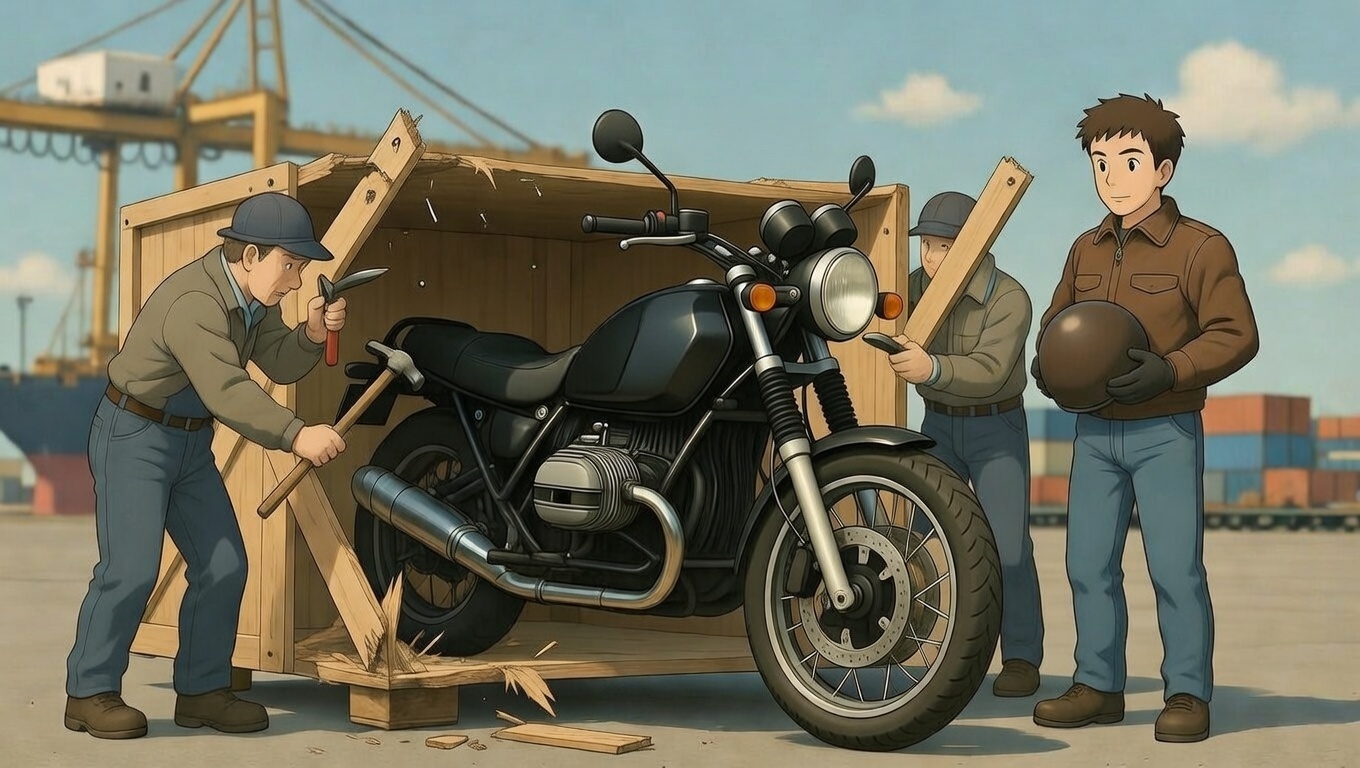
There are several ways to ride in Japan. You can rent a bike, or buy one here and ride it. But some riders want to travel on their own machine — the one they’ve spent years dialing in to fit their body perfectly. Some are mid-way through a world tour and want to include Japan on the route.
Others have found a vehicle that only exists in Japan. A JDM they spotted at auction, or a bike they came across at a shop — and they need to get it home.
For all of these, we handle the international shipping logistics.
Overseas → Japan, Japan → overseas. Route selection, packing arrangements, documentation, and coordination with our partners. The kind of thing that tends to stop people in their tracks — “where do I even start?” — we take care of it end to end.
First — Which Situation Are You In?
What you need depends on your goal.
- Touring — Ship your own bike to Japan, ride it, ship it back
- Purchase / Export — You’ve bought a vehicle in Japan and want to send it overseas
- Import / Relocation — You want to bring your own vehicle from overseas into Japan
Not sure? Just reach out. We’ll listen and work out together where to begin.
Shipping Methods
There are four main options. Which one fits depends on your budget, timeline, and route.
| LCL (Sea Freight, Shared) | FCL (Sea Freight, Full Container) | Ro-Ro | Air Freight | |
|---|---|---|---|---|
| Cost (approx.) | ¥200,000+/unit | ¥50,000+ (SE Asia routes) | Route-dependent | ¥500,000+ |
| Transit Time | 3–6 weeks | 3–6 weeks | 2–5 weeks | 3–7 days |
| Pros | From 1 unit. Low cost | No crating needed. Cost-efficient at volume | No packing needed. Ridden on board | Fastest by far |
| Cons | Crating required | Higher cost | Limited routes | Expensive. Strict hazmat rules |
These are rough benchmarks. Costs vary significantly depending on the origin/destination combination.
Sample Costs (1 Motorcycle, LCL Sea Freight)
- Yokohama → Rotterdam (Europe): approx. ¥400,000 (sea freight + crating + customs + insurance)
- Japan → Mombasa, Kenya: approx. ¥400,000 sea freight alone
- Japan → Dar es Salaam, Tanzania: approx. ¥700,000 sea freight alone
The above are Japan-side costs only. Destination-side port fees, import duties, inspection, and registration fees apply separately.
What We Actually Do
Route Selection
Air or sea? Which port or airport? We look at the balance of cost and time and propose a realistic route.
Air is fast but expensive. Sea freight is cheaper but takes 2–6 weeks. Depending on the origin and destination, options may be limited. Sorting that out is the first step.
Packing Arrangements
In international shipping, packing specs can determine whether a shipment is even possible.
Does it need a crate, or will a pallet do? Do the handlebar width and case dimensions fit within the required envelope? What are the hazmat conditions for fuel and batteries?
These are the things that, if not checked in advance, result in “sorry, we can’t ship this” and starting over. We confirm everything with our partners upfront to catch problems before they happen.
Documentation
Export deregistration, commercial invoice, packing list, Carnet de Passages, temporary import declaration.
International shipping always involves paperwork — but you don’t have to handle all of it yourself. From the start, we’ll be clear about what’s needed, what we can prepare on our end, and what we’ll need from you.
For permanent exports, the process begins with provisional export deregistration at the Land Transport Office. For temporary exports, a Carnet de Passages en Douane is required. We’ll walk you through either scenario.
Pickup & Delivery
Vehicle collection on the Japan side, delivery to the port or airport, and receipt upon arrival.
“Can I collect it at the airport myself?” “Can it be delivered to my hotel?” “Can I ride it to the port?” — it varies by situation, so we work it out case by case.
Temporary Import — Riding in Japan on Your Own Bike
If you’re bringing your bike from overseas, riding Japan, and taking it back home, this falls under temporary import procedures.
Using a Carnet
With a Carnet de Passages en Douane (CPD), temporary customs clearance is granted duty-free. In Japan, JAF (Japan Automobile Federation) is the issuing authority.
- Validity: 1 year (renewal applications possible)
- Riding is permitted on Japanese roads under your home country registration (between treaty signatory countries)
- Customs stamp required at each border crossing
On entry: declare at customs with your JAF certificate and Carnet. On departure: re-export declaration with the Carnet.
Using International Ferries
On ferries operating between Japan and other countries (Osaka, Kobe, Sakaiminato, Shimonoseki, Hakata), duty-free temporary import/export is possible using a standard “Temporary Vehicle Import/Export Declaration.” No Carnet required.
→ Full procedural details are covered in our guide: How to Export a Motorcycle from Japan
Common Concerns
“What if it gets damaged in transit?”
We photograph the vehicle’s condition before packing. Packing specs are confirmed with our partners to ensure the method is appropriate for international transport. We can also arrange shipping insurance — typically 0.1–0.8% of the declared value.
We won’t say the risk is zero. But by working out in advance exactly how the bike will be secured and protected, we can prevent the vast majority of issues.
“What if it doesn’t arrive?”
We can track shipment status through our partners. If a delay occurs, we’ll let you know as soon as we find out.
International shipping can be disrupted by weather, customs, or port congestion. That’s why we recommend building in buffer time — and we’ll flag any known delay risks from the outset.
“I have no idea what this will cost.”
Because it depends on vehicle size, origin, destination, and shipping method, there’s no fixed price list. That said, if you can give us something like “one motorcycle from [country] to Japan by sea,” we can get you a ballpark.
“If the vehicle is cheap, would buying locally be better value?”
Once you factor in shipping, customs, insurance, and taxes, the total cost is at minimum ¥250,000–400,000. If the vehicle is priced under ¥500,000, buying a used one locally may actually be cheaper. That said, if you have a specific bike you want shipped, that’s a different conversation.
Notes on the Destination Country
Exporting from Japan is one thing — the receiving country will also have its own procedures and costs.
- Import duty: 0–20% of vehicle value (varies by country)
- Commodity/engine displacement tax: Many countries apply surcharges above 750cc
- VAT/GST: 12–25% (based on CIF value)
- Environmental & safety standards: Emissions regulations (Euro 5, etc.), lighting requirements, ABS mandates, etc.
Destination-side procedures are handled by a local customs broker. Once we know which country you’re shipping to, we can flag the key considerations in advance.
Pricing
Service fee + actual costs (payments to partner vendors)
Factors that affect pricing:
- Origin to destination (country/region, port/airport)
- Shipping method (air / sea)
- Vehicle size and weight
- Whether crating is required and how
- Timing and urgency
Things to Know
Earlier Is Better
International shipping often takes longer than expected. Sea freight: 2–6 weeks, and potentially longer during peak periods.
We recommend working backwards from “when do I want to start riding?” or “when am I leaving Japan?” and building in a comfortable buffer.
Scope of Service
- Domestic road transport and ferry bookings within Japan are not offered (international shipping only)
- Customs clearance may require involvement from our partner brokers or action on your end — we’ll be clear from the start about who does what
For More Detail
→ How to Export a Motorcycle from Japan — an in-depth guide covering shipping method comparisons, cost breakdowns, and step-by-step procedures
What We Need for a Quote
Essential
- Direction (overseas → Japan / Japan → overseas)
- Origin and destination (country/city, port/airport)
- Target dates (desired arrival / departure / pickup date)
- Vehicle details: make, model, year, country of registration, VIN/frame number, running condition (rideable / pushable / non-runner)
Helpful for a Faster Quote
- Dimensions (L × W × H) and weight
- Photos (front, side, rear — showing the full vehicle)
- Fuel status, battery type
- Whether cases/bags will be shipped attached
- Scope of service needed (pickup, packing, destination receipt, customs broker referral)
Purpose-Specific
- Touring: Japan arrival/departure dates, regions you plan to ride, Carnet status
- Purchase/Export: Vehicle location, export deregistration status, destination country
- Import/Relocation: Departure city and country, intended base area after arrival
Contact
Get in touch here.
Related Pages