
Introduction: The Parts Supply Problem Facing Classic Car Owners
Neoclassic vehicles (four-wheeled and two-wheeled) from the 1990s to the early 2000s are now more than 20 years old, and manufacturers are scaling back or discontinuing supply of original parts for them. As a result, securing parts to keep your vehicle running has become a major challenge. Cars are made up of about 30,000 parts, many of which are essential for safe operation and passing vehicle inspections. For example, scenarios like “a headlight breaks, you can’t find a replacement, you fail inspection, and end up scrapping the car” can happen in real life. To continue enjoying classic car ownership, it makes sense to stock key components in advance to prevent such situations.
However, storing every single part indefinitely is not realistic. Fortunately, the engine block and widely compatible mechanical parts can often be substituted with parts from other vehicles or used replacements—in reality, the parts you truly “can’t live without” are limited. On the other hand, when model-specific parts that can’t be substituted run out of stock, the car becomes undrivable or fails inspection, causing headaches for owners. Below, we’ll identify the categories of critical parts that are especially difficult to source today, explain why they matter, and discuss how to secure and store them. We’ll also explore why building a relationship with a reliable shop that has specialized knowledge matters so much. For neoclassic car owners, we hope this serves as a strategy for keeping your beloved vehicle running for years to come.
Current Parts Supply: Why Is It Getting So Hard to Find What You Need?
These days, sourcing classic car parts is becoming increasingly difficult. Manufacturers are phasing out production for older vehicle models one after another, and even consumables that used to be readily available are now running out of stock. As a result, used parts prices are skyrocketing, and premium prices for rare components have become the norm at auctions. For example, a camchain tensioner that is essential to the engine of a certain neoclassic car had no original inventory, and when a used one was found, it cost about ten times the original new price. Even then, the situation was “we’re lucky to have found one at all.”
Furthermore, in recent years even new cars face parts supply disruptions due to semiconductor shortages and similar issues. As manufacturers shift toward EV development, they have little bandwidth for classic car parts, and even foreign makers are discontinuing their old-vehicle component production. Against this backdrop, the idea that “money can still get you any part or car you want” is becoming obsolete. Because what you want may not be available when you want it, it has become a golden rule of classic car ownership to stock multiple units even if they cost more while they are still in circulation. In fact, veteran owners of bikes from 50 years ago have said things like “I stock unused parts for several bikes. Being prepared prevents regrets.” This kind of advance preparation is the secret to enjoying classic cars for the long haul.
Key Parts Categories You Should Stock
Now let’s take a detailed look at the parts categories you should prioritize securing for maintaining a neoclassic vehicle. The parts listed below are those most likely to cause serious problems if they run out of stock, and they represent areas that trouble many classic car owners. For each one, we’ll introduce why it matters and tips on securing and storing it.
1. Exterior Parts (Lights, Lenses, Body Seals, etc.)
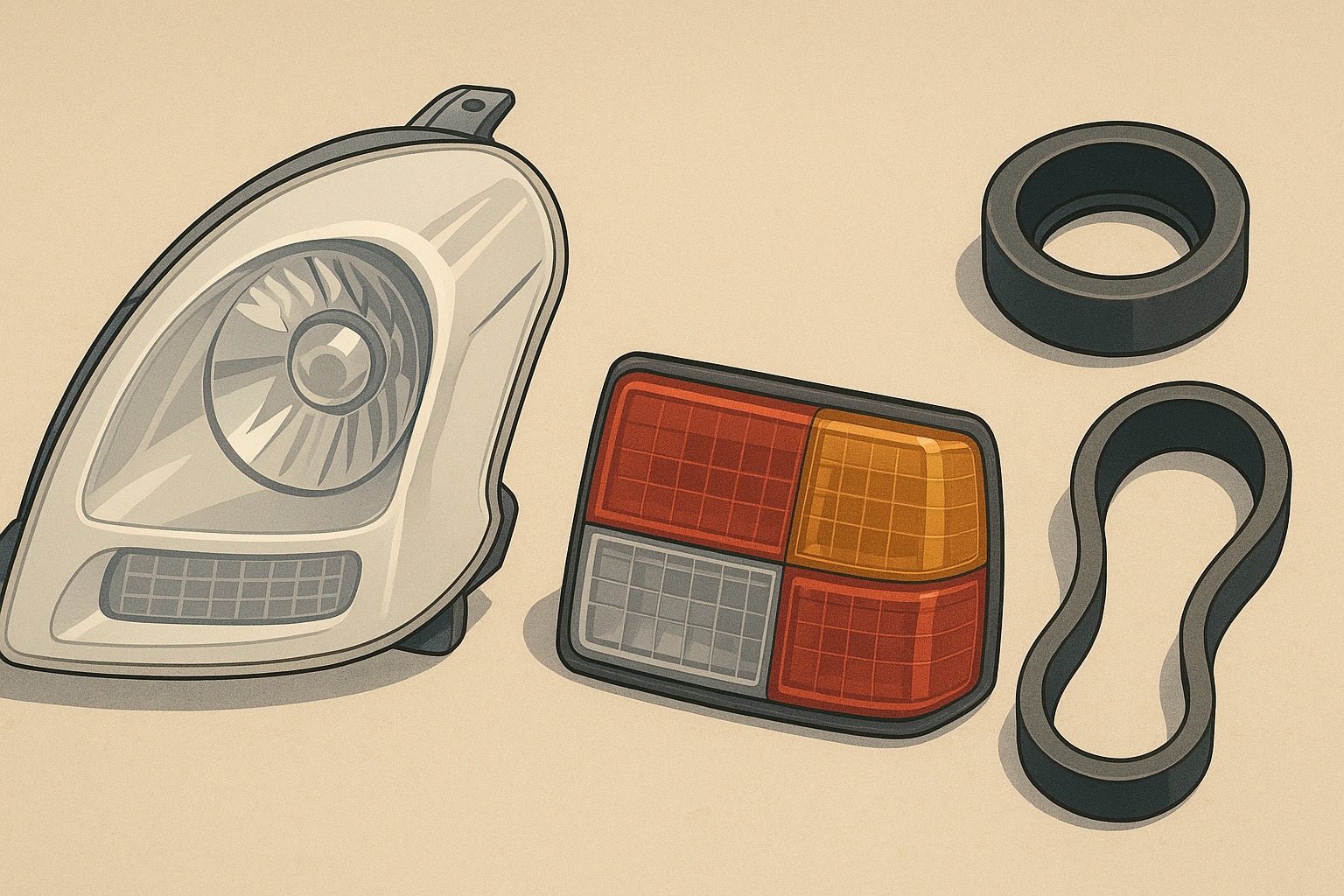
Among exterior parts, headlight and taillight lenses are especially critical: if they crack or deteriorate, the vehicle fails inspection and cannot be driven. Since 2015, vehicle inspection standards for headlights have shifted to emphasize low beam performance, making lens cloudiness, yellowing, and cracks fatal reasons for failure. It’s entirely possible to see a scenario like “lens crack with light leakage → inspection failure → if unfixable, your only option is to sell it to a used car buyer.” Because the integrity of lighting systems is strictly mandated by law, having new or good-condition stock gives you peace of mind.
Headlights typically have resin covers that tend to become cloudy with age, so if new assemblies are currently available, it is a good idea to secure new Assy units. Additionally, keep spare bulbs and ballasts on hand (in the case of HID vehicles), and slow the deterioration of the current lights through coating treatment or periodic polishing. To prevent lens cracks, applying a stone chip protection film is also effective.
Turn signal, taillight, and retractable light units are also difficult to substitute because they are specific to each model. It’s too late to search once they break, so if you find a good used one on a net auction, secure it and store it early. Fortunately, lights are relatively compact and easy to store, so packing them in a box with desiccant and storing in a dark place allows for long-term preservation (detailed storage methods follow below).
Moreover, rubber seals on the body (weatherstripping) and similar components are essential to the exterior. When door and window frame seals deteriorate and crack, they not only cause rain leaks and wind noise, but prolonged neglect leads to rust and interior degradation. However, weatherstripping is extremely difficult to source. Even restoration vehicles displayed in automotive museum collections have fine cracks remaining in their window gaskets or have undergone skillful repairs, to the point that even official manufacturer restorations often cannot provide new pieces. As a result, projects where clubs or enthusiasts pool resources to custom-manufacture replacement seals do exist. Gathering such information and, if needed, participating in or contributing to reproduction projects is one option.
《Exterior Parts Stocking Tips》
- Prioritize stocking legally required parts like headlights and taillights. Also implement crack and cloudiness prevention measures.
- Rubber parts like weatherstripping are hard to find. If new units are available, buy several, and store them in a dark place with controlled humidity (details follow).
- Exterior panels like bumpers and fenders are large and difficult to store, but since they’re at risk in accidents, if you find good used examples, it’s worth securing them. However, since worst-case custom fabrication (FRP replication or metalwork) is possible, they’re not as high priority as lighting components.
- Check auctions and secondhand sales sites regularly and buy immediately when items appear. With prices trending upward, “I can get it later” is a dangerous approach.
2. Electrical Components (Alternators, Motors, ECUs, etc.)
Electrical system parts are also vital to classic car maintenance. The prime examples are alternators (generators) and starters (starter motors). If these fail, driving and restarting become difficult and the vehicle won’t run. Fortunately, rebuilt alternators and starters have circulated for decades, and in many cases repair shops can replace them even without original parts. That said, as the supply of rebuilt units for older vehicles shrinks each year, having a spare used core on hand and considering getting it overhauled by a specialist yourself is worth planning for. Some classic car enthusiasts even keep a spare alternator with them and can swap it roadside if needed, showing why building redundancy into the electrical system is so valuable.
Next, power window motors and wiper motors and other motor types are important because when they fail, the windows and wipers stop working, which is inconvenient and dangerous. Most of these are custom-designed for specific vehicle models, making replacements difficult, so remove and stock them from used donor vehicles, or if possible, place an order for new units early. Window switches and other switch types tend to develop contact problems over time, but they are parts that can usually be adapted from similar vehicles. Secure them with harnesses from dismantled cars, and if you maintain them with cleaning and contact reviver and store them, you can swap them in plug-and-play fashion when needed.
Electronic control units (ECUs) on older vehicles also require attention. Vehicles from the 1990s onward are equipped with various computers including electronic fuel injection control and ABS control units, but these can fail due to deterioration of electronic components on the circuit board (capacitors) or solder cracks. If the manufacturer has exhausted inventory, obtaining a new ECU becomes difficult, and repair requires advanced electronics expertise. Having a specialist firm replace or refresh the capacitors inside the ECU is effective preventive maintenance, but first, securing a used ECU in working condition offers peace of mind. In particular, vehicles with immobilizers often have ECUs and keys that are linked, so it is better to secure a matching key cylinder and keys as a set (more on keys later).
«Electrical Component Procurement Checkpoints»
- Replace the alternator and starter while rebuilt units are still available, and keep the removed old units as cores. If you can stock spare rebuilt units as well, that is even better.
- Power window and wiper motor types and regulator types should be removed from used donor vehicles and kept in storage. Even units with unconfirmed operation can often be restored through disassembly and servicing, so there is value in acquiring them.
- Stock wiring harnesses and relays and other key components as backups for breakage or deterioration. In particular, fuse boxes or relay boxes as complete sets can sometimes be obtained used at low cost.
- For ECUs and electronic control units, secure a used unit in good condition as soon as you find one. Storage should include moisture and static electricity protection measures, and since capacitors deteriorate over time even without power, pre-replacing them ensures complete reliability. If you do not have a spare ECU, research specialized firms that offer circuit board repair services.
3. Sensors and Electronic Devices (Engine and Chassis Control)
Modern vehicles use many sensor types. Engine control includes O2 sensors (oxygen sensors) and airflow sensors (MAF), throttle sensors, coolant temperature and oil temperature sensors, and various other detection devices. When these fail, they cause engine trouble or the engine check light to illuminate. For instance, an O2 sensor malfunction throws off fuel mixture, resulting in poor fuel economy and unstable idling, and the vehicle will not pass the emissions inspection portion of the vehicle inspection. If the check light remains illuminated, the vehicle inspection fails, so a sensor failure cannot be overlooked.
Sensors are fundamentally consumable parts and replacement with new units is desirable. However, when the inventory of original sensors for older vehicles is depleted, finding replacements becomes challenging. Generic sensors to manufacturer standards can sometimes be used as substitutes. In fact, many O2 sensors have generic Bosch or Denso equivalents available, and cases exist where these can be adapted by changing the connector. Additionally, aftermarket compatible airflow sensors are supplied for some domestic vehicles made by Suzuki and Nissan. Therefore, look up the model number of the sensor used on your vehicle and gather information about cross-vehicle applications and aftermarket compatibility. If needed, purchase used sensors in working condition in advance, clean them, and store them for peace of mind.
For safety devices, ABS sensors (wheel speed sensors) and airbag-related sensors are also important. If the ABS warning light remains on, the vehicle will not pass inspection (vehicles equipped with ABS must show normal operation as a requirement of the test), so if a sensor fault or break is the cause, replacement is necessary. Most ABS sensors are vehicle-specific, and when new stock runs out, you have no choice but to turn to used units. Since this is a part that rusts, seizes, and breaks easily, stock one or two spare sensors as backup. When removing them, take care to avoid breaking the connections.
«Sensor Procurement Checkpoints»
- Engine control sensors (O2, MAF, throttle position, crank angle, etc.) should be replaced with new units once the recommended replacement period has passed, and keep the old sensors removed as well (for emergency use as a stopgap). If new units are hard to find, locate and secure a used unit in good condition.
- Even if sensors have the same model number, connector differences and other variations can occur between manufacturing years, so research compatibility information. Note any information where aftermarket or cross-vehicle use is possible, and acquire them if you find them.
- ABS and airbag sensors have a low failure rate, but when they do fail, alternatives are hard to find. In particular, acquiring a used ABS sensor and treating it with moisture protection (such as applying contact grease to the connector part) to slow deterioration and keep it in storage is a better approach.
- When storing, be mindful of rust and moisture protection. Apply contact reviver to the sensor terminal area as needed to prevent oxide film formation, and store in sealed bags. Also, store parts with moving elements (for example, plastic knock sensors) in a dark location to prevent deterioration.
4. Interior Parts (Trim, Seats, Dashboard, etc.)
Interior parts do not directly affect driving performance, but maintaining the original feel and comfort is something classic car owners care about. The parts most prone to wear are first seat upholstery, trim, and fabrics. Fluffy velour fabrics from the 1980s and other period-authentic new materials are essentially unobtainable today. If a seat tears or sags, the current reality is that you must either hunt for a good used seat from an identical model or have it reupholstered with similar fabric. Fortunately, in recent years reproduction seat upholstery sets for popular classic cars have begun to appear. Research whether such developments exist for your vehicle type, and if they do, do not miss the opportunity to purchase.
Dashboards and interior plastic parts are also prone to sun damage and cracking, making them parts owners want to replace. However, new dashboard assemblies are essentially unobtainable, so the general approach is to secure used units and perform repair restoration as needed. Small cracks can become quite clean with commercial repair kits or professional restoration, but if there is significant cracking, the dashboard must be replaced entirely. For this reason, if you find a used dashboard in good condition, it is worth securing it early. If storage space is hard to come by, an effective approach is to lay a dashboard mat that blocks sunlight to prevent cracks and thus keep the original part from deteriorating as much as possible.
Other commonly missing interior parts include meter panels, switch knobs, consoles, and trim pieces. Small plastic components are prone to cracking due to age-related deterioration, but in recent years there have been cases where replica parts made by enthusiasts using 3D printers are distributed and sold. Share information through owners’ clubs and social media, and take advantage of such alternatives when available. Also, meter units and audio systems may be offered restoration services by restoration specialists. Examples include having an old car stereo that no longer works overhauled at a specialist shop, or having meter gear damage repaired. For interior parts, while it can be hard to “buy new,” there are relatively good options to “repair what you have.” While consulting with a trusted specialist, make sure to keep broken interior parts rather than throwing them away, since you may need them later.
《Interior Parts Sourcing Tips》
- Seat and interior trim fabrics are difficult to source new. Damaged areas can be re-covered by a professional upholstery specialist, so find a shop that stocks similar colors and textures. If you insist on original parts, use your network to hunt for good used examples for transplantation.
- For dashboard and panel assemblies, keep spare units on hand if you have storage space. If space is limited, protect the original carefully (UV protection, indoor storage) to extend its life.
- For small parts (clips, knobs, etc.), stock multiples whenever possible. Replace fragile components with new ones while they’re still available, and keep removed parts as emergency backups.
- Since interior components are in a constant battle against deterioration, regular maintenance is essential to extend their lifespan. Care for leather and vinyl with protective products, use anti-cracking agents on plastics, and make an effort to “prevent parts from wearing out.”
5. Suspension and Brake Components (shocks, brakes, bushings, etc.)
Suspension and brake parts—commonly called “running gear”—are another area where classic vehicles often face sourcing difficulties. Since these parts are critical for safe operation, we’d want to replace any that are worn or broken, but for older vehicle models it’s not uncommon to find that original shock absorbers, bushings, and brake components are discontinued.
Shock absorbers (dampers) are consumable items, but if original manufacturer parts aren’t available, aftermarket or cross-platform alternatives can work. Fortunately, major manufacturers like Kayaba and Bilstein still produce and supply dampers for classic vehicles in many cases. First, check whether an aftermarket damper compatible with your car is available; if it is, replace it sooner rather than later (save the old damper you remove as a core for rebuilding, making it a backup). If aftermarket options don’t exist, you can source a used original damper and have it overhauled by a specialist.
Bushings (suspension bushings, engine mounts, and other rubber components) harden and crack over time, compromising ride comfort and handling stability. Ideally these should be replaced with new parts, but for some vehicles the original parts are discontinued and unavailable. In such cases, generic bushing materials or cross-platform alternatives from other models may work. Often, if dimensions match, parts from other manufacturers can be adapted—this is routine practice in classic car restoration. Search online classic car communities and blogs to see if anyone has posted information like “this bushing can be sourced from another model” for your vehicle. If you find a current-production bushing from another car that looks compatible, buying it in advance is also a good hedge against the future.
For brake systems, brake pads and rotors are relatively easy to source (many cross-platform and aftermarket options exist), but overhaul kits for brake calipers and master cylinders can be discontinued. Without an overhaul seal kit, the system cannot be disassembled for service, making it impossible to respond if brake fluid leaks. For domestic vehicles, generic kits from brake manufacturers may work, so investigate compatible part numbers and secure them. Also, old brake hoses are prone to ballooning and cracking, so replacing them early is advisable (store the replacement hose as an emergency backup if it’s in good condition).
A word about tires: while new tires themselves are still available for purchase today, there is a size standard discontinuation issue unique to older vehicles. For example, the Michelin TRX (a tire for metric-size wheels) adopted on some vehicles from the 1980s has no domestic alternatives and is hard to find. In such cases, you have no choice but to change wheels and go with a current size. Additionally, for popular classics, classic tires—limited-edition offerings that recreate period-correct tread patterns—are sometimes released. If your car’s original tire size risks being discontinued, check for such news, and if needed, stock the necessary quantity. Keep in mind, though, that tires are rubber products subject to age-related deterioration; if you stockpile them and store them for years, they’ll harden and become unusable. Pay attention to your purchase timing and avoid stocking more than you’ll reasonably need.
《Suspension and Brake Components Sourcing Tips》
- Use new-production aftermarket shock absorbers, and keep old originals for rebuilding and trade-in. Coilover kits are still available for some vehicles, so research what aftermarket manufacturers offer.
- For suspension bushings and mounts, assess their condition and proactively replace them with compatible generic parts if they’re still serviceable (for example, switching to generic urethane bushings). If you want to preserve the original shape, keep used stock on hand and consider having replica parts made when needed.
- For brakes, stock extras of consumables (pads and rotors). Also recommended: buy small parts like seal kits and reservoir caps before they sell out. Research the market and source aftermarket alternatives.
- Wheel nuts and hub bearings, suspension arms, and similar components can also break. Especially hub bearings—once you know the part number, generic manufacturer versions are available, so having the compatible part number on file gives you peace of mind.
6. Key Cylinders and Lock Components (ignition keys, door locks, etc.)
Finally, there’s an often-overlooked area: key cylinder components. If the ignition (main key) cylinder or door lock breaks, engine starting and locking become difficult. On older vehicles, wear inside the key cylinder or broken tumblers can cause problems like “the key won’t turn” or “the key won’t come out.” If the key won’t even turn to the ACC position, the steering wheel lock won’t release either, creating a serious problem where even towing becomes difficult.
New cylinders can be installed if manufacturer stock is available, but for classic vehicles key cylinders are often discontinued. When that’s the case, one approach is to search for a used cylinder from an identical model. However, used units are scarce, and even if you find one, the key likely won’t fit, so the locksmith will need to rearrange the tumblers. Highly skilled locksmiths can sometimes adjust a new cylinder’s internal shims to match your existing key. While it costs money, you can end up with “the same key but a new internal cylinder.” It’s possible.
Another approach is to use a cylinder assembly from a different model that’s similar. If there’s a key mechanism with common design within the manufacturer’s lineup, substitution may be possible. With Japanese domestic vehicles, for example, some older Nissan models can work with later universal key assemblies, so it’s worth gathering information while consulting with mechanics and locksmiths.
Let me also mention the key itself. Smart keys with immobilizers can sometimes become difficult to reissue at a dealer, and losing one can result in having to replace the entire ECU. Even with older cars, always make spare keys, and be sure to keep track of your key number tag and check how to re-register the immobilizer. The key is a small part, but losing or breaking it can have huge consequences. Especially with classic cars, original blank keys for spares are rare items, so if you find one online, I recommend buying it and using it to make spares.
《Key Cylinder & Key Procurement Checklist》
- If the key starts turning stiffly, use a lubricant made for key holes early on. If that doesn’t help, proactively source a used cylinder and have it overhauled.
- Partner with a locksmith and ask whether replacement or tumbler adjustment is possible. A locksmith experienced with classic cars may have spare parts in inventory, so gather information.
- If possible, source a complete key set (ignition & door & trunk cylinders plus keys) from a donor vehicle and have it serviced to work with your car for complete peace of mind.
- Always make multiple spare keys. Immobilizer keys are a hassle to re-register if lost, so watch out for dead batteries and glitches, and check their operation regularly.
Sources for parts and effective storage methods
Once you’ve decided to secure these important parts, you’ll also want to think about where to source them and how to store them. Here I’ll outline the main sourcing routes and storage tips.
Main sources for part procurement
- Factory order (new genuine parts): If stock is available, getting genuine parts first is the safest bet. But once stock runs out, the part is “discontinued,” so you should secure it while you can place an order. Some manufacturers will remanufacture the part if a certain number of back-orders accumulate. It’s worth asking dealers anyway—check stock status and ask about future availability. Recently Toyota and Nissan have begun producing reproduction parts for some classic models, but the range of available parts is limited, so don’t rely too heavily on this.
- Parts merchants and aftermarket parts: Research whether genuine OEM parts or equivalents are available commercially. Auto repair shops or parts merchants may have stock. Aftermarket parts are often cheaper than genuine ones and generally perform just as well. A helpful mechanic or specialty shop will sometimes search out compatible parts and suggest them.
- Used parts (Yahoo Auctions, dismantlers, etc.): This method involves sourcing used parts stripped from scrapped vehicles through private sales or dealers. Online auctions often have rare parts, but prices can spike and you risk being outbid. You need to check new listings regularly and develop a sense of fair market prices. You can also contact dismantlers directly and ask them to search their inventory (some have online part-sharing networks across the country). Used parts vary in condition, so when possible confirm the actual item, and securing extras is ideal.
- Using rebuilt parts: Engines, transmissions, alternators and similar components are available as rebuilt (reconditioned) parts in the market. Even when new stock isn’t available, searching nationwide often turns up inventory, so contact parts suppliers and specialists. Rebuilt parts are used components that have been overhauled, so they’re not brand new, but their performance is nearly equivalent and the price is lower. You can sometimes get them even more cheaply through a “core exchange,” where you trade in your old part.
- Custom fabrication and repair: When you simply can’t source a part, you have the option of asking a machine shop to fabricate it. For metal parts, you can create a drawing from the original and make a one-off part. Plastic parts can also be duplicated if you make a mold. Realistically it comes down to budget, but in this world, “money can solve most impossibilities.” Practical examples include custom fabricating a radiator or oil cooler from a generic core, or replicating cracked plastic parts using fiberglass or a 3D printer. Researching the various specialists available will give you a strong safety net as a last resort.
- Parts from other models and generic components: As mentioned earlier, you can substitute generic parts in some cases. For example, generic rubber hoses or off-the-shelf electrical components—if the shape fits, there’s no performance problem, so use them actively. The advantage that generic parts are abundant on the market and supply is reliable is significant. Bushings and fuel pumps are things you can adapt from generic components. Especially for function-first applications (for example, if the fuel pump output is right, a different shape is fine), it’s worth first establishing the required performance, then considering substitute parts. Also, using the reuse information mentioned earlier, adapting parts from other models by the same manufacturer is a standard approach. Surprisingly, manufacturers often use common parts across different models, and it’s quite common for different model types to share the same part number. It takes experience and knowledge, but using adapted parts really does help. Research to find out “what other vehicles use this part?” and bring components from the matching model.
Tips for storing parts long-term
Keeping valuable parts that you’ve gone to great trouble to obtain requires storing them properly so they don’t deteriorate. Storage precautions vary depending on the part material, so keep these points in mind.
- Metal parts (such as engine mechanical components, bolts, etc.): To prevent rust, coat the surface with grease, wrap it in oil-soaked paper (grease paper, etc.), then seal it in a plastic bag. This blocks moisture and prevents rust over the long term. Choose a storage location that avoids extreme heat and humidity, and ideally place it in a sealed container with desiccant. For large metal parts like engine blocks, apply rust preventative oil, wrap in plastic wrap, and store in a warehouse. Check periodically to make sure no rust spots have appeared.
- Rubber and resin parts (for example: bushings, hoses, weather stripping, timing belts, and so on): rubber degrades from ultraviolet light, oxygen, and extreme temperature and humidity changes. The basic approach is to store them in a dark place away from direct sunlight, and the ideal environment has little temperature fluctuation and humidity around 40–60%. If humidity is too high, rubber swells; if too low, it hardens from drying. Use a desiccant or store in a container with adequate ventilation. Sealing completely in a plastic bag risks trapping moisture inside, so the trick is to leave ventilation holes or wrap in breathable material. Also, ozone is rubber’s enemy, so keep parts away from motors (which generate ozone). Storing them with a thin coat of silicone grease to create an air barrier is also said to be effective. To keep parts in usable condition after long storage, check their condition periodically and look for cracks or hardening.
- Electronic parts and circuit boards (for example: ECUs, sensors, semiconductor parts): pay attention to moisture and static electricity. For moisture protection, keep them in sealed bags with desiccant (silica gel) and store indoors where it does not get extremely hot. Old boards also suffer solder deterioration, so after long storage it is wise to inspect them for solder cracks. Applying contact cleaner to pins and connector areas beforehand prevents problems with poor contact due to oxidation when you actually use them. Consumable parts on the board, such as electrolytic capacitors, are best replaced with new ones before degradation happens during storage.
- Exterior painted panels (for example: fenders, hoods, and so on): to protect the paint finish, wrap them in soft cloth or padding, and store flat rather than leaning them up. Avoid direct sunlight and humid environments, and apply rust preventative treatment as needed. For large parts, it is difficult, but make effective use of space by hanging parts from the ceiling of a warehouse or garage. During storage, inspect condition every six months to a year, and check for rust or paint peeling.
- Interior parts and fabrics (for example: seat upholstery, carpets, headliner material, and so on): clean and air-dry them thoroughly before storing. Fabric and leather are vulnerable to mold, so store them in boxes with desiccants and mothballs, and place them in a breathable location away from direct sunlight. Regularly oil leather products to keep them supple. Store resin interior panels away from direct sunlight, laying them flat so they do not warp. If you cannot store them indoors, wrapping them in a blanket and putting them in a cardboard box makes a real difference.
By storing each type of part using the method best suited to it, you can maintain them in a condition where they will likely still work 10 years down the road. Since it would defeat the purpose to let the parts you took such care to secure deteriorate, store them with an awareness of managing “humidity,” “temperature,” and “light.”
Make use of specialty shops and owners’ clubs
Finally, I want to emphasize how important relationships with trustworthy specialty shops and information communities are for classic car owners. Do not face part-sourcing worries alone—drawing on the knowledge of professionals and fellow enthusiasts opens up new possibilities.
A shop specializing in classic cars is a strong ally to the owner. There are trustworthy businesses that import out-of-print parts from overseas or even manufacture replicas in-house, and some shops have abundant expertise and inventory, coordinating with clubs and volunteer groups to custom-order the reproduction of rubber parts and the like. If you maintain a connection with such specialists, even if a part is unavailable, they can “search for it,” “make it,” or “advise you,” so you can keep driving your classic car with confidence, despite the fact that classics break down and parts go missing.
Moreover, specialist shops do more than simply supply parts; they also support you in extending the life of parts through proper maintenance. Craftspeople skilled in classic car repair possess extensive knowledge about “which parts should be replaced before they fail” and “which parts can be reinforced with substitutes.” When you consult with them during a regular inspection, you may receive suggestions for preventive maintenance such as “this looks suspect by the next inspection, so let’s start looking for a part for it.” Rather than giving up immediately because a part is hard to find, you can often discover a way forward by first consulting with a skilled mechanic.
Owners’ clubs and classic car communities online are also extremely useful. Through the knowledge and connections of those who came before, information about part availability can emerge, and members can help each other out. If you speak up saying “I’m looking for this part,” it is not uncommon in classic car circles for someone to unearth it from a warehouse and give it to you. In today’s information society, if you actively engage through SNS and blogs and build a mutual aid network where people say “I want this part” or “I have that one,” you can feel secure.
Furthermore, in recent years, manufacturer-affiliated heritage parts programs have been gradually expanding. Nissan and Mazda have begun reissuing parts for the Skyline GT-R and Roadster NA, and Toyota has started resupplying parts for vehicles like the AE86 and Supra. If your own car qualifies for one of these programs, do not miss out—catch the information and order the necessary parts right away. However, reproduction parts are often available for a limited time and in limited quantities, so it is essential to move quickly.
In short, maintaining a classic car is about relationships and staying informed. Rather than hunting for parts alone, having a knowledgeable specialist shop as your “primary care doctor” and having fellow enthusiasts as your “peers” dramatically increases the sense of security and your ability to secure parts. Think of “joining a classic car enthusiast community as part of ensuring your parts supply,” and please make active use of it.
In Conclusion: Prepare Now, Worry Never—Enjoy Your Classic Car Life
In maintaining a neo-classic vehicle, avoiding the situation where you “cannot drive because there are no parts” requires advance information gathering and a stock of parts, as well as support from trusted specialists. For each part category we have covered in this article, I hope you will review them in the context of your own car or motorcycle, and take action with thoughts like “this is hard to get, so I should prepare a spare” or “I should look into whether a substitute would work here.”
Keeping classic cars requires effort, but the joy of tracking down rare parts and the satisfaction of keeping your beloved car running through ingenuity are incomparable. While you’re still fortunate enough to find usable parts, stock up on “an ounce of prevention” so you won’t panic when the time comes, and you can continue driving your car for years to come. As parts become harder to source, the message is clear: “strike while the iron is hot”. Don’t put it off—start making your preparations right now.
Finally, even if you can’t keep a parts car, there’s a lot you can cover through partnerships with specialists and communities. With the knowledge of professionals and fellow enthusiasts on your side, make sure you’re fully prepared so your neo-classic car keeps running strong for years to come, and enjoy a rewarding classic car lifestyle.