
Introduction
This article has been completely rewritten with information current as of October 2026. It covers both people sending motorcycles from Japan overseas and people bringing motorcycles from abroad into Japan and then taking them out again.
Let me start with an overview of costs. A temporary import and export of one motorcycle between Japan and Europe costs around 10,000 euros total. Even one way, Japan-side costs from Yokohama to Rotterdam run 500,000–600,000 yen, with local costs around 200,000 yen. International motorcycle shipping involves more expense and more paperwork than most people expect.
There is one more thing I want to convey in this article. Japanese export customs procedures include operational practices that you cannot learn from reading the law alone. In particular, there is almost no accurate information available about the Motor Vehicle Temporary Import and Export Declaration Form (C5014), used on international ferries, and the CPD carnet (自家用自動車通関手帳). This article focuses on facts that we at Good Loop have confirmed through actual dealings with customs, ferry operators, and customs brokers on real projects.
Transportation methods and cost estimates
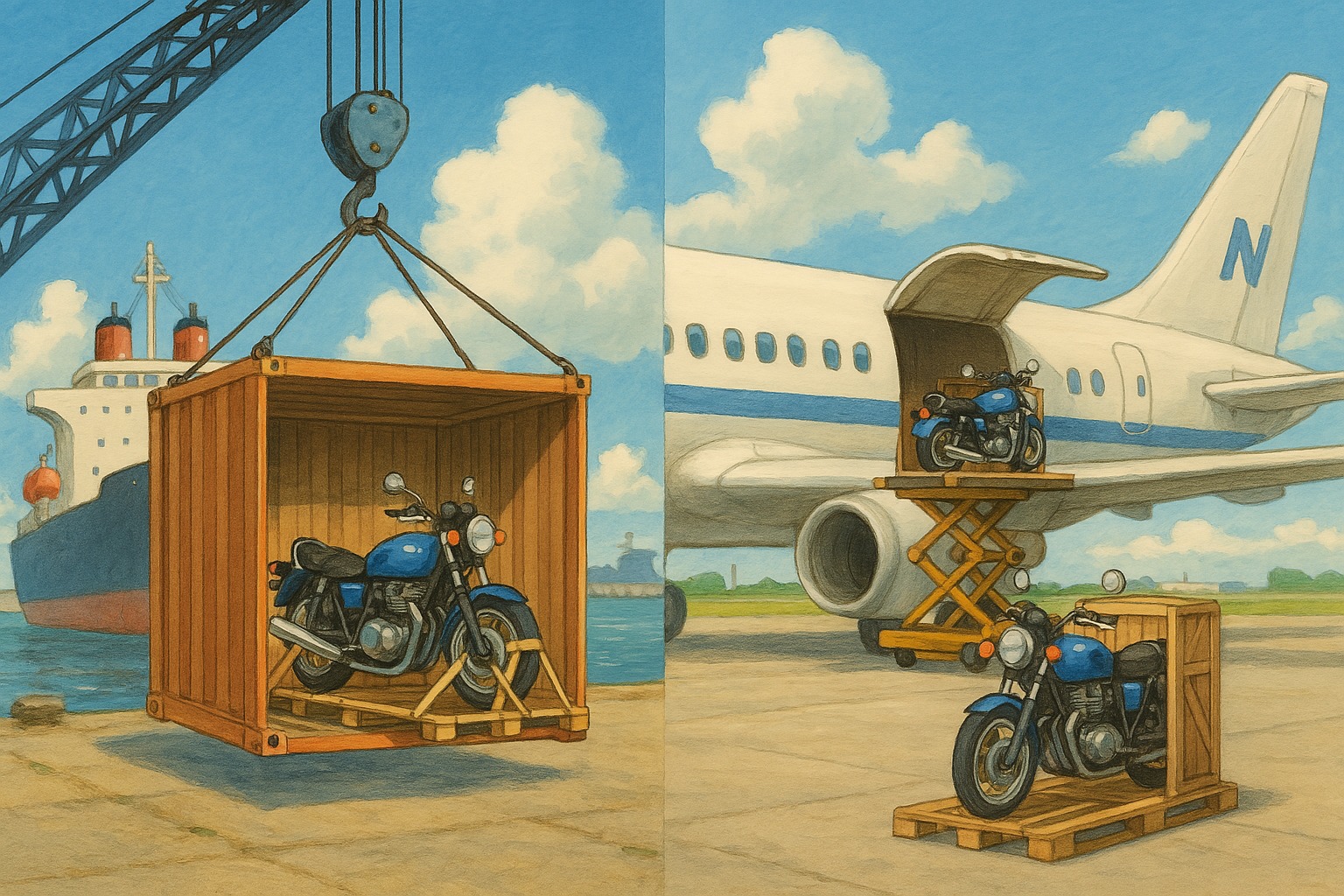
Practically available methods for international motorcycle shipping are four: container consolidation (LCL), full container load (FCL), international ferry, and air transport. Ro-Ro ships (car-only vessels), the mainstream choice for vehicle exports, are almost never used for shipping a single motorcycle.
| Category | Container Consolidation (LCL) | Full Container Load (FCL 20ft) | International Ferry | Air freight |
|---|---|---|---|---|
| Cost estimate | Japan side: 500,000–600,000 yen Local side: around 200,000 yen (Yokohama to Rotterdam example) | Around 1,200,000 yen per unit (If you consolidate 5–6 motorcycles, the freight share works out to 200,000–240,000 yen per unit. Fixed costs are separate.) | Contact each operator | From Japan 1,000,000 yen and up per unit |
| Time required | Over one month to Europe (Over two weeks from intake to loading) | Same as above | One to two days | Several days |
| Packing | Wooden crate packing | Fixed inside container | Not required (self-propelled) | Wooden crate or pallet |
| Features | Possible from one unit onward. Customs brokers often decline. | More economical when consolidating multiple units | Korea and Russia routes only. Temporary import and export via C5014 is possible. | Fast, but expensive. Vehicle height significantly affects the quote. |
Cost guideline by destination (container consolidation, one unit)
| Destination | Japan side | Local side | Days required |
|---|---|---|---|
| Europe (Rotterdam) | 500,000–600,000 yen | Around 200,000 yen | Over one month |
| United States | 500,000–600,000 yen | Around 200,000 yen | Over three weeks |
The cost breakdown is the same for both destinations as explained in the “Container Consolidation (LCL)” section above. Tariffs and value-added tax are not included. The days required is an estimate from intake in Japan until you can pick up the cargo at the port in the destination country.
For permanent export to the United States, there is a requirement that the motorcycle be 25 years or older from its date of manufacture. Read “What is the United States 25-year rule?” for more information.
→ What is the US 25-year rule?
Container Consolidation (LCL)
This is the standard method for sending one motorcycle overseas. Pack it in a wooden crate and load it into a container with other cargo. Japan-side costs include wooden crate packing, inland transportation pickup, CFS (container freight station) intake, port charges, export customs clearance, and ocean freight. On the local side, costs include obtaining a D/O (delivery order), import customs clearance, and terminal charges.
For shipments to Europe, the process takes over one month. Because intake to loading alone takes over two weeks, plan backward from your departure date with some margin.
Mixed consolidation exports of used motorcycles are declined by many customs brokers.They shy away from it because the effort is high for low profit, especially on individual shipper shipments. Good Loop has secured partners who can handle these kinds of projects, so if you cannot find a broker, please contact us.
Full Container Load (FCL)
One 20ft container costs around 1,200,000 yen as a guideline. You can fit 5–6 motorcycles, so consolidating them brings the freight share to about 200,000–240,000 yen per motorcycle. However, lashing costs to secure the vehicles inside the container are charged separately according to how many units there are, so it does not divide evenly. Even so, it often costs less than consolidation and is well suited for group rides or consolidating multiple motorcycles headed the same way from different owners.
International Ferry
International ferries connecting Japan with Korea and Russia include routes where you can ride motorcycles on self-propelled. Routes and fares change, so contact each operator directly.
- Sakaiminato–Donghae (Korea)–Vladivostok: Eastern Cruise & Ferry (Eastern Dream)
- Hakata–Busan: Camellia Line
- Shimonoseki–Busan: Kanpu Ferry
- Osaka–Busan: Panstar Ferry
The main conditions for temporary export on an international ferry from Japan are as follows.
- Round-trip booking is required; you cannot book a return with an open date. Temporary import and export procedures are possible only on the same route.
- Cargo other than the motorcycle’s equipment and supplies is treated as separate freight. You may need to remove all cargo from inside the vehicle for inspection when entering and leaving the country.
- When returning to Japan, there is a random X-ray inspection of the vehicle. Vehicle transport to the inspection station is at your expense.
- Booking should be one month before departure; document submission should be two weeks before as a guideline.
Fares are determined by cabin class and vehicle type, and to this are added Japan-side proxy customs clearance fees, Korea-side duty-free procedures fees, and Korean automotive insurance charges.
International ferries have a system (C5014) allowing temporary import and export without a carnet. However, operational constraints mean it may not be usable if you are not traveling round-trip. For details, read “Temporary Import and Export Systems and Actual Operations” below.
Air freight
Delivery takes several days, but shipping from Japan costs over 1,000,000 yen per unit. If a vehicle is too tall to fit in an air container (ULD), it requires a dedicated cargo plane, and the quote shoots up significantly. Special care is needed with tall vehicles like adventure bikes. This option is for emergencies or when time takes priority over cost.
Temporary Import and Export Systems and Actual Operations
Vehicles for overseas touring are handled not as a permanent export but as a “temporary import and export,” with the plan to return them to the original country after a certain period. The systems related to Japan are two: the CPD carnet and the Motor Vehicle Temporary Import and Export Declaration Form (C5014). First I will explain their legal position, then I will explain how they actually work.
CPD Carnet (Carnet de Passages en Douane)
CPD (Carnet de Passages en Douane) is a customs document based on the “Customs Convention on the Temporary Importation of Private Motor Vehicles” (1954, New York). Under the guarantee of FIA/AIT, it allows vehicles moving between contracting countries to temporarily import duty-free. Japan’s national law is the “Law Concerning Special Provisions of the Customs Law in Connection with the Implementation of the Customs Convention on the Temporary Importation of Private Motor Vehicles” and its ordinance.
- The issuing authority in Japan is JAF (Japan Automobile Federation). Issue fees are 30,000 yen for a 5-page booklet and 46,000 yen for a 25-page booklet (6,000 yen discount for JAF members). It normally takes about one month from application to issuance.
- The validity period is one year.
- Overseas issuing authorities by country can be confirmed at carnetdepassage.org
- To enter Japan on a CPD issued abroad, JAF certification is required. Certification is by advance reservation. JAF certification office list (in English)
Motor Vehicle Temporary Import and Export Declaration Form (C5014)
Private motor vehicles traveling between Japan and foreign countries on international ferries can use Customs Form C No. 5014, “Motor Vehicle Temporary Import and Export Declaration,” for duty-free temporary import and export, separate from a carnet. The basis is the customs notice “Customs procedures for private motor vehicles imported or exported using international ferries” (Zōkukan No. 849).
- Temporary import: Create two copies of form C5014 and declare them to customs. Once approved, one copy will be issued as an import permit and will be needed at the time of re-export.
- Re-export: Submit the import permit as an export declaration. Once an export approval stamp is affixed, it becomes an export permit.
The annex to the notice defines the scope of spare parts, accessories, and equipment that can be brought in duty-free as follows.
| Item | Item | Quantity |
|---|---|---|
| Spare parts | Wheels (with tires) | The number normally carried as spare equipment on that passenger vehicle |
| Consumable spare parts such as sparking plugs, fan belts, and fuses | One piece (or the number simultaneously used if multiple identical items are used at the same time) | |
| Accessories | Head rests, safety seat belts, etc. | Items for passenger safety protection that are installed on the passenger vehicle |
| Air conditioners, heaters, radios, televisions, stereos, etc. | Items incorporated into the passenger vehicle by methods such as fitting or screwing | |
| Equipment, etc. | Tools necessary for the maintenance and preservation of that passenger vehicle (including jacks, tire gauges, etc.) and other items (car wash brushes, feather dusters, wax, etc.) | One piece or one set (of tools) |
| Items necessary for safe operation of that passenger vehicle (warning lights, smoke signals, etc.) | One piece | |
| Cushions, floor mats, seat covers, etc. | Items in use | |
| Motor fuel | Up to the capacity of the built-in fuel tank and approximately one auxiliary fuel container (18 liters) |
ATA carnets and CPD carnets are different
There are two types of customs documents called “carnets”: ATA carnets and CPD carnets. Many people in the logistics industry have only handled ATA carnets and are unfamiliar with CPD carnet operations. Even if a service provider says “I understand carnets,” they may not know the procedures specific to CPD. When requesting a service provider’s assistance, always make sure to tell them that it is a CPD carnet.
| ATA carnet | CPD carnet | |
|---|---|---|
| Underlying treaty | ATA Convention (1961), Istanbul Convention (1990) | Customs Convention on the Temporary Importation of Private Road Vehicles (1954) |
| Scope | Commercial samples, professional equipment, exhibit items at trade fairs and events | Private road vehicles that operate on public roads (two-wheeled, four-wheeled, and recreational vehicles) |
| Japanese issuing organization | Japan Commercial Arbitration Association (JCAA) | JAF (Japan Automobile Federation) |
| International guarantor organization | International Chamber of Commerce (ICC/WCF) | FIA/AIT |
| Typical examples with vehicles | Round-trip transport of racing vehicles or display vehicles as cargo | A traveler temporarily exports and imports a vehicle they will drive themselves |
An example of a vehicle brought in on an ATA carnet being driven on public roads would be the vehicles competing in Rally Japan. The vehicles are imported as cargo, and a separate temporary operation permit (temporary license plate) is obtained for public road driving. For travelers who ride in on their vehicle and ride out, a CPD carnet is used.
Practical operation (1): Consider the C5014 as exclusively for ferry round trips
Zaikangai 849 is a notice that establishes procedures for vehicles being exported and imported using international ferries. We were told by customs that it is “intended in principle for entry and exit by ferry.” In practice, the following points are important.
- If the round trip is not by ferry, the customs branch will require a CPD carnet. If you plan to enter by ferry and exit from a different port by container or air, the C5014 may not be accepted at the time of entry. Ferry companies provide guidance in accordance with customs branch instructions.
- Operations vary by customs branch.The Sakaiminato Customs Branch does not allow temporary import under C5014 on the premise of re-export by means other than ferry. At other ports, there is a record of operations being approved where vehicles imported under C5014 are exported with the regular export declaration attached to the C5014, and the customs office at the port of export notifies the customs branch at the port of entry, thereby confirming duty-free status. We have experience exporting vehicles that entered by ferry to containers under this operation. However, judgments are made on a case-by-case basis, and it is not always approved.
- You may be asked to provide security.Under Article 13, Paragraph 3, as applied by Article 17, Paragraph 2 of the Tariff Rate Law, the security can be waived except when the customs director deems it necessary according to administrative guidance. If requested, deposit cash at the legal affairs bureau and receive a refund after export approval.
In conclusion: If you will not exit Japan by ferry from the port where you entered, obtain a CPD carnet before coming to Japan.There are travel accounts on the internet to the effect that “the law does not require exit by ferry, so there is no problem,” but customs branches requiring a CPD carnet is an operational fact. Even if there are examples of successful negotiation, results are not reproducible.
Operational practice (2): Export will be stopped if equipment is not listed on the CPD carnet
When exporting a motorcycle from Japan on a CPD carnet, there have been cases where customs brokers have refused to export because equipment such as pannier cases, bags, and tools are not listed on the carnet. This was an export project by a Dutch rider who imported on a CPD carnet and planned to export by container.
The background involves differences in the operations of issuing authorities.
- The CPD carnet issued by the JAF has a list of personal items and spare parts attached as an appendix to the final page and is sealed with an official stamp.
- Issuing authorities overseas do not commonly attach such supplementary lists.
- During import by ferry, the person and motorcycle enter at the same time, so baggage is treated as personal effects. There is no record of what was imported as within the scope of the carnet.
- The scope of the carnet is determined by the customs office at the time of export. It is not determined by the customs office at the time of entry or by the customs broker.
Under the law, accessories not listed are not all excluded from the scope of the carnet. Article 2, Paragraph 1 of the Special Measures Law includes in “motorcycles” “parts thereof imported together with them and normal equipment and accessories.” Article 9, Paragraph 3 of the convention does not require special notation for normal equipment, and Paragraph 4 allows requiring notation for accessories not recognized as normal equipment. Article 2 of the Implementation Order requires notation for spare parts priced at 10,000 yen or more, air conditioning equipment, television receivers, and other accessories priced at 10,000 yen or more.
In the case mentioned above, we consulted with customs and received the answer that accessories and spare parts priced at less than 10,000 yen per item can be exported within the scope of the carnet even if not listed on it.
Personal belongings such as clothing and camping equipment are not subject to the carnet in the first place and are duty-free under a separate system as a traveler’s personal effects (Kuragashira No. 627). However, the distinction between items entering as personal effects and items entering as equipment of the motorcycle is not recorded at the time of entry. If these are not carried by the owner and are exported with the motorcycle in a container, they fall outside the scope of the carnet for export declaration purposes and must be declared as separate cargo. When a customs broker says “we cannot export because it is not listed on the carnet,” this does not mean it is legally impossible to export; it means it cannot be handled under the carnet alone.
That said, the decision rests with the customs office of the export location. When having a CPD carnet issued overseas, either have the equipment listed in the “Other particulars” field or have the issuing authority attach a stamped equipment list as a separate document. This alone will help you avoid trouble at export.
Practical Operation (3): It is not realistic for non-residents to handle export declaration themselves
If you leave by ferry, you and your motorcycle go through customs together. However, if you send only the vehicle as cargo by container or air freight, export declaration is required. The declaration documents are in Japanese. While it is not impossible for an individual to do this, it is not realistic.
Moreover, many customs brokers decline to handle mixed exports of used motorcycles, and even fewer have experience with CPD carnets. If you are shipping a vehicle out of Japan as cargo, secure an agent who understands CPD carnet procedures as early as possible. Good Loop has a track record of arranging export declarations using both CPD carnets and C5014.
Practical Operation (4): Marine insurance does not cover external damage
Marine insurance for used vehicles can be obtained under ICC (C) conditions. Exterior scratches and paint peeling are excluded even under ICC (A) conditions for used vehicles. Insurance covers major damage such as maritime accidents or total loss.
Comparison of Carnet and Permanent Export
| Item | CPD carnet (temporary import/export) | Permanent export |
|---|---|---|
| Cost | Issuance fee and guarantee deposit (refundable if conditions are met) | Shipping and import country’s tariffs and taxes |
| Customs | Tax-exempt temporary import | Taxed and registered in import country |
| Validity period | 1 year | Unlimited |
| Registration | Traveling on original country plates (subject to receiving country regulations) | Re-registered in import country |
| Appropriate for | Overseas touring, rally participation | Relocation, sale, regular local use |
Pre-export Preparation Checklist
- Vehicle inspection: Confirm no leaks in lubricants and coolant. Charge the battery and adjust tire pressure.
- Cleaning: Remove mud and plant seeds from tires and body. For shipments to Australia and New Zealand from September through April, fumigation or heat treatment for brown marmorated stink bug control is mandatory, with associated costs.
- Fuel: Keep as minimal as possible. For air transport, empty the tank and ventilate.
- Battery: Insulate the positive terminal with tape. Lithium-ion batteries require a UN3481 label and may be refused for transport.
- Accessories: Remove mirrors and screens to reduce packing volume. Keep expensive cameras or navigation devices in a separate shipment or as hand luggage.
- CPD carnet: Verify that equipment is listed in the “Other particulars” field or in a stamped separate document.
- Documents:
- Temporary import/export: CPD carnet, or C5014 import permit if traveling by ferry
- Permanent export: Export deregistration provisional registration certificate or export notification certificate
- List of enclosed items
Procedures and required documents for permanent export (Japan side)
The deregistration procedure varies by engine displacement in terms of office and required documents.
| Category | Engine displacement | Office | Procedure |
|---|---|---|---|
| Moped | 125cc or less | Municipal office | Scrapping declaration |
| Light motorcycle | 126–250cc | Transport bureau | Submit return notification and receive light vehicle registration certificate returned (same documents as when scrapping domestically) |
| Small motorcycle | 251cc or more | Transport bureau | Submit export notification and receive export notification certificate |
The subsequent process is the same regardless of engine displacement.
- Preparation of customs documents: invoice, packing list, certificate of transfer
- Export declaration to customs and export permit
- Issuance of B/L and attachment of marine insurance
Customs clearance and taxes in import country (in case of permanent import)
- Tariff: 0–20% of vehicle value
- Excise tax and engine displacement tax: Many countries apply higher rates for engine displacement over 750cc
- VAT/GST: 12–25% (on CIF value basis including tariff)
- Environmental and safety standards: emissions regulations (Euro 5 and so on), lighting standards, ABS requirements, and more. Japanese-spec motorcycles cannot receive compliance certification as-is, and may require individual approval or replacement of lights, muffler, or ECU.
How to receive the vehicle locally
- Pickup at the CFS: the most economical option. After local customs clearance, you pick up the motorcycle yourself.
- Door-to-door: includes local customs clearance and delivery. Additional charges apply.
- Pickup at the airport: for air freight. You can choose an airport close to where your tour begins.
Ports and airports have free storage periods (free time), after which storage fees are charged daily. Once you receive notice of arrival, proceed promptly with customs clearance and pickup.
Frequently Asked Questions (FAQ)
Q1: I want to import by ferry into Japan and export by container from Yokohama. Can I enter with Form C5014?
A: It may not be permitted. If it is not a round-trip voyage, the customs branch will require a CPD carnet. Procedures vary by branch, and while there are instances where entry by ferry and exit by container have been successful, it is not permitted at Sakai Port. If you want to be certain, obtain a CPD carnet before departure.
Q2: I read on an internet travel blog that you can get through without a carnet if you negotiate.
A: That was an exception granted in an individual case. It is an operational fact that customs branches require a CPD carnet for non-round-trip voyages. Asserting rights based on something not written in the law text has no reproducibility. Additionally, it may inconvenience subsequent travelers.
Q3: My CPD carnet does not list pannier cases or tools. Will that be a problem?
A: The customs broker may raise this at export. Under the law, accessories and spare parts costing less than 10,000 yen per item do not require entry, but the determination is made by the customs office at the point of export. It is safest to ask the CPD carnet issuing organization to enter them in the “Other particulars” field or to provide a separate list with their stamp.
Q4: How much does shipping insurance cost?
A: A rule of thumb is 0.1 to 0.8 percent of the insured amount (the vehicle value plus freight and so on). Scratches and paint peeling on used motorcycles are not covered.
Q5: Is it cheaper to buy a used motorcycle locally rather than ship one?
A: In most cases, yes. Including transport, customs, and insurance, a one-way trip to Europe costs 700,000 to 800,000 yen total on the Japan side and the destination side combined. If the vehicle price is below this, buying a used motorcycle locally is cheaper. For permanent import, tariffs and value-added tax are additional.
Q6: Is a quotation free of charge?
A: A quotation is charged. Use the amounts in this article as a rough guide for an estimate. For an individual quotation, you must confirm charges with the forwarder, customs broker, and packing company separately. If you request a quotation from us, we will deduct the quotation fee from the charges at the time of order.
Treaties, laws, and circulars referenced
- Customs Convention on the Temporary Importation of Private Motorized Road Vehicles (1954, New York)
- Law concerning Special Provisions of the Tariff Law etc. accompanying the implementation of the Customs Convention on the Temporary Importation of Private Motorized Road Vehicles
- Cabinet Order for the Implementation of the Law on Special Provisions to the Customs Law and Other Laws Pertaining to the Customs Convention for the Temporary Importation of Private Vehicles (in Japanese)
- Tariff Rate Law (in Japanese) (Articles 13 and 17)
- Customs Procedures for the Export and Import of Private Motorized Road Vehicles Using International Ferry Services (Kura-kan No. 849) (in Japanese)
- Treatment of “OECD Council Decision and Recommendations on International Tourism Policy” (Kura-kan No. 627) (in Japanese)
- Customs Declaration for Temporary Export/Import of Automobiles (Customs Form C No. 5014) (in Japanese)
- Japan Customs: Export and Import Procedures Using the CPD Carnet (Foreign Carnet)
- Guide to the Automobile Carnet (JAF)
- Carnet de Passages (FIA/AIT)
Services we offer
Based in Yokohama, we arrange international transport for motorcycles, primarily for riders on overseas tours. The transport itself is handled by our partner forwarders, customs brokers, and packing companies; we handle the overall coordination and consolidation of documents.
- Arranging container consolidation, full container rental, and air freight with wooden crate packaging
- Export customs clearance with CPD carnet and C5014
- Consultation on re-exporting vehicles that entered via international ferry (including C5014 procedures)
- Temporary import from overseas, and pickup and ground transportation from ports within Japan
- Temporary storage of your motorcycle before departure
- Arrangement of marine insurance
When you contact us, please provide the motorcycle type, departure and destination locations, preferred timeframe, whether you need temporary or permanent export, and whether you have a CPD carnet. Individual quotations are subject to a fee.
→ Details on the process, cost estimates, and information needed for a quote are compiled at International shipping (motorcycle import/export).
Abbreviations and terms
| Abbreviation | Term | Definition |
|---|---|---|
| CPD | Carnet de Passages en Douane | CPD carnet (Carnet de Passages en Douane) for the temporary import of private motor vehicles for travel |
| ATA | Admission Temporaire / Temporary Admission | ATA carnet. Carnet for temporary import of commercial samples, professional equipment, and exhibition goods |
| C5014 | Temporary Export-Import Declaration for Automobiles (Customs Form C No. 5014) | Declaration form for duty-free temporary export-import of private motor vehicles crossing via international ferry |
| LCL | Less than Container Load | Container consolidation |
| FCL | Full Container Load | Full container rental |
| Ro-Ro | Roll-on/Roll-off | Specialty ship for automobiles that are driven on and off |
| CFS | Container Freight Station | Container freight station |
| B/L | Bill of Lading | Shipping receipt |
| D/O | Delivery Order | Delivery order |
| ULD | Unit Load Device | Air cargo container or pallet |
| ICC(A)/(C) | Institute Cargo Clauses | Marine insurance coverage terms. (A) is the broadest and (C) is more limited |
| CIF | Cost, Insurance & Freight | Price, insurance, and freight included |
| VAT/GST | Value Added Tax / Goods and Services Tax | Value Added Tax |
| UN3481 | ― | UN number for equipment containing lithium-ion batteries |
| JAF | Japan Automobile Federation | Japan’s CPD carnet issuing and certification authority |
| FIA/AIT | International Automobile Federation / International Touring Alliance | International guarantee bodies for CPD carnet (Carnet de Passages en Douane). Unrelated to ATA carnet |
| JCAA | Japan Commercial Arbitration Association | Issuing body for ATA carnets in Japan |
Please contact us here